Threats and Alliances in the Middle East
Saudi and Syrian Policies in a Turbulent Region
Format:Paperback
Publisher:Cambridge University Press
Published:29th Oct '20
Currently unavailable, and unfortunately no date known when it will be back
This paperback is available in another edition too:
- Hardback£99.00(9781108493628)
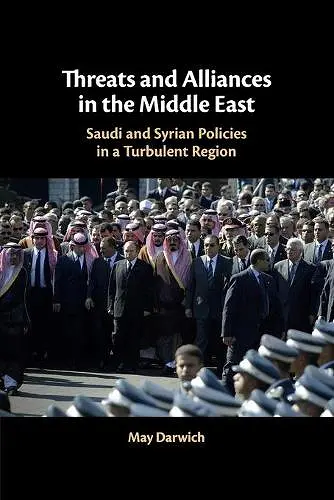
Examines Saudi and Syrian policies during three pivotal wars, to understand how identity and power influence state behaviour in the Middle East.
Examining Saudi and Syrian policies during three pivotal wars, the Iran-Iraq War (1980–1988), the 2006 Lebanon War, and the 2009 Gaza War, May Darwich analyses the forces that shape threat perceptions and alliance choices in the Middle East, debating the role of identity and power in influencing state behaviour in the Middle East and beyond.Examining differing perceptions of threats and the subsequent alliance choices of two Arab states, Saudi Arabia and Syria, during three pivotal wars in the region: the Iran-Iraq War (1980–1988), the Lebanon War (2006), and the Gaza War (2009), May Darwich analyses how ideational and material forces influence leaders' perceptions in the Middle East, and their broader international relationships. Using these comparative cases studies, Darwich advances our understanding of why, and the conditions under which, identity can play a predominant role in shaping the perception of threat in some cases, whilst material power is predominant in others. By engaging in significant debates about the role identity and material power in shaping state behaviour in the Middle East, this study has significant implications for international relations theory and beyond.
'May Darwich presents a subtle and convincing argument about how identities and material interests intersect in alliance choice. Her framework not only illuminates her cases, but suggests a path forward in dealing with the larger theoretical issue.' Gause, III F. Gregory, Texas A & M University
'A superb analysis of Saudi and Syrian foreign policy decisions and alliance choices. This insightful book explains how material and ideational factors both shape regime threat perceptions, and when and how one set of threats overrides the other. Darwich's work contributes to - but also challenges - realist, constructivist, and regime security approaches. It is a must-read for students of alliances, international relations theory, and Middle East politics alike.' Curtis R. Ryan, Appalachian State University, North Carolina
'This does not only provide important new knowledge about Saudi and Syrian threat perceptions during three major regional wars, it also constitutes an excellent example of academic bridge building. Combining insights from neo-realism and constructivism from general international relations (IR) literature on alliance making, it is a brilliant example of how a dialogue between IR and Middle East studies can enrich both fields of study.' Morten Valbjørn, Aarhus Universitet, Denmark
ISBN: 9781108737630
Dimensions: 150mm x 230mm x 12mm
Weight: 330g
222 pages