Science and Judicial Reasoning
The Legitimacy of International Environmental Adjudication
Format:Paperback
Publisher:Cambridge University Press
Published:7th Jul '22
Currently unavailable, and unfortunately no date known when it will be back
This paperback is available in another edition too:
- Hardback£104.00(9781108489669)
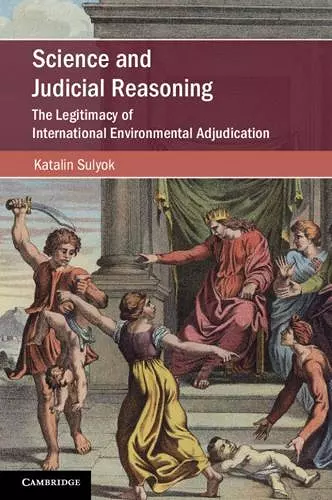
This pioneering study on environmental case-law examines how courts engage with science and reviews legitimate styles of judicial reasoning.
Examining how judges evaluate scientific knowledge when framing disputes, hearing evidence, conducting causal inquiry, and setting the standard of review, Sulyok provides a comparative analysis of environmental case-law across major international courts. This work also suggests reasoning styles with which judges can legitimately justify decisions.Science, which inevitably underlies environmental disputes, poses significant challenges for the scientifically untrained judges who decide such cases. In addition to disrupting ordinary fact-finding and causal inquiry, science can impact the framing of disputes and the standard of review. Judges must therefore adopt various tools to adjust the level of science allowed to enter their deliberations, which may fundamentally impact the legitimacy of their reasoning. While neglecting or replacing scientific authority can erode the convincing nature of judicial reasoning, the same authority, when treated properly, may lend persuasive force to adjudicatory findings, and buttress the legitimacy of judgments. In this work, Katalin Sulyok surveys the environmental case law of seven major jurisdictions and analyzes framing techniques, evidentiary procedures, causal inquiries and standards of review, offering valuable insight into how judges justify their choices between rival scientific claims in a convincing and legitimate manner.
'Environmental disputes often confront adjudicators with complex issues of scientific fact. Sulyok's book surveys in detail the response of international courts and tribunals to this challenge, and provides a sophisticated analysis and evaluation of different approaches to science in judicial reasoning. A useful asset for the libraries of adjudicators and practitioners alike.' James Crawford, International Court of Justice
'This book offers a comprehensive account and in-depth analysis of judicial engagement with science in the international settlement of environmental disputes. Dr. Sulyok, trained both in law and science, deals with a most interesting aspect of international adjudication. While her advocacy for a more activist judicial engagement with science is well presented, this study in a way touches on some more fundamental aspects of international adjudication, not necessarily limited to environmental cases, such as collection of evidence, choice of experts, burden of proof, techniques of judicial inquiry. For an international judicial organ, either permanent or ad hoc, fact-finding in an international context often proves difficult and challenging. This is especially true when a case is laden with complicated scientific evidence and data. Recommendations that Dr. Sulyok has put forward in this book provide food for thought.' Xue Hanqin, Vice-President of the International Court of Justice
'International environmental law is uniquely dependent on concepts and procedures that presuppose scientific assessment. This excellent book offers a first comprehensive study of how international adjudicative bodies manage the tension between scientific and legal rationalities in environmental disputes, and how they might do so more effectively. Sulyok's analysis is crisp, insightful and original. Highly recommended reading!' Jutta Brunnée, Professor of Law and Metcalf Chair in Environmental Law, University of Toronto
'This is an impressive book which addresses the important and timely topic of how scientific knowledge should be integrated in judicial reasoning. Although the work is focused specifically on international environmental law and adjudication, its theoretical depth and vast analysis of scholarship and practice make it an indispensable tool for any area of international law where judicial decision is confronted with the problem of reconciling 'scientific truth' with the normative imperative of administering justice.' Francesco Francioni, Professor and Chair of International Law, European University Institute, Florence
ISBN: 9781108747431
Dimensions: 228mm x 152mm x 22mm
Weight: 610g
432 pages