The Intricacies of Dicta and Dissent
Format:Paperback
Publisher:Cambridge University Press
Published:12th Aug '21
Currently unavailable, and unfortunately no date known when it will be back
This paperback is available in another edition too:
- Hardback£99.00(9781108841498)
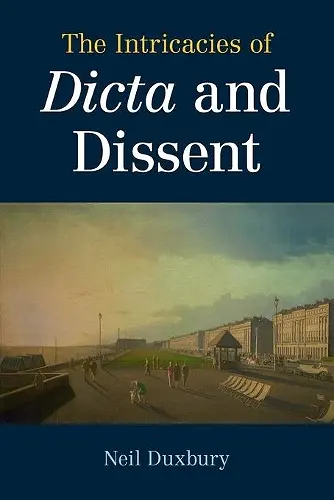
The book examines obiter dicta and dissenting opinions as aspects of judicial decision-making.
The book is aimed at judges, barristers and academic lawyers. It examines obiter dicta and dissenting opinions as aspects of English case law. The author shows that dicta and dissent have complex histories, have been put to various uses, and resist straightforward categorization as secondary sources of law.Common-law judgments tend to be more than merely judgments, for judges often make pronouncements that they need not have made had they kept strictly to the task in hand. Why do they do this? The Intricacies of Dicta and Dissent examines two such types of pronouncement, obiter dicta and dissenting opinions, primarily as aspects of English case law. Neil Duxbury shows that both of these phenomena have complex histories, have been put to a variety of uses, and are not amenable to being straightforwardly categorized as secondary sources of law. This innovative and unusual study casts new light on – and will prompt lawyers to pose fresh questions about – the common law tradition and the nature of judicial decision-making.
'Professor Duxbury provides us with a wealth of scholarship and some valuable insights into two aspects of judging which have not received much attention to date. In particular, he shows us how the two are inter-related – all dissents being essentially obiter dicta – and debunks the myth that today's dissent is tomorrow's orthodoxy – although I hope that it is not always a myth.' Brenda Hale, the Baroness Hale of Richmond, former President of the Supreme Court of the United Kingdom
'A very thoughtful discussion of two aspects of judicial practice which deserve more attention, exploring how obiter dicta are used to fit an individual case into a wider principled legal scheme and what moves judges to write dissents. It encouraged me to reflect more deeply about my own judicial writing.' Philip Sales, Justice of the Supreme Court of the United Kingdom and the Judicial Committee of the Privy Council
'In these twin essays of breathtaking range and erudition, Neil Duxbury illuminates two largely unstudied ways in which judges contribute to the common law by expressing views that create no binding precedent. Anyone interested in the craft of judging will be wiser, as well as hugely well informed, after reading this book.' George Leggatt, Justice of the Supreme Court of the United Kingdom
'Advocates and judges constitute a small minority of the legal profession. But they and others will be rewarded by reading this attractive, succinct monograph, which is an exemplary and insightful study into under-appreciated aspects of the craft of judgment writing and legal argument…. It is difficult to imagine readers who would not emerge wiser from reading the account of the changing attitudes to majority decisions of multi-member courts.' Mark Leeming, Judge of Appeal, Supreme Court of New South Wales, Cambridge Law Journal
'Anyone writing on either dicta or dissent shall firmly stand upon the shoulders of this book.' Elijah Granet, Notes on the Style of the Law
'I warmly recommend this lepidum novum libellum. Its charm is different from that of Catullus, but it is immensely readable, and readers will be richly rewarded.' Mark Leeming, Cambridge Law Journal
ISBN: 9781108794886
Dimensions: 229mm x 152mm x 14mm
Weight: 400g
288 pages