Sold Out? US Foreign Policy, Iraq, the Kurds, and the Cold War
Format:Hardback
Publisher:Palgrave Macmillan
Published:20th May '15
Currently unavailable, and unfortunately no date known when it will be back
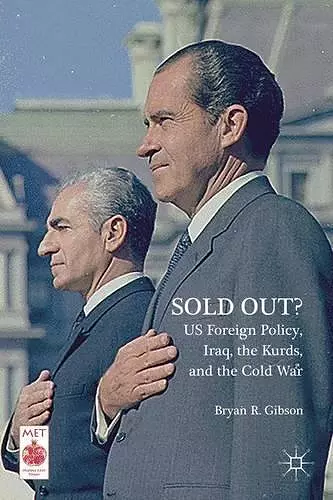
"In this perceptive, well-informed, and meticulously researched book, Bryan R. Gibson offers the most detailed and comprehensive study to date of US-Iraqi relations from the late 1950s to the 1970s, especially as those relations bore on the status and fate of Iraqi Kurds. Gibson persuasively shows that the drive to contain the Soviet Union was the overriding factor in US policy toward Iraq and its Kurdish population. More provocatively, he challenges scholars who portray Secretary of State Henry Kissinger's treatment of the Kurds as a particularly shameful chapter in modern US diplomacy. Without denying the cynicism underlying Kissinger's Kurdish policy, Gibson argues that that policy featured greater thoughtfulness and restraint than previous accounts have acknowledged. No scholar of US-Iraqi relations should ignore this book." (Salim Yaqub, University of California, Santa Barbara, USA) "This book gives a fascinating insight into US foreign policy toward Iraq by looking at how various administrations dealt with Iraq's different regimes. By extensively researching American documents, Gibson clearly shows how the Cold War was the driving force behind US foreign policy for more than a quarter century. An important source for anyone interested in US-Iraqi relations during this critical period." (Joseph Sassoon, Georgetown University, USA; author of Saddam Hussein's Ba'th Party: Inside an Authoritarian Regime)
This book analyzes the ways in which US policy toward Iraq was dictated by America's broader Cold War strategy between 1958 and 1975.This book analyzes the ways in which US policy toward Iraq was dictated by America's broader Cold War strategy between 1958 and 1975. While most historians have focused on “hot” Cold War conflicts such as Cuba, Vietnam, and Afghanistan, few have recognized Iraq's significance as a Cold War battleground. This book argues that US decisions and actions were designed to deny the Soviet Union influence over Iraq and to create a strategic base in the oil-rich Gulf region. Using newly available primary sources and interviews, this book reveals new details on America's decision-making toward and actions against Iraq during the height of the Cold War and shows where Iraq fits into the broader historiography of the Cold War in the Middle East. Further, it raises important questions about widely held misconceptions of US-Iraqi relations, such as the CIA's alleged involvement in the 1963 Ba'thist coup and the theory that the US sold out the Kurds in 1975.
ISBN: 9781137487117
Dimensions: unknown
Weight: 5502g
257 pages