Built Environment Education for Children and Youth
Establishing the Field
Rosie Parnell author Angela Million author Marta Brković Dodig author
Format:Paperback
Publisher:Taylor & Francis Ltd
Publishing:30th Sep '26
£37.99
This title is due to be published on 30th September, and will be despatched as soon as possible.
This paperback is available in another edition too:
- Hardback£155.00(9781138833692)
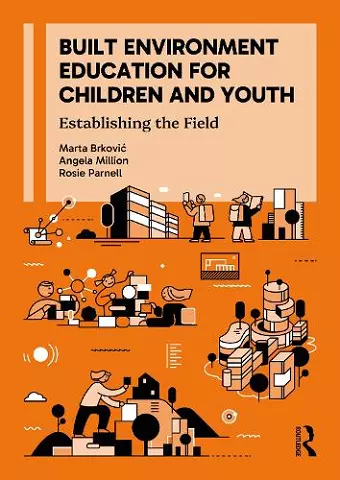
How do children learn about the spaces in which they live, play, and grow? Built Environment Education for Children and Youth is an essential guide to a dynamic yet fragmented field, bringing together educators, architects, spatial designers and planners, as well as cultural practitioners working in museums, schools, universities, architecture centres, professional bodies, networks and private practice, to explore how young people can meaningfully engage with their built environments. By engaging with the built environment, young people develop agency and spatial literacy that support their sense of belonging, underpin civic participation, and open up more equitable possibilities for shaping the places they inhabit. Grounded in a broad international evidence base—drawing on an analysis of 385+ Built Environment Education initiatives in institutional settings, 30 practitioner interviews and 15 in-depth studies—this book reflects BEE state of the art practice across world regions and contexts. Depicting innovative pedagogies and real-world examples, it charts a path towards a more cohesive and inclusive approach to built environment education and Baukultur. Whether you're an educator, designer, planner or policymaker, this engaging resource will inspire you to shape the future of built environment education— by strengthening the next generation’s capacity to understand and shape place, recognising children as spatial agents in their own right.
"This book is a game-changer for Built Environment Education! Blending research, real-world practice, and global perspectives, the authors provide much-needed structure to the field. The UIA Architecture and Children Work Programme recognizes its vital impact—not just for architects and educators, but for all who believe in building a more humanized, reflective, and just world through active participation, play, fun, and learning activities, which empower children to actively shape the future of the built environment."
Mina Sava and Carolina Pizarro, International Union of Architects, Architecture & Children Work Programme
"Built Environment Education for Children and Youth: Establishing the Field explores how young learners engage with architecture and design—not through passive instruction, but through exploration, experimentation, and even failure. Failure isn’t the end; it’s the beginning of mastery. By allowing children to struggle productively with spatial challenges, built environment education (BEE) fosters deeper spatial literacy, creativity, and critical thinking. Bringing together global perspectives, this book shapes a cohesive framework for BEE, turning fragmented efforts into a shared vision. For educators, policymakers, and practitioners, it’s an invitation to rethink learning—because true understanding comes not from avoiding failure, but from learning through it."
Manu Kapur, Director of the Singapore-ETH Center, Professor for Learning Sciences and Higher Education at ETH Zurich, Switzerland
"The built environment supports everyday learning through an international language based on "silent messages." Built Environment Education aims to instil an active awareness of these messages, so that children and youth not only hear, but also listen to their surroundings; not only look, but also see and subsequently understand the spaces and places that they inhabit. This book offers rich insights and diverse ideas for teachers, educationalists, practitioners and facilitators interested in contributing to this dynamic field. For children and youth it represents an important call to get involved in shaping their own built environments."
Henry Sanoff, AIA, Professor Emeritus of Architecture, ACSA/Alumni Distinguished Professor, North Carolina State University, USA
"This book highlights Built Environment Education (BEE) as an important educational field by connecting theory with practice. It provides educators, researchers, and policymakers with essential tools to promote meaningful interactions between children and their built environments. In doing so, this text lays the groundwork for incorporating aesthetic, cultural, and ecological awareness into children's everyday learning experiences."
Guillermo Marini, Associate Professor, School of Education, UC Chile
"Children create spaces – playfully, imaginatively, and with a spirit of discovery. In doing so, they engage with key themes of life and development, experiencing the built environment in their own unique way. They develop a wide range of spatial competences and an awareness of the malleability and transformability of their surroundings. How they can be supported and encouraged in this process is clearly presented in this publication on BEE pedagogy – historically grounded, methodologically skilled, and interdisciplinary across cultural boundaries. The aim is to enable spatial learning in a situated, place-based, and playful manner. A fascinating work that will enrich professional spatial practices – from social pedagogy and youth work to neighbourhood development and socio-cultural initiatives – while forging diverse connections with planning-related professions and ways of thinking."
Christian Reutlinger, Professor of Urban Health at the Institute for Social Planning, Organisational Change and Urban Development, Institute for Social Work and Health, The University of Applied Sciences and Arts Northwestern Switzerland
"Few people consider the built environment and those that do, often think of it as a passive envelope for their lives. However, it is much more potent than that. It can shape their opportunities, challenges and experiences of inclusion - for example. This is particularly powerful in childhood and adolescence when expansive environmental opportunities can actively support development, learning and the beginnings of lifelong patterns for wellbeing. Teaching children about the built environment so that they can actively engage with developing it and determining its form, functions and opportunities; recognising children as active agents in their own experience is an empowering approach with benefits for both young people and their environments. This book fills a special niche and makes a wonderful contribution to the development of environmental education for children and young people."
Kate Bishop, Professor at the School of Built Environment, Faculty of Arts, Architecture and Design, UNSW Sydney, Australia
"How and What do children and young people learn about their built environment as they grow up? This engagingly designed analysis provides readers with all the essential and international insights on the topic. Beyond that: How do educators and planners create stimulating and supportive learning environments to pass on our diverse Baukultur? On this, too, the compilation by the three renowned authors offers numerous tips and reflections. This is how Baukultur is formed and cultivated."
Thomas Coelen, Professor of Socialization, Youth Education, and Life Course Research, Department of Education, University of Siegen, Germany
ISBN: 9781138833708
Dimensions: unknown
Weight: 453g
268 pages