Planning Democracy
Modern India's Quest for Development
Format:Hardback
Publisher:Cambridge University Press
Published:31st Mar '22
Currently unavailable, and unfortunately no date known when it will be back
This hardback is available in another edition too:
- Paperback£32.00(9781009044585)
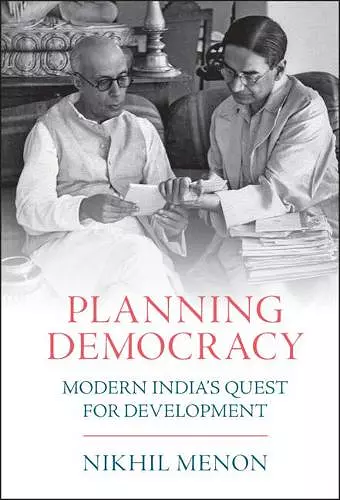
An innovative history exploring independent India's experiment fusing Soviet-inspired economic management with Western-style liberal democracy.
Planning Democracy is the story of India's historic experiment to marry democracy and central planning. In this engaging and innovative account, Nikhil Menon explores how independent India embarked on a planning project to fuse Soviet-inspired economic management and Western-style democracy at a time when they were considered incompatible.The Indian planning project was one of the postcolonial world's most ambitious experiments. Planning Democracy explores how India fused Soviet-inspired economic management and Western-style liberal democracy at a time when they were widely considered fundamentally contradictory. After nearly two centuries of colonial rule, planning was meant to be independent India's route to prosperity. In this engaging and innovative account, Nikhil Menon traces how planning built India's knowledge infrastructure and data capacities, while also shaping the nature of its democracy. He analyses the challenges inherent in harmonizing technocratic methods with democratic mandates and shows how planning was the language through which the government's aspirations for democratic state-building were expressed. Situating India within international debates about economic policy and Cold War ideology, Menon reveals how India walked a tightrope between capitalism and communism which heightened the drama of its development on the global stage.
'Written with wit and energy, impeccably well researched, Planning Democracy makes a bold new contribution to our understanding of the Indian state after 1947. Menon's is the best history we have of India's great experiment with statistics: a data-driven attack on social and economic inequality that aimed, not always successfully, to be compatible with participatory democracy. Menon combines intellectual and institutional history to make a compelling case that we should focus less on whether planning “succeeded” or “failed,” in any narrow sense, and more on the profound ways it shaped India's political imagination. This excellent book is sure to find a wide and appreciative audience across disciplines.' Sunil Amrith, Yale University
'Through richly researched analysis, Menon skilfully brings to life the multi-dimensional world of planning in early independent India. Exploring how planning – as process and as political imaginary – has reshaped state and society this book offers critical historical insight into events and debates that continue to shape our world today.' Eleanor Newbigin, SOAS
'Full of telling details, quirky anecdotes, interesting dramatis personae, and set against a fraught geopolitical background, Planning Democracy makes India's quixotic experiment with “democratic planning” come truly alive. Through this story, Menon provides a smart and clear-eyed analysis of the ambitions and failures of the Nehruvian state.' Mrinalini Sinha, University of Michigan
'This book provides a well-written and fresh perspective on centralized economic planning in post-independence India. Past studies have primarily focused on the economic impact of planning. Menon's richly detailed study instead explores an important set of political and institutional questions raised by this approach: How did planning in India seek to blend seemingly contradictory Soviet-inspired ideas of economic planning with commitments to liberal democratic institutions and increasing citizen participation in politics? How did the quotidian implementation of planning expand the state's footprint in ways that endure beyond any individual government or ideological era? And how were the language and ideas behind planning infused within Indian society, shaping everything from political life to popular culture? Menon's compelling answers are worth reading for anyone interested in contemporary India, especially at a time of renewed debate and concern regarding the degree of centralization in India's political and economic institutions.' Tariq Thachil, University of Pennsylvania
ISBN: 9781316517338
Dimensions: 235mm x 154mm x 15mm
Weight: 415g
292 pages