Capitalism and the New Political Unconscious
A Philosophy of Immanence
Dr Fabio Vighi editor Professor Riccardo Panattoni editor
Format:Hardback
Publisher:Bloomsbury Publishing PLC
Published:20th Apr '23
Currently unavailable, and unfortunately no date known when it will be back
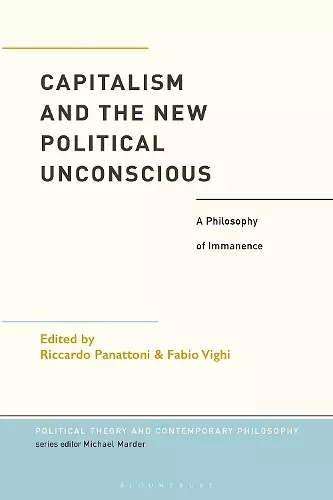
Exploring the appeals to the unconscious used in contemporary politics, international scholars investigate the importance of both psychoanalysis and the philosophy of immanence to a new understanding of political power.
Taking seriously Jacques Lacan’s claim that ‘the unconscious is politics’, this volume proposes a new understanding of political power, interrogating the assumption that contemporary capitalism functions by tapping into forms of unconscious enjoyment, rather than providing transcendental conditions for the articulation of political meanings and desires. Whether we’re aware of it or not, political communication today targets the audience’s libidinal response through political and institutional language: in policies, speeches, tweets, social media appearances, gestures and images. Yet does this mean that current power structures no longer need symbolic or ideological frameworks? The authors in this volume think not. Far from demonstrating a shift to a post-ideological age, they argue instead that such methods inaugurate an altogether novel approach to political power. Written by leading scholars from around the world, including Roberto Esposito and Slavoj Žižek, each chapter reflects on contemporary power and inspires consideration of new political potentialities, which our focus on politics in transcendental rather than immanent terms has thus far obscured. In so doing, Capitalism and the New Political Unconscious provides an original and forceful exploration of the centrality of both psychoanalytic theory and the philosophy of immanence to an alternative understanding of the political.
The individual chapters of Capitalism and the new Political Unconscious provide invaluable keys for interpreting the most recent innovations in the world economy and the subtle changes in our interpretations of the signs and symbols steering those mutations. The book offers a sophisticated guide to understanding the architecture of power in the third decade of the twenty-first century. * Darrow Schecter, Professor of Critical Theory & Modern European History, University of Sussex, UK *
The codependent forces of corporate digital media and a truth-averse reactive subjectivity mark an unprecedented shift in the nexus between politics and the unconscious, this book argues. Its extraordinary value lies in the proposed solution, radical in its deceptive banality: the rehabilitation of public institutions in their capacity to mediate the ravages of jouissance. * James Penney, Professor of Cultural Studies and French and Francophone Studies, Trent University, Canada *
ISBN: 9781350240247
Dimensions: unknown
Weight: unknown
232 pages