Biopolitics After Neuroscience
Morality and the Economy of Virtue
M Therese Lysaught author Jeffrey P Bishop author Andrew A Michel author
Format:Paperback
Publisher:Bloomsbury Publishing PLC
Published:28th Dec '23
Currently unavailable, and unfortunately no date known when it will be back
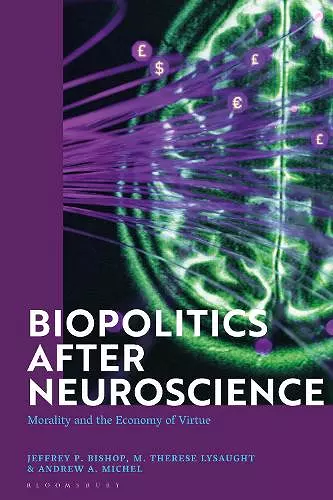
Three leading bioethicists take a social and historical approach to contemporary neuroscientific claims on morality and the brain.
This book offers a provocative analysis of the neuroscience of morality. Written by three leading scholars of science, medicine, and bioethics, it critiques contemporary neuroscientific claims about individual morality and notions of good and evil. Winner of a 2021 prize from the Expanded Reason Institute, it connects moral philosophy to neoliberal economics and successfully challenges the idea that we can locate morality in the brain. Instead of discovering the source of morality in the brain as they claim to do, the popularizers of contemporary neuroscience are shown to participate in an understanding of human behavior that serves the vested interests of contemporary political economy. Providing evidence that the history of claims about morality and brain function reach back 400 years, the authors locate its genesis in the beginnings of modern philosophy, science, and economics. They further map this trajectory through the economic and moral theories of Francis Bacon, David Hume, Jeremy Bentham, John Stuart Mill, and the Chicago School of Economics to uncover a pervasive colonial anthropology at play in the neuroscience of morality today. The book concludes with a call for a humbler and more constrained neuroscience, informed by a more robust human anthropology that embraces the nobility, beauty, frailties, and flaws in being human.
This book is a tour de force, offering a detailed analysis of the neuroscience of morality in relation to neoliberal economic thought. It is both a provocative critique of current neuroscience and a call for a more humane cultural conversation about what it means to be human. It will be essential reading for anyone interested in the wider philosophical, theological or ethical implications of neuroscience. * Neil Messer, Professor of Theology, University of Winchester, UK *
A perceptive and illuminating work. Hidden within the technical theories of neuroscience, Bishop, Lysaught and Michel, uncover a moral language with disturbing implications for race, poverty, and many other areas of urgent political concern. It turns out much of what claims to be a “science” of the brain is, in fact, ideology. * Jason Blakely, Associate Professor of Political Philosophy, Pepperdine University, USA *
Hypothesizing originally that neuroscience could be adduced to complicate virtue ethics, the authors discovered instead the embeddedness of neoliberal drivers and norms in the field itself. Deeply researched, immensely thoughtful and beautifully written, this work is a major contribution to understanding how the sciences mirror rather than bracket social and political principles of an age. * Wendy Brown, UPS Foundation Professor, Institute for Advanced Study, USA *
Neuroscience promises to unlock the secrets of the brain and release powerful forces for healing and well-being, albeit at the cost of erasing free will and moral responsibility. Biopolitics after Neuroscience powerfully traces the roots of this project in a social imaginary spawned by eighteenth-century political economy, linked with the rise of utilitarian moral theory, and bound up with policing the “undeserving” poor. The brain is imagined as a new invisible hand, the secrets of which can be unlocked through neuroscience and directed toward the formation of maximally efficient, productive economic citizens. Bishop, Lysaught and Michel’s bold analysis should give readers pause about jumping on this latest Big Science bandwagon. * Jennifer A. Herdt, Gilbert L. Stark Professor of Christian Ethics, Yale University, USA *
This is the sort of volume I have eagerly awaited. The authors skillfully describe how neoliberal values have shaped neuroscientific research. However, their argument transcends this specialty. After this book, no discipline—academic or otherwise—can afford to ignore how its practitioners may unknowingly serve their political and economic masters. * Bruce Rogers-Vaughn, Visiting Scholar, Vanderbilt Divinity School, USA *
This book is a necessary read for anyone interested in theological ethics, bio-ethics, or the neurosciences. Bishop et al. weave a complex yet clear narrative of the underlying anthropologies which govern the contemporary political economy and its relation to the neurosciences. * Canadian-American Theological Review *
ISBN: 9781350288485
Dimensions: unknown
Weight: unknown
304 pages