Moral Philosophy and De-Colonialism
The Irrationality of Oppression
Format:Hardback
Publisher:Bloomsbury Publishing PLC
Published:19th Feb '26
Currently unavailable, and unfortunately no date known when it will be back
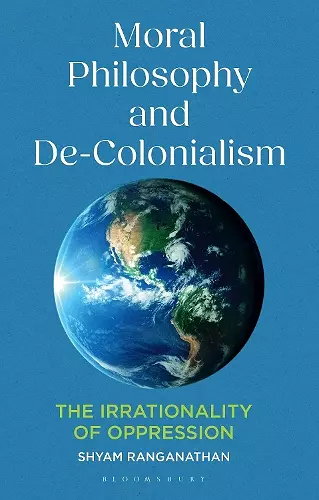
A timely look at the ways in which colonialism has undermined the study of moral philosophy, showing how a rigorous study is achieved by drawing on indigenous thought.
This groundbreaking book, Moral Philosophy and De-Colonialism: The Irrationality of Oppression, argues that colonialism is fundamentally irrational and incompatible with the public practice of moral philosophy—the reason-based exploration of right choices and good outcomes.
Moral Philosophy allows participants to make their own ethical decisions, which colonialism denies. Drawing on South Asian moral philosophy that colonization renders invisible, Ranganathan argues that all irrationality and oppression stems from interpretation: a confusion of thought with attitudes toward thoughts that imposes perspectives as explanations. Indigenous traditions use explication: explanation in terms of thought itself (not attitudes toward thoughts). The historical origins of interpretation lie in the Linguistic Account of Thought (LAT), which confuses what can be thought with culturally encoded attitudes. Rejected in ancient South Asia and controversial in ancient China but acclaimed in the West (Eurocentric thinking with ancient Greek origins), the West becomes a global colonizing tradition. Its successes—including normative theories of autonomy and freedom—result from colonially appropriating Indigenous capital and epistemic labor. Indigenous thinking follows Linguistic Externalism (LE): thought as the disciplinary use of semantic expression. While LAT promotes anthropocentric, communitarian ethics, LE allows Indigenous people to acknowledge diverse persons including the Earth, treating learning as logic-based inquiry rather than cultural competence. The book explores LAT's basis for genocide and White Supremacy's 2000-year institutionalization of Secularism2 (defining the Western as secular, the BIPOC as religious). It illustrates how originally free people adopt colonization by cooperating with the colonizer, hoping for good outcomes, gambling away procedural justice and explication. Colonization stems not from stated values but from the metaethical choice to interpret, creating a rational obligation to decolonize. Drawing from Western, Chinese, and Indian traditions while making contributions to the philosophies of AI, science, race, reason, religion, language, thought, and translation, this book makes visible the Indigenous foundations of moral philosophy and all inquiry, along with the colonial origins of irrationality.
A bold contribution to the urgent task of decolonising the field of moral philosophy: from a South Asian perspective, Ranganathan shows how the simultaneous appropriation and erasure of Indigenous thought plays a critical role in normalising regimes of violence and oppression. * David Wengrow, co-author of The Dawn of Everything: A New History of Humanity. *
A highly original work, rigorous in its application of arguments from analytic philosophy and provocative in its critique of the irrationality of colonialism. Shyam Ranganathan makes a persuasive case for decolonization as central to the very practice of moral philosophy. -- Dr. Joydeep Bagchee
ISBN: 9781350464131
Dimensions: 218mm x 144mm x 20mm
Weight: 460g
272 pages