SPSS for Psychologists
Virginia Harrison author Richard Kemp author
Format:Hardback
Publisher:Bloomsbury Publishing PLC
Published:19th Feb '26
£110.00
Supplier delay - available to order, but may take longer than usual.
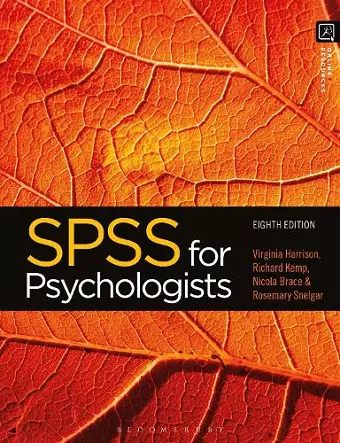
An unbeatably clear, step-by-step guide to using SPSS for statistical analysis for Psychology students
Students can find statistical analysis a challenging and complex task and, in order to master the techniques and complete their assignments successfully, they need a sound understanding of IBM SPSS. Updated to be compatible with IBM SPSS 30, with handy screenshots throughout, the eighth edition of this trusted and practical textbook will take students on a step-by-step journey towards carrying out a range of essential tasks with confidence: from performing an analysis to interpreting outputs and reporting the results.
Further features of this new edition include a dedicated chapter on non-parametric tests, guidance on when to use each type of test, updated and additional activities, and helpful explanations of basic concepts such as normality, power and reproducibility.
This book is an unbeatable, must-have guide to SPSS that will allow psychology students at all levels to master this powerful software tool.
Accompanying online resources are available for this title, including exercises and data sets to help students follow along and practice the analyses in SPSS. These resources are designed to support teaching and learning when using this textbook and are available at no extra cost.
I really appreciate the practical, step-by-step process of inputting an analysis into SPSS (namely, “which variable goes into which box?”) and interpreting the output (“which table is actually most important in the 9 tables that SPSS has spat out to me? Which number do I need to look at here? What does this other number mean?”). I feel like no other textbook does that as well as ‘SPSS for Psychologists’. * Kirin Hilliar, Heriot-Watt University, Dubai *
My own personal view is that textbooks that tie themselves to a very costly proprietary software that will not be available to students after leaving academia (such as SPSS) have an increasingly limited appeal. The sector is slowly but steadily moving to open-source software (R) that is used outside the academic world * David Smith, University of Hull *
The main strength is that it very clearly guides through the use of various elements of the SPSS program, and that it is easy to look up a particular test. It is good with the examples and data, including how to write up the results using APA after each section. * Thomas Alrik Sørensen, Aalborg University *
Excellent illustrations taking students through SPSS output. […] I’ve always liked (for example) p244 and p249, and how when discussing epsilon values, the book notes that you could use one of three, but that you should not get too hung up on which one. This is the sort of thing I prefer. Explain where needed, gloss over unnecessary complications, to get the students through the challenges. * James Jackson, Leeds Trinity University *
We do not recommend this at present but I do like that is has online tutorials and exercises/data sets this is very useful for students. I also like that at the end of each of the sections there is a summary. The data sets at the back of the book are helpful for reference and the glossary is useful too. * Jennifer Coe, University of Suffolk *
It explains concepts clearly and is structured well so students can easily find the information they need. Additionally, the order in which chapters are presented is logical. I also find the information covered here is suitable for multiple years of research methods students. If students purchase the book, they can use it over the course of their studies. * Lynn Wright, Abertay University *
I have used this book before in my teachings, and it is a great book. However, it misses additional exercises with added datasets that they can be used for student assignments. Also there are no instructor resources that the instructor can use in class to follow the same routines and structure that they are used in the book. [more exercises and PowerPoint slides are being added to the website] * Silvia Corbera Lopez, Central Connecticut State University *
I’d really only consider this text if the amount of formulas/math was increased and I fully understand that the authors probably purposefully avoided including that material – and that makes complete sense. This is a great text; it just doesn’t fully meet my very specific needs. [We have not changed this as the book is not designed to do this; Brysbaert Statistics for Psychologists would be a better alternative for this instructor] * Stephen Brown, Red Deer Polytechnic *
ISBN: 9781350465015
Dimensions: 280mm x 202mm x 34mm
Weight: 1500g
544 pages
8th edition