Cinematic Time in the Odyssey
Deleuze’s “Crystal Images” in Homer
Format:Hardback
Publisher:Bloomsbury Publishing PLC
Publishing:4th Feb '27
£85.00
This title is due to be published on 4th February, and will be despatched as soon as possible.
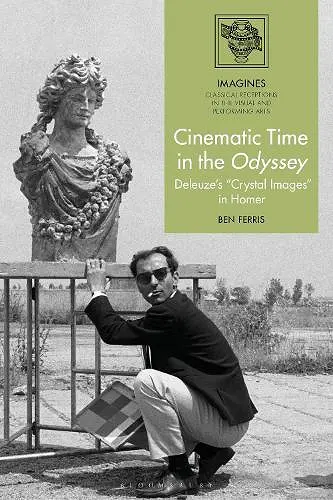
This book examines the Odyssey through film, using Deleuze’s cinema theories to reveal new insights.
Through the lens of Gilles Deleuze’s philosophy and film theory, this book explores how time operates in Homer’s Odyssey. Using Deleuze’s concept of the “crystal image”, which illustrates the non-linear nature of past, present, and future, author Ben Ferris examines the Odyssey’s temporal complexities alongside key films. Each chapter engages with a distinct aspect of time: metapoetics, trauma, and the afterlife.
Case studies of iconic films highlight each of these three temporal aspects of Homeric epic. Alain Resnais’ Last Year at Marienbad (1961) and Jean-Luc Godard’s Contempt (1963) illuminate metapoetics. Resnais’ Hiroshima mon amour (1959) explores trauma, while Theo Angelopoulos’ Ulysses’ Gaze (1995) and Coppola’s Apocalypse Now (1979) engage with death and the afterlife. Applying Deleuze’s theory places modern films in dialogue with ancient epic, to offer fresh insights into Homeric temporality and the Odyssey’s themes of metapoetics, trauma, and death.
Filmmaker and philologist Ben Ferris views the Odyssey through a set of highly sophisticated theoretical lenses. Probing cinematic masterpieces from Resnais through Angelopoulos enables him to bring into deep focus the epic’s amazing complexity. A superbly sensitive study, this is the boldest, most compelling reading of Homeric craft in decades. * Richard P. Martin, Antony and Isabelle Raubitschek Professor in Classics, Stanford University, USA *
The visual dimension of Homer’s epics and its quasi-cinematic qualities have long been noted. Ben Ferris takes these observations in a different and more innovative direction. Grounded in Gilles Deleuze’s cinematic theory, the book moves beyond exploring filmic practices to uncovering a philosophy of cinema which subtends Homer’s epics. The central theme is temporality and the specific operation of Deleuze’s image crystal: a figure which holds past, present and future in intricate suspension. Cinematic Time in the Odyssey makes a wonderful contribution to the ongoing dialogue between ancient texts and modern visual theory. * Miriam Leonard, Professor of Greek Literature & its Reception, University College London, UK *
Ferris convincingly argues that Gilles Deleuze’s cinematic categories, especially the crystal-image, illuminate aspects of the Odyssey in fascinating and important ways. With great care and detail, Cinematic Time in the Odyssey brings Homer into contact with filmmakers, such as Alain Resnais and Jean-Luc Godard, to impressively claim that time, trauma and death work in cinematic ways in the Odyssey. A remarkable work. * Richard Rushton, Professor in Film Studies, University of Lancaster, UK *
Ferris’s Cinematic Time in the Odyssey complicates ideas of temporality and meaning by using film’s asynchrony to peel back not only Classical but Modern ideas of time so that we can better understand Odysseus’ present as forever haunted by both past and future. * Philip Waddell, Associate Professor of Classics, University of Arizona, USA *
ISBN: 9781350579606
Dimensions: unknown
Weight: unknown
240 pages