The Age of Analogy
Science and Literature between the Darwins
Format:Paperback
Publisher:Johns Hopkins University Press
Published:24th Dec '19
Currently unavailable, and unfortunately no date known when it will be back
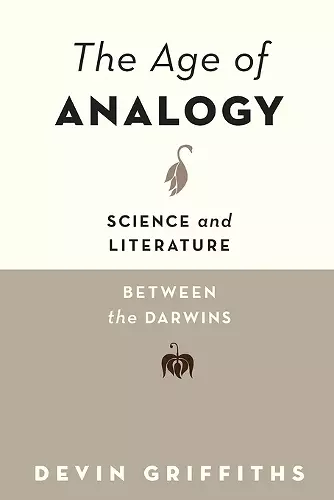
This book explores the influence of literature on scientific thought in the nineteenth century, focusing on the contributions of the Darwins and their innovative narrative styles.
In The Age of Analogy, Devin Griffiths delves into the intricate relationship between literature and science during the transformative period of the nineteenth century. The Darwins, Erasmus and his grandson Charles, stand out as pivotal figures in evolutionary theory, each contributing uniquely to the discourse of their time. Erasmus was known for his epic poems and scientific treatises, while Charles gained fame for his influential works, including The Voyage of the Beagle and The Origin of Species. Their literary endeavors were not merely supplementary to their scientific pursuits; rather, they were deeply intertwined and reflective of the literary currents of their era.
Griffiths argues that the writing styles of the Darwins were significantly shaped by the poets, novelists, and historians surrounding them. This influence inspired the Darwins and their contemporaries to innovate narrative forms that could articulate the complexities of the natural world revealed by contemporary science. By employing imaginative language and diverse genres, they initiated a new form of historical analysis, termed “comparative historicism,” which diverged from traditional historical narratives. This approach blossomed in literary formats such as the realist novel and elegy, ultimately enriching the understanding of continuity between past and present life forms.
The book also examines the vital role of analogies in historical and scientific thought, proposing a new theory that underscores language's capacity to illuminate insights into both nature and society. The Age of Analogy serves as a comparative study of the Darwins’ contributions to the intertwined fields of literature and science, making it an essential read for students and scholars interested in nineteenth-century British literature and the evolution of scientific thought.
[A] serious, detailed, and convincing account with few unexplored avenues. Recommended.
—Choice
The Age of Analogy represents a valuable contribution to scholarship on literature and science. Building on the established models of new historicism and of Gillian Beer's foundational work on Darwinism, it nonetheless offers something new by asking researchers in this field to think more carefully about the kinds of historicism that operate both in their own work and in nineteenth-century literary and scientific writing.
—Review of English Studies
The Age of Analogy is perhaps the most ambitious and important book on the entanglement of nineteenth-century scientific culture and literature to have been written this century—in a field of highly ambitious and truly important books. But it also elucidates the entanglement of nineteenth-century culture with our own, bringing light to contemporary historicist practices, particularly in literary studies.
—Isis
For those interested in either of the intertwined histories of literature and science—or in what we might more generously call the intellectual culture of the 1780s through the 1850s—Griffiths' book is both readable and richly rewarding.
—Review 19
This ambitious work should shape future thinking about historicism, science and literature in the nineteenth century and beyond in new and significant ways. Griffiths deserves to be congratulated on having achieved this and, in the process, on having written some of the best recent criticism on Charles Darwin and George Eliot in particular, which is no mean feat in itself.
—British Society for Literature and Science
The book is well written and the richness of the study is impressive. It is precisely because of this wide-ranging approach that The Age of Analogy demonstrates so convincingly that, while the scholarship on analogy is not new, Griffiths takes it to another level where he explores events in a pluralist state of time. This, he terms comparative historicism. As such, The Age of Analogy makes a valuable contribution to the humanities and sciences.
—Metascience
The Age of Analogy promises to transform our understanding of literary and scientific history in the Anthropocene. This is a big, challenging, eloquent book. I cannot recommend it highly enough.
—Nineteenth-Century Contexts
As Griffiths builds his argument and examines his literary examples, he, in effect, applies the analogical paradigm he theorized in the opening chapters, generating a compelling set of insights into modes of thought that circulated in the first half of the nineteenth century, some of which continue to shape and define our own times. A necessary intervention.
—Journal of British Studies
[A] deeply impressive book.
—SEL Studies in English Literature 1500–1900
Ambitious in its scope and vision and eloquently written, The Age of Analogy is a challenging and thought-provoking study that gives us new and enriching ways to read nineteenth-century intellectual history
—Dickens Quarterly
What is exhilarating about The Age of Analogy is its bold insistence upon the utility of imaginative literary form as an active agent in science, with the power not only to reflect knowledge of the world but to add to it as well.
—Literature and History
A book of enormous erudition, especially for a first book. Great books change how criticism does its business, this happens far more rarely than one might think.
—Wordsworth Circle
The Age of Analogy promises to transform our understanding of literary and scientific history in the Anthropocene. This is a big, challenging, eloquent book. I cannot recommend it highly enough.
—Nineteenth-Century Contexts
Devin Griffith's multifaceted, richly textured The Age of Analogy argues that the nineteenth century saw the emergence of a new mode of engaging with history—'comparative historicism'—that increasingly fostered what Griffiths calls a 'flat' view of temporal existence. Griffith's method exemplifies the same kind of analogical reasoning that his book investigates. In most cases, it does this with remarkable success, furnishing the field of Victorian science and literature with some truly fresh inspiration and insight.
—Victorian Studies
It is clarifying and invigorating to have a scholar as searching and well-read as Devin Griffiths address the problem of analogy head on. He ambitiously tracks analogy as an evolving mode of thought during the eighteenth and nineteenth centuries, focusing on analogy as a method central to the emerging field of comparative historicism . . . The Age of Analogy is an impressive book that refuses to shy away from a topic as daunting as analogy just because it threatens to become unwieldy. Griffiths is unusually generous in the alacrity with which he maps the questions that interest him onto a huge range of scholarly fields, including linguistics, mathematics, publishing history, botany, comparative anatomy, astronomy, and musical theory.
—Anna Henchman, Boston University, Victorian Review
The Age of Analogy brims with original arguments and demonstrates Griffiths's impressive range and dexterity in a wide variety of fields and discourses.
—Adam Sneed, Southwest Tennessee Community College, Studies in Romanticism
Devin Griffiths's excellent The Age of Analogy: Science and Literature between the Darwins makes a compelling case for the importance of literary language to the development of scientific theory and practice . . . [The Age of Analogy] demonstrates an encyclopedic grasp of everything from set theory to Saussurian semiotics . . . As Griffiths so masterfully demonstrates, analogy helps us extend our imaginative apprehension of the world's past and present—as well as its possible futures.
—Ella Mershon, Marquette University, Modern Philology
ISBN: 9781421436326
Dimensions: 229mm x 152mm x 23mm
Weight: 499g
352 pages