Great War Modernisms and 'The New Age' Magazine
Format:Hardback
Publisher:Continuum Publishing Corporation
Published:12th Jul '12
Currently unavailable, and unfortunately no date known when it will be back
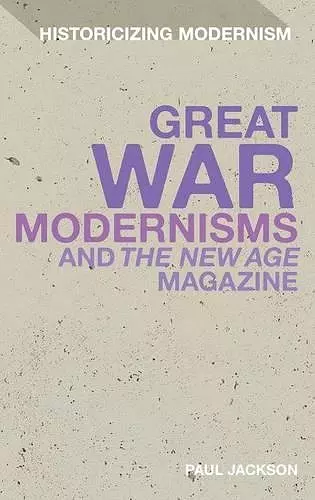
A study of the politics and philosophy of writers contributing to the 'Little Magazine', The New Age during 1907 and 1922.
A study of the politics and philosophy of writers contributing to the Little Magazine, "The New Age" during 1907 and 1922. It demonstrates the need to interpret modernism not merely as an aesthetic phenomenon, but inherently linked to politics and philosophy. It examines a wartime modernism that embraced socialist and political views.The literary magazine The New Age brought together a diverse set of intellectuals. Against the backdrop of the First World War, they chose to write about more than modernist art and aesthetics. By closely reading and contextualizing their contributions, Paul Jackson's study engages with the political and philosophical responses of literary artists to modernity. Jackson demonstrates the need to interpret modernism not merely as an aesthetic phenomenon,but inherently linked to politics and philosophy. By placing the writing of a canonical modernist, Wyndham Lewis, against a figure usually excluded from the modernist canon, H.G. Wells, Jackson examines further a wartime modernism that embraced socialist and political views. This reinterpretation of modernism provides a historicised understanding of the politicised hopes of artists promoting revolutionary forms of cultural renewal. Considering modernist writers' relationship between politics,philosophy and aesthetics in the context of total war Jackson encourages new cultural-historical definitions of modernism. In addition this study provides the first close analysis of cultural contributions from a leading wartime Little Magazine, tracing the radical modernist debates that developed in its pages.
'This is an intelligent and thought-provoking study which encourages us to rethink the meaning of 'modernism'. After reading Paul Jackson's book, historians and literary scholars will have to question the utility of a narrow, aesthetic definition of modernism. Jackson shows, in several fine case studies, that the concept has equal validity for exaplaining the many ways in which intellectuals and politicians were trying to make sense of a world in flux. Great War Modernisms is an important contribution to twentieth-century intellectual history.' -- Dan Stone, Royal Holloway, University of London, UK
‘Jackson explores the intense mood of expectancy of a new era induced in the generation of British intellectuals directly affected by the catastrophe of the First World War. In doing so he shows how a wide variety of longings for regeneration are linked with the radical experimentations in aesthetics, social organization, economics, and politics that fed into inter-war European thought - each of which are increasingly recognized as different manifestations of modernism. As a result, all too familiar 'English' figures suddenly appear in a fresh 'continental' light. This new approach hopefully signals a belated readiness of British cultural historians to break out of decades of self-imposed insularity and isolationism when considering Europe-wide cultures of modernism.' -- Professor Roger Griffin, Department of History, Oxford Brookes University, UK
ISBN: 9781441180087
Dimensions: unknown
Weight: 432g
192 pages