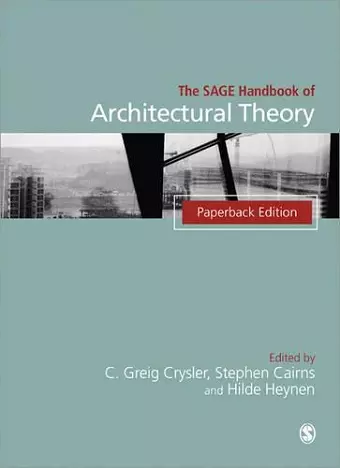
The SAGE Handbook of Architectural Theory
Stephen Cairns editor Hilde Heynen editor Greig Crysler editor
Format:Paperback
Publisher:Sage Publications Ltd
Published:15th Oct '13
Currently unavailable, and unfortunately no date known when it will be back
This paperback is available in another edition too:
- Hardback£171.00(9781412946131)
"Offers an intense scholarly experience in its comprehensiveness, its variety of voices and its formal organization... the editors took a risk, experimented and have delivered a much-needed resource that upends the status-quo."
- Architectural Histories, journal of the European Architectural History Network
"Architectural theory interweaves interdisciplinary understandings with different practices, intentions and ways of knowing. This handbook provides a lucid and comprehensive introduction to this challenging and shifting terrain, and will be of great interest to students, academics and practitioners alike."
- Professor Iain Borden, UCL Bartlett School of Architecture
"In this collection, architectural theory expands outward to interact with adjacent discourses such as sustainability, conservation, spatial practices, virtual technologies, and more. We have in The Handbook of Architectural Theory an example of the extreme generosity of architectural theory. It is a volume that designers and scholars of many stripes will welcome."
- K. Michael Hays, Eliot Noyes Professor of Architectural Theory, Harvard University
The SAGE Handbook of Architectural Theory documents and builds upon the most innovative developments in architectural theory over the last two decades. Bringing into dialogue a range of geographically, institutionally and historically competing positions, it examines and explores parallel debates in related fields. The book is divided into eight sections:
- Power/Difference/Embodiment
- Aesthetics/Pleasure/Excess
- Nation/World/Spectacle
- History/Memory/Tradition
- Design/Production/Practice
- Science/Technology/Virtuality
- Nature/Ecology/Sustainability
- City/Metropolis/Territory.
Creating openings for future lines of inquiry and establishing the basis for new directions for education, research and practice, the book is organized around specific case studies to provide a critical, interpretive and speculative enquiry into the relevant debates in architectural theory.
I have been impressed by the quality of this handbook. Rather than simply edit and repackage familiar (but rightly famous) critical essays from leaders in the field, this book looks freshly at the field(s), and has commissioned intelligent and well-written chapters that cut the jargon and elucidate the various topics in a straightforward but serious manner.
The book arrived on my desk just as I was landed the task of running an M-Arch module in Architecture Culture, and I have no hesitation in recommending it as the set text. Indeed, I find a good number of the chapters (I′ve not read them all yet) complement well the lectures I have planned. Its price is reasonable given its encyclopaedic scope, and its production values are high. I particularly welcome the double-column layout - much easier to read! -- Gerald Adler
The core of architectural theory for the past several decades has looked to architecture′s autonomous structures and formal procedures as its primary material for analysis. Now in this collection, architectural theory expands outward to interact with adjacent discourses such as sustainability, conservation, spatial practices, virtual technologies, and more. We have in The SAGE Handbook of Architectural Theory an example of the extreme generosity of architectural theory. It is a volume that designers and scholars of many stripes will welcome. -- K. Michael Hays
Architectural theory interweaves interdisciplinary understandings with different practices, intentions and ways of knowing. This handbook provides a lucid and comprehensive introduction to this challenging and shifting terrain, and will be of great interest to students, academics and practitioners alike. -- Professor Iain Borden
Offers an intense scholarly experience in its comprehensiveness, its variety of voices and its formal organization... the editors took a risk, experimented and have delivered a much-needed resource that upends the status-quo. -- Architectural Histories (journal of the European Architectural History Network)
Theory is dead, long live theory! Discussing an era some call post-critique and others the end of theory, the debate over architectural critique and theory is more alive than ever. The SAGE Handbook of Architectural Theory draws an essential map for anyone who wants to participate in this debate... Although the critique of architecture has lost power with the advance of capitalism, exercises like this revive the value of theory, even in the intellectual context of contemporary pragmatism. The pedagogical value and the exemplary quality of this collaborative editorial process make the book a highly recommended reading. -- David H. Falagán
This book is much more than a Handbook of Architectural Theory. It is a handbook of architecture, taking us through the most fundamental and creative thinking in structure, plan and form. It is at the same time a handbook of architectural history; of urbanism; of explorations into site, global city and mega-city; and of the topology and topography of space. None of the existing readers on architecture, urbanism or space have the breadth, the pedagogic value and amalgamation of creative thinking as this SAGE Handbook. A must as a reference resource. -- Scott Lash
The textbook "The SAGE Handbook of Architectural Theory" represents an excellent general approach to contemporary architecture theory. Some of the essays in the book are fundamental in understanding the current and future architecture, and therefore cannot be missing from an in-depth reading list.
M. Christine Boyer′s text on "heritage terrorism" is probably among the best texts written on the theme of memory, and in general Section 4 is accurate, precise and indispensable as regards my form of teaching.
At the same time the part on sustainability places an important emphasis on the complexities related to the scale of problems, and the text by Simon Guy underlines all the main problems and the most disruptive solutions.
Section 8 offers some interesting but not yet coherently-defined ideas in terms of representing a theory of urbanization, the archipelago city and the slum as a theory are fascinating and certainly useful concepts for students, although some levels of complexity may be difficult in the case of undergraduate students .
Finally, I underline an error on pages 630 and 631, the images seem to refer to maps of the Province of Lecce, in southern Italy, rather than Rio de Janeiro or Cayenne.
Hope my comments will be useful. -- Dr Marco Spada * drupal *
A complete guide for students that engage with theoretical explorations suitable at all levels of study and covering a range of aspects. -- Miss Liana Psarologaki * drupal *
This is an excellent publication addressing contemporary theoretical debates in architecture. Many of the issues the book deals with, including spatial practices, and sustainability are the focus of attention on our BA in Architectural Design. Through the process of engaging critically with the broad range of scholarly writing in the different sections it is hoped our students will deepen their understanding about architecture and develop their awareness of what it means to engage with architectural theoretical debates critically. -- Mrs Maeliosa O'Brien * drupal *
excellent key text. Very useful for helping students of architecture to develop their theoretical understanding of the subject. -- Ms Anna Hawkins * drupal *
This is an excellent handbook on architectural theory covering a wide range of interesting topics. It provides students and academics with breadth and depth in critical theoretical areas that support architectural design, research and pedagogy. It is an excellent resource. -- Professor Karim Hadjri * drupal *
- Winner of Choice Magazine Outstanding Reference/Academic Book Award 2013
ISBN: 9781446282632
Dimensions: unknown
Weight: 1210g
776 pages