The Gothic Forms of Victorian Poetry
Format:Paperback
Publisher:Edinburgh University Press
Published:31st May '24
Should be back in stock very soon
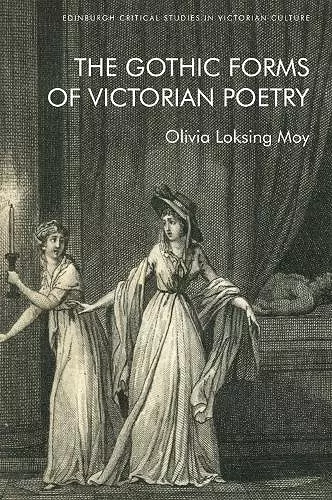
A lonely damsel imprisoned within a castle or convent cell. The eavesdropping of a prisoner next door. The framed image of a woman with a sinister past. These familiar tropes from 1790s novels and tales exploded onto the English literary scene in ‘low-brow’ titles of Gothic romance. Surprisingly, however, they also re-emerged as features of major Victorian poems from the 1830s to 1870s. Such signature tropes — inquisitional overhearing; female confinement and the damsel in distress; supernatural switches between living and dead bodies — were transfigured into poetic forms that we recognise and teach today as canonically Victorian. The Gothic Forms of Victorian Poetry identifies a poetics of Gothic enclosure constitutive of high Victorian poetry that came to define key nineteenth-century poetic forms, from the dramatic monologue, to women’s sonnet sequences and metasonnets, to Pre-Raphaelite picture poems.
In nuanced and innovative readings that transfigure traditional generic divides, Olivia Loksing Moy explores the overlooked afterlife of the wild particularities of Romantic Gothic fiction in a variety of Victorian poetic genres – including the dramatic monologue, women’s sonnet sequences and picture poems – vividly reanimating and reframing sensational novelistic tropes and novel verse forms. -- Cornelia Pearsall, Smith College, Northampton
Olivia Loksing Moy’s first monograph, The Gothic Forms of Victorian Poetry, is a vibrant and vital contribution to Victorian studies. [...] This book is highly recommended for anyone exploring the location of the Gothic in the Victorian era, as Moy successfully draws ‘lines of influence that reach across a continuous long nineteenth century,’ making it clear that the Gothic did not vanish after the 1790s only to be revived at the fin de siècle (p. 11). Rather, it contributed through its form to many canonical Victorian texts. Additionally, Moy’s references to the Gothic persisting in periodicals and annuals demonstrate that more attention still needs to be paid to the popular fiction of the period. A final triumph of this monograph’s approach is how it identifies a new method of analytical practice – the classification of Gothic forms – and demonstrates how this can be implemented. -- Scarlette-Electra LeBlanc, University of Hull * BAVS Newsletter *
ISBN: 9781474487184
Dimensions: unknown
Weight: unknown
320 pages