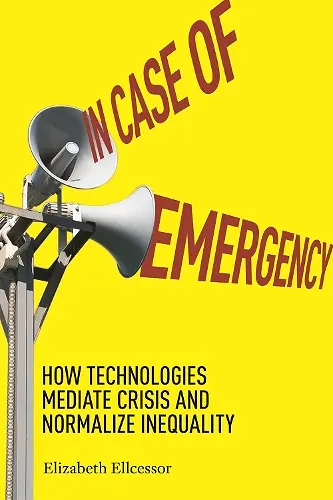
In Case of Emergency
How Technologies Mediate Crisis and Normalize Inequality
Format:Paperback
Publisher:New York University Press
Published:19th Apr '22
Currently unavailable, and unfortunately no date known when it will be back
A much-needed look at the growth of emergency media and its impact on our lives
In an emergency, we often look to media: to contact authorities, to get help, to monitor evolving situations, or to reach out to our loved ones. Sometimes we aren’t even aware of an emergency until we are notified by one of the countless alerts, alarms, notifications, sirens, text messages, or phone calls that permeate everyday life. Yet most people have only a partial understanding of how such systems make sense of and act upon an “emergency.” In Case of Emergency argues that emergency media are profoundly cultural artifacts that shape the very definition of “emergency” as an opposite of “normal.” Looking broadly across a range of contemporary emergency-related devices, practices, and services, Elizabeth Ellcessor illuminates the cultural and political underpinnings and socially differential effects of emergency media.
By interweaving in-depth interviews with emergency-operation and app-development experts, archival materials, and discursive and technological readings of hardware and infrastructures, Ellcessor demonstrates that emergency media are powerful components of American life that are rarely, if ever, neutral. The normalization of ideologies produced and reinforced by emergency media result in unequal access to emergency services and discriminatory assumptions about who or what is a threat and who deserves care and protection. As emergency media undergo massive growth and transformation in response to digitization and attendant entrepreneurial cultures, Ellcessor asks where access, equity, and accountability fit in all of this. The first book to develop a typology of emergency media, In Case of Emergency opens a much-needed conversation around the larger cultural meanings of “emergency,” and what an ethical and care-based approach to emergency could entail.
"
In this moment, in which everything and nothing are simultaneously defined using the language
of emergency, Elizabeth Ellcessor’s book is resonant, brilliant, timely, and compassionate, and
helps to chart a way forward. Her analysis of emergency media and how they express specific
articulations of technology, culture, and power as well as their connection to existing forms of
white supremacy, disability justice, and misogyny are rigorous, and explain how our
understandings of emergencies and the media with which we communicate that information have
life and death stakes.
"
Sirens blare. Maps blaze in alarming colors. Phones buzz stridently as pop-up alerts invade the
screen. Media technologies index the presence of an emergency, putting us on alert, entreating us
to leap into protective action. Yet as Elizabeth Ellcessor argues cogently in her timely, alarming,
and ultimately reparative book, emergency media and the workers operating them also have the
power to construct emergency—to cultivate panic, to amplify risk, to signal when we’ve tipped
over into some unacceptably harmful, destructive, or costly deviation from the norm. Emergency
media inform how ‘normality’ is defined, and whose norms become the standard. It thus has the
capacity, as Ellcessor shows us, to cultivate a new norm that's more inclusive, just, and
compassionate.
ISBN: 9781479811632
Dimensions: unknown
Weight: 318g
216 pages