Cervantes, Technology, and the Novel
An Aesthetic of Instrumentality in Don Quixote
Format:Hardback
Publisher:University of Toronto Press
Published:15th Dec '25
Should be back in stock very soon
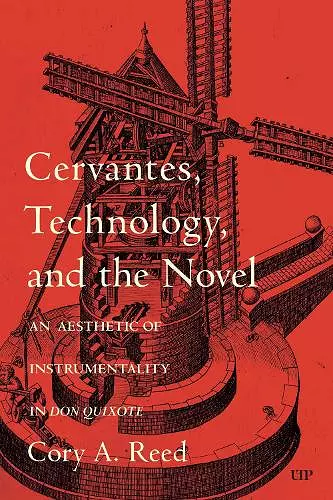
This book examines the technological and scientific imagery in Cervantes’s novel, Don Quixote, and the ways in which the Scientific Revolution participated in the author’s examination of early modern European culture during a time of crisis and change.
Cervantes’s representation of technology not only documents the cultural dynamics of the transition between medieval scholasticism and early modern empiricism in Spain but also celebrates the agency of the individual to effect change in the world. Machines in Don Quixote often function as the would-be knight’s nemesis, playing a role in foiling his quest to revive a mythical, pre-technological Golden Age. They also appear as ingenious devices that straddle the border between magic and engineering in a modern expression of human creativity and ingenuity. For Cervantes and his characters, technology is not just about machines, but about the human desire to reverse power structures and exercise agency.
Cory A. Reed, a specialist in early modern Spanish literature, analyzes how Cervantes’s aesthetic of instrumentality encourages his reader to engage critically with the world in a time of cultural transformation. Cervantes, Technology, and the Novel thus demonstrates how Don Quixote becomes an instrument of enlightenment achieved through imagination.
“Cervantes, Technology, and the Novel offers a brilliant new appraisal of Don Quixote—both the man and the book—in terms of the shifting scientific, political, and social paradigms of the seventeenth century. Gauging the competition between new discourses based on empirical observation and traditional scholastic textual authority, Cory A. Reed masterfully demonstrates Cervantes’s sustained use of technology as ‘a metaphor for the rapidly changing world of the early modern period.’” -- Marina S. Brownlee, Robert Schirmer Professor of Spanish and Comparative Literature, Princeton University
“Cory A. Reed’s Cervantes, Technology, and the Novel opens a vital and previously uncharted field of inquiry in Cervantine studies, situating Don Quixote within the epistemic transformations of early modernity. Developing an ‘aesthetic of instrumentality,’ Reed shows how Cervantes interrogates the porous boundaries between humans and machines, fiction and empiricism. Deeply original and methodologically rigorous, this book redefines Cervantes’s cultural relevance and becomes—once read—indispensable.” -- Mercedes Alcalá Galán, Professor and H.I. Romnes Fellow, Department of Spanish and Portuguese, University of Wisconsin-Madison
“Cervantes, Technology, and the Novel is a groundbreaking study that places Cervantes’s Don Quixote at the centre of early modern Spain’s technological and intellectual transformation, revealing how machines and instruments function not as narrative curiosities but as catalysts of epistemic change. With lucid prose and meticulous research, Corey A. Reed offers essential insights into Cervantes’s engagement with science, reason, and the rapidly shifting intellectual landscape of his time.” -- Chad M. Gasta, Professor and Chair, Department of Languages, Literatures & Cultures, and Associate Dean, University of Delaware
“Cervantes, Technology, and the Novel is the definitive study of the role of technology in Don Quixote. Among other things, the author describes how Don Quixote’s encounters with three types of mills—windmill, fulling mill, and watermill—are essential moments in his cognitive trajectory from scholasticism to empiricism. It is a masterful study and a major contribution to Cervantes studies.” -- Howard Mancing, Professor Emeritus of Spanish, Purdue University
ISBN: 9781487566036
Dimensions: 236mm x 160mm x 25mm
Weight: 560g
322 pages