Electronic Literature as Digital Humanities
Contexts, Forms, and Practices
Professor Dene Grigar editor Dr James O’Sullivan editor
Format:Paperback
Publisher:Bloomsbury Publishing PLC
Published:25th Aug '22
Currently unavailable, and unfortunately no date known when it will be back
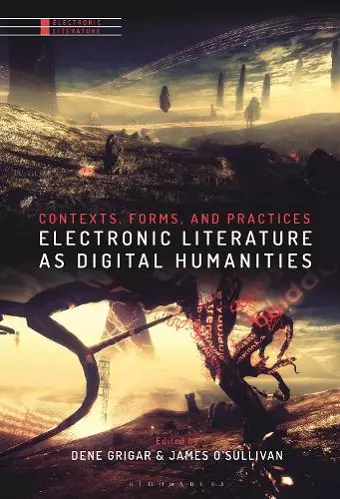
Provides a context for the development of the field, informed by the forms and practices that have emerged through the years, and offers resources for others interested in learning more about electronic literature.
This book is available as open access through the Bloomsbury Open programme and is available on www.bloomsburycollections.com. Electronic Literature as Digital Humanities: Contexts, Forms & Practices is a volume of essays that provides a detailed account of born-digital literature by artists and scholars who have contributed to its birth and evolution. Rather than offering a prescriptive definition of electronic literature, this book takes an ontological approach through descriptive exploration, treating electronic literature from the perspective of the digital humanities (DH)––that is, as an area of scholarship and practice that exists at the juncture between the literary and the algorithmic. The domain of DH is typically segmented into the two seemingly disparate strands of criticism and building, with scholars either studying the synthesis between cultural expression and screens or the use of technology to make artifacts in themselves. This book regards electronic literature as fundamentally DH in that it synthesizes these two constituents. Electronic Literature as Digital Humanities provides a context for the development of the field, informed by the forms and practices that have emerged throughout the DH moment, and finally, offers resources for others interested in learning more about electronic literature.
This book connects, indeed makes inextricable, the cutting-edge fields of electronic literature and digital humanities. Situating work by pioneers in the field of electronic literature alongside emergent artists and scholars from around the world, the book draws a transversal and provides new ways of approaching born-digital literature through a focus on contexts (social, institutional, theoretical), forms (aesthetic, poetic, medial), and practices (pedagogy, preservation, publishing). This is a book that can be used for teaching students of all levels interested in understanding the current state of literary studies. * Jessica Pressman, Associate Professor of English and Comparative Literature, San Diego State University, USA *
As digital humanities scholarship becomes increasingly involved with digital arts and culture, this publication offers a treasure trove of examples of the integration of these fields. In their collection, Electronic Literature as Digital Humanities: Contexts, Forms, and Practices, Dene Grigar and James O’Sullivan have assembled a variety of scholarly approaches to the natural relationship between electronic literature and digital humanities. The essays expand on traditional strategies in humanities research such as deep history, tracing both the print and computer origins of e-lit, and the extent of global presence. The works also examine remarkable instances of digital practice and form. The scope and the specificity of the book make it an excellent resource for researchers. * M.D. Coverley, author of Califia (2000)//Marjorie Coverley Luesebrink, Electronic Literature Organization, USA *
After Goethe imagined a world literature in formation, Karl Marx predicted its rise, and Franco Moretti mapped its whereabouts, is such a thing realizable at last in digital environments? Is electronic literature, ignored by English Departments and all but a few Creative Writing Programs, ready to be integrated into the Digital Humanities? There is certainly no shortage of candidates for an emerging world literature in this gathering of multi-national talents by Dene Grigar and James O’Sullivan; no shortage of languages, cultural backgrounds, heritage and creative contexts. Emerging genres like Interactive Fiction are said to express a multivariate world mode (Montfort), one that could well replace national one-sidedness and resituate local literatures. We are beginning now to look at literary works written in the form of a computer program. Recombinant, database, codework and network fictions (Seaman, Manovich, Marino, Ciccoricco); collective imaginaries (Pullinger and Armstrong); aesthetic animism (Jhave); nonlinear, nonconscious, affective, and emergent significations (Hayles, Rettberg and Coover); sound no less than sighted texts (Luers). We have here, in this volume, sustained scholarly engagement with locative media, spatial narratives, augmented realities that display an aesthetic, geographical, and linguistic diversity never so apparent in earlier formations of the "Humanities." At the least, there will be (as there have always been) literary suggestions of "some world other than the one we inhabit" (Moulthrop). * Joseph Tabbi, Professor of American Literature, University of Bergen, Norway *
ISBN: 9781501373893
Dimensions: unknown
Weight: unknown
392 pages