The Space That Remains
Reading Latin Poetry in Late Antiquity
Format:Paperback
Publisher:Cornell University Press
Published:15th Dec '20
Currently unavailable, and unfortunately no date known when it will be back
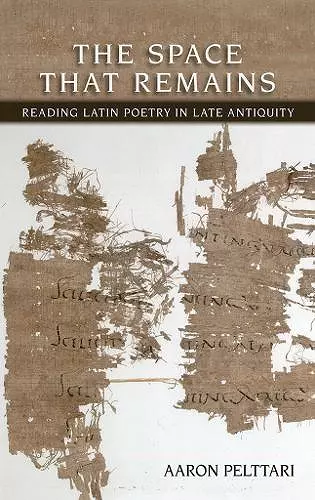
In The Space That Remains, Aaron Pelttari offers the first systematic study of the major fourth-century poets since Michael Robert's foundational The Jeweled Style. It is the first book to give equal attention to both Christian and Pagan poetry and the first to take seriously the issue of readership.
As Pelttari shows, the period marked a turn towards forms of writing that privilege the reader's active involvement in shaping the meaning of the text. In the poetry of Ausonius, Claudian, and Prudentius we can see the increasing importance of distinctions between old and new, ancient and modern, forgotten and remembered. The strange traditionalism and verbalism of the day often concealed a desire for immediacy and presence. We can see these changes most clearly in the expectations placed upon readers. The space that remains is the space that the reader comes to inhabit, as would increasingly become the case in the literature of the Latin Middle Ages.
The analysis itself is sharp and to the point, with each passage deftly handled to serve its point. The conclusions are thought-provoking.
(Comitatus)Pelttari's project is thought-provoking... The Space that Remains will be fundamental to future discussions of Latin textuality, compositional practices, and the horizons of readers' expectations in Late Antiquity.
(Journal of Roman Studies)This book is destined to be quoted in every discussion on late antique literary studies and it makes a significant contribution to the debate on Latin poetry of the 4th century.
(Bryn Mawr Classical Review)The Space That Remains is an exciting book...Throughout it all, the author himself is excited, passionate, engaged... As a vision of strong readers in late antiquity, and as its own example of strong reading, The Space That Remains is promising and illuminating new work.
(Classical World)In recent criticism of Late Antique poetry, Aaron Pelttari's book stands out because it has a theoretical focus on fourth-century literature. It is not a study of a particular poet, nor of a particular genre. Pelttari seeks to understand the special character of writing and reading poetry during this time period—what he describes as a "shift."
(The Medieval RevISBN: 9781501752056
Dimensions: unknown
Weight: 454g
210 pages