Indirect Subjects
Gender, Transitional Justice, and the Making of Female Victimhood in Post-Revolutionary Tunisia
Format:Paperback
Publisher:Stanford University Press
Publishing:30th Mar '27
£26.99
This title is due to be published on 30th March, and will be despatched as soon as possible.
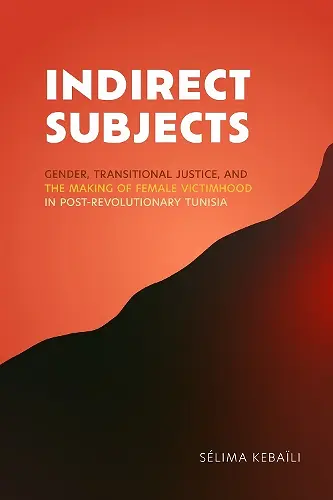
Indirect Subjects offers a critical investigation into how internationalized transitional justice processes reshape the meaning of female victimhood. Drawing on in-depth ethnographic research and a detailed analysis of Tunisia's transitional justice process, the book demonstrates that the push to include women in the aftermath of the 2011 revolution unfolded through a liberal and developmentalist framework that ultimately undermined the recognition of Islamist women's experiences of political repression. By tracing the antagonisms and negotiations between victims and institutional actors of the transitional justice process, the book theorizes the making of indirect subjects—that is, the subjectivation of women as apolitical agents through the erasure of the contentious dimensions of the violence they had endured. The book shows how a set of liberal international development norms and practices—the professionalization of local female victims' NGOs, an essentialist and culturalist approach to violence and victimhood, the consideration of women as tools for human rights, and a focus on events and bodies to define violence—came together to marginalize female victims' experiences of political violence while simultaneously promoting women's participation in transitional justice. Together, the insights and results of this research displace traditional understandings of gender issues in the Arab uprisings and forges a new path to understanding how relations of power between North and South operate in the context of political uncertainty.
"This book is impressively researched, theoretically ambitious, and empirically rich. Sélima Kebaïli advances a novel conceptual intervention—indirect subjects—that illuminates how internationalized justice and development frameworks actively reshape political subjectivity. The importance of this book lies not only in its empirical focus on Tunisia, but in its broader theoretical implications for how gender, victimhood, and depoliticization operate within liberal transitional justice regimes."—Swethaa Ballakrishnen, author of Accidental Feminism "With this sensitive and critical feminist ethnography of Tunisia's transitional justice process, Sélima Kebaïli has revealed a fascinating and disturbing dynamic: women were incorporated into the process as suffering victims of violence, but never political actors. Kebaïli's work is an inspiring example of postcolonial scholarship's power to help us recognize political marginalization produced in the name of liberation."—Lori Allen, author of A History of False Hope: Investigative Commissions in Palestine
ISBN: 9781503649309
Dimensions: unknown
Weight: unknown
208 pages