Coercive Human Rights
Positive Duties to Mobilise the Criminal Law under the ECHR
Dr Natasa Mavronicola editor Laurens Lavrysen editor
Format:Paperback
Publisher:Bloomsbury Publishing PLC
Published:28th Jul '22
Currently unavailable, and unfortunately no date known when it will be back
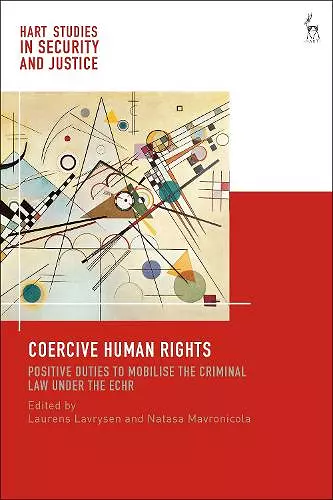
This edited collection offers a rigorous analysis of the European Court’s ‘coercive duties’ doctrine and its operation in national jurisdictions as well as theoretically informed engagement with overarching questions surrounding duties to coerce and punish in human rights.
Traditionally, human rights have protected those facing the sharp edge of the criminal justice system. But over time human rights law has become increasingly infused with duties to mobilise criminal law towards protection and redress for violation of rights. These developments give rise to a whole host of questions concerning the precise parameters of coercive human rights, the rationale(s) that underpin them, and their effects and implications for victims, perpetrators, domestic legal systems, and for the theory and practice of human rights and criminal justice. This collection addresses these questions with a focus on the rich jurisprudence of the European Court of Human Rights (ECtHR). The collection explores four interlocking themes surrounding the issue of coercive human rights: First, the key threads in the doctrine of the ECtHR on duties to mobilise the criminal law as a means of delivering human rights protection. Secondly, the factors that contribute to a readiness to demand coercive measures, including discrimination and vulnerability, and other key justificatory reasoning shaping the development of coercive human rights. Thirdly, the most pressing challenges for the ECtHR’s coercive duties doctrine, including: - how it relates to theories and rationales of criminalisation and criminal punishment; - its implications for the fundamental tenets of human rights law itself; - its relationship to transitional justice objectives; and - how (far) it coheres with the imperative of effective protection for persons in precarious or vulnerable situations. Fourthly, the (prospective) evolution of the coercive human rights doctrine and its application within national jurisdictions.
This volume is an excellent example of a critical examination of the jurisprudence of the ECHR. It not only provides clarity about their guidelines, justification and implications in an area that is gaining in importance, but also provides impetus for further development as well as references to possible limits and risks of the concept of criminal law protection obligations. -- Philip Czech * Newsletter Menschenrechte (Bloomsbury translation) *
This volume demonstrates, in a holistic way, how coercive human rights duties have inevitably generated tensions with some of the more ‘orthodox’ concerns of human rights law … It also offers a solid basis from which to reappraise concrete developments related to the criminal law (enforcement) tools that are capable of affording effective redress for human rights violations and determine individual criminal liability. * Europe des Droits & Libertés *
ISBN: 9781509945399
Dimensions: unknown
Weight: unknown
312 pages