Labour Law, the Cold War, and the Right to Strike
A Legal and Political History of Order 1305
KD Ewing author Andrew Moretta author
Format:Hardback
Publisher:Bloomsbury Publishing PLC
Published:28th May '26
£95.00
Supplier delay - available to order, but may take longer than usual.
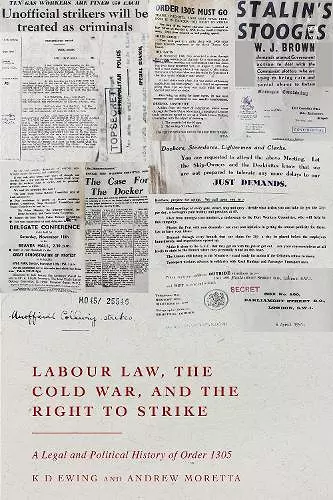
This book examines the origins, deployment, and legacy of Order 1305, a measure introduced in 1940 to make it a criminal offence to take part in a strike.
Surprisingly, the prohibition on the right to strike was retained by the Attlee administration after the Second World War, and was transformed to become a weapon of government during the Cold War to deal with what were wrongly claimed by ministers to be Communist-inspired strikes engineered for subversive purposes.
In a deep analysis of Order 1305, the authors provide a reassessment of the role of the State in industrial relations. Challenging much contemporary learning in labour law, the book is informed by a very detailed engagement with Cabinet and ministerial papers, which highlight the contradictions on the part of government in simultaneously promoting and containing trade union power. These sources also highlight the extent to which trade unions both relied on and were co-opted by the State.
The main focus of the book, however, is the role of Order 1305 in the control of trade union activists, with the continuing presence of the criminal law and allegations of communist inspired strikes ensuring an important role for MI5 and Special Branch in post-war industrial relations. Material unearthed at the National Archives demonstrates unequivocally not only that trade unions were deeply penetrated, but also that trade union activists were the subject of extensive surveillance, as the authors fully reveal.
ISBN: 9781509983162
Dimensions: 236mm x 160mm x 24mm
Weight: 640g
328 pages