Innovation and Experiential Learning in Academic Libraries
Meeting the Needs of Today's Students
Sarah Nagle editor Elias Tzoc editor
Format:Paperback
Publisher:Bloomsbury Publishing PLC
Published:15th Mar '22
Currently unavailable, and unfortunately no date known when it will be back
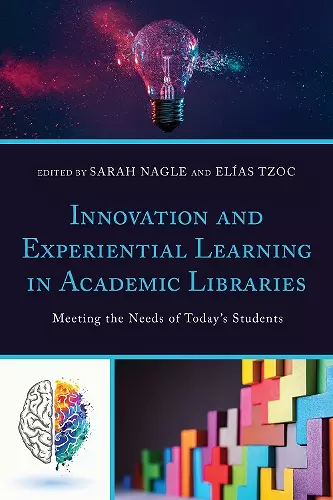
As technology advances and the skills required for the future workforce continue to change rapidly, academic libraries have begun to expand the definition of information literacy and the type of library services they provide to better prepare students for the constantly-developing world they will face upon graduation. More than teaching the newest technologies, information literacy is expanding to help students develop enduring skills such as critical thinking, creativity, problem solving, communication, teamwork, and more. Innovation and Experiential Learning in Academic Libraries: Meeting the Needs of 21st Century Students addresses the multitude of ways that academic librarians are collaborating with faculty and helping students develop these enduring skills by developing and integrating active and experiential learning approaches into teaching activities.
This book is divided into three sections. The first section explores the role that library leaders play in supporting and advocating for innovation in information literacy and library services. The second section features case studies from librarians who are implementing novel and multidisciplinary approaches to information literacy and innovative services, such as maker scholarship, digital humanities, undergraduate research experiences, and new active learning strategies. These case studies also highlight how the COVID-19 pandemic has transformed teaching and learning in academic libraries. The final section looks to the future, providing guidance to information professionals on the issues and technologies that will drive transformations of information literacy in the coming years, such as artificial intelligence and new information literacy applications. As such, library administrators, academic librarians, information literacy practitioners, and technologists will benefit from this book.
The newest installment in the “Innovations in Information Literacy” series brings a diverse perspective to the topic. Librarians and editors Nagle and Tzoc have gathered a well-rounded collection of work centered on “empower[ing] discovery, creation, and success” through experiential learning programs. The book is primarily focused on 3D printing and scanning but also features chapters on zines, undergraduate research labs, and collider spaces. What makes this volume unique is the inclusion of many perspectives from outside librarianship: authors come from the fields of computer science, digital scholarship, art, and instructional design. This makes for an intriguing, refreshing read…. The diversity of projects represented make this a must-read for library leaders considering experiential learning programs. * Library Journal *
In this timely and worthy read, the authors share diverse cases of library services and programs through innovation, creativity, experimentation, and interdisciplinary collaboration. Their insights and case studies from different types of libraries, from undergraduate to research-focused institutions, confirm leadership as a critical ingredient of innovative organizational changes. -- Jeehyun Davis, University Librarian, American University
This pragmatic, insightful book highlightsa wide spectrum of experiments and experiences – guiding readers across the thematic landscapes of ideation, outreach, and program building. Recommended for library practitioners looking to wade out into the waters of innovation. -- Brian Mathews, associate dean for Innovation and Interdisciplinarity, Carnegie Mellon University Libraries
If you are looking for ways to reimagine library instruction for the 21st century, Sarah Nagle and Elias Tzoc gathered some of the most innovative practitioners to share their ideas and experiences – including obstacles and how they overcame them – for this book. I’m excited to act on what I learned! -- Alexis Smith Macklin, PhD, Director of Grace Library and the Center for Digital Learning and Innovation
This is an essential book for our field. Nagle and Tzoc remind us that our conversations on making technologies is limited without talk about information literacy -- we need to focus on community building and the urgent need to further develop critical skills and information literacy." -- Maggie Melo, assistant professor, University of North Carolina at Chapel Hill - School of Information and Library Science
This is a great resource for library leaders and staff on the role an academic library can play in innovation, disruption, and in creating programs and services that make an academic library the intellectual center of campus for today's college students. -- Param Bedi, vice president, Library and Information Technology, Bucknell University
This is a great primer for someone just dipping their toe into the active learning pool, and the case studies are a great resource if you’re looking to develop a similar program. * Journal of the Australian Library and Information Association *
This title would be useful to anyone who creates learning experiences in academic libraries, most particularly to anyone involved with makerspaces and creative technology spaces. I found it personally useful as a sciences liaison librarian in a mid-sized public institution, especially since I work closely with our campus makerspace. But there is a case study for any member of an academic library in this book, whether they are a traditional liaison, a makerspace coordinator, a functional expert, a library director, or a student working in creative spaces. There are case studies for high-technology and high-budget environments, high-tech but low-budget, low-tech and no-budget, and any other permutation. This is a slight exaggeration – but it does feel like the book intentionally includes a huge variety of programs in different stages of execution, success, assessment, and expansion. With its focus on sustainability and the diversity of programs that can fall under the umbrella of innovation and experiential learning, I find it hard to fault the broad title – this is a broad topic, the authors in this book truly do work to meet the needs of learners in sustainable ways, and many roles in academic libraries can benefit from this text and learn from their efforts. * Technical Services Quarterly *
ISBN: 9781538151846
Dimensions: 221mm x 152mm x 12mm
Weight: 304g
222 pages