Disabled and Neurodiverse Staff
Toward Inclusion in the Library and Information Science Workforce
Keren Dali editor Kim M Thompson editor
Format:Hardback
Publisher:Bloomsbury Publishing PLC
Publishing:12th Nov '26
£90.00
This title is due to be published on 12th November, and will be despatched as soon as possible.
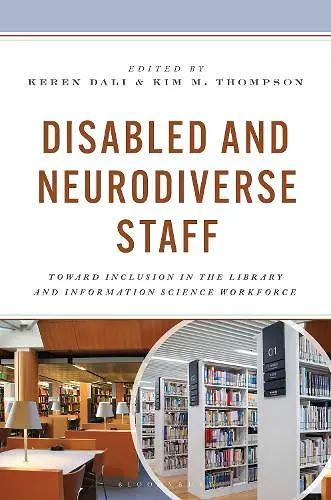
Explore a multi-dimensional and nuanced view of disability and neurodiversity in the Library and Information Science workforce from those directly impacted in the field.
Despite significant progress in improving the inclusion of disabled and neurodiverse patrons in libraries and information organizations of all types, much more work is needed to change the situation in the Library & Information Science (LIS) workforce. No true inclusion of community members can be achieved if disabled and neurodiverse patrons are not adequately represented in the library workforce. Disabled and neurodiverse graduates of LIS programs cannot always find fulfilling employment or are employed below their qualifications, if they manage to integrate in the job market at all post-graduation.
This volume offers a multi-dimensional view of disability and neurodiversity in the LIS workforce by combining the narratives of disabled and neurodiverse library staff with those of their colleagues and peers, as well as their supervisors and managers. It reflects the array of experience from various types of libraries and information settings.
Featuring chapters on theory and practice, annotated bibliography and resource compilation, this book is more than just a window into the current issues, it is a call to build a more inclusive and accessible future.
Disabled and Neurodiverse Staff: Towards inclusion in the LIS Workforce tackles a major gap in library research and practice. The editors of this extremely timely volume note that our society is precariously balanced between stronger policies in favor of 'inclusive and fair educational and workplace practices,' and very public challenges to those same inclusive values. In this environment, LIS research and practice have both become more deeply interested in issues of inclusion when it comes to neurodiversity and disabilities among our patrons, but very little thought has been given to library staff working under such invisible (or even visible) diversities. Disabled and Neurodiverse Staff fills that gap, and does so with a remarkable breadth of content. The essays, scoped literature reviews, and own-voices reflections in these pages harmonize contributions from different classes of authors: researchers, practitioners, and the self-identified disabled and neurodiverse. The book thus offers a wide variety of both theoretical conclusions and practical recommendations for researchers and librarians, and should appeal to LIS students and faculty, librarians and managers, researchers, and even HR professionals. Two chapters even provide complete and research-supported aspirational frameworks for the evaluation of an organization's policy documents, and for fostering equitable transitions into the workplace for disabled and neurodiverse LIS graduates. Deeper understanding and support for recent (and future) library students will be one of the book's most powerful legacies. -- Timothy J. Dickey, PhD, Director of Library Services and Associate Professor, Pontifical College Josephinum , USA
Libraries were the first societal institution to truly commit to including and advocating for disabled people, yet disabled people remain persistently underrepresented in the library workforce. Keren Dali, Kim Thompson, and the other contributors to this book collate myriad perspectives on the experiences of disabled library workers and the reasons that the demographics among library professionals do not reflect their commitment to disabled community members. A vital contribution to understandings of inclusion and representation in the library workforce, this book provides many ideas from research and practice for making the library professions more welcoming of and accessible to disabled people. -- Paul T. Jaeger, Professor and Distinguished Scholar-Teacher, College of Information, University of Maryland, USA
As a published author in the field of neurodivergence and libraries, I can say that the collection, Disabled and Neurodiverse Staff: Toward Inclusion in the Library and Information Science Workforce, produced by Keren Dali and Kim Thompson, occupies a very special place in the literature of this field. While libraries have made slow but steady progress on the subject of accommodating patrons with neurodivergence, there has been very little attention to the next, vital issue of employment of neurodivergent individuals in the library, an issue of great importance to the employees in their drive to integrate themselves into the community, and to libraries as they pursue their mission of diversity. In addition to identifying this issue with such clarity, the editors have done an extraordinary job in defining its ramifications with great thoroughness, recruiting commentators in the form of subject experts and those with personal experience, and addressing topics with a mix of research rigor, passion, and conviction. -- Matthew Conner, Student Services Librarian, UC Davis Library, USA, and coauthor of Libraries and Reading: Intellectual Disability and the Extent of Library Diversity
Dali and Thompson’s Disabled and Neurodiverse Staff contributes an essential scholarly and practice-oriented resource on this essential topic. Combining academic research with personal and professional accounts, the authors delve deeply into real world experiences of disabled and neurodiverse library staff and those that support them. Dali and Thompson provide inclusive coverage that enables a shift of mindset for anyone who is/has worked with or seeking to hire disabled or neurodiverse individuals. Most revealing were the perspectives and experiences shared by disabled and neurodiverse library staff, their co-workers, and managers who are aspiring to improve the work culture and experience for their disabled or neurodiverse co-workers. Through their own voices and those of their co-workers, disabled and neurodiverse staff expressed hidden and often unknown (to others) feelings of social isolation, marginalization, and overt or latent discrimination and fear which continues to be perpetuated through workplace cultures through something as basic as the ableist wording in job ads. Dali and Thompson’s book is a critical resource that reaches beyond library and information science education and practice as they introduce readers to models and frameworks such as the biopsychosocial model to understand the complex workplace culture of disabled and neurodiverse staff. -- June Abbas, PhD, Professor and Director, School of Library and Information Studies, University of Oklahoma, USA
ISBN: 9781538199831
Dimensions: unknown
Weight: unknown
324 pages