The Complicity of Friends
How George Eliot, G. H. Lewes, and John Hughlings-Jackson Encoded Herbert Spencer’s Secret
Format:Paperback
Publisher:Associated University Presses
Published:10th Jun '14
Currently unavailable, and unfortunately no date known when it will be back
This paperback is available in another edition too:
- Hardback£104.00(9781611484182)
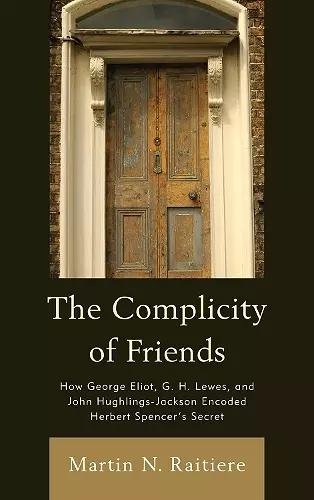
One of Victorian England’s most famous philosophers harbored a secret: Herbert Spencer suffered from an illness so laden with stigma that he feared its revelation would ruin him. He therefore went to extraordinary lengths to hide his malady from the public. Exceptionally, he drew two of his closest friends—the novelist George Eliot and her partner, G. H. Lewes—into his secret. Years later, he also shared it with a remarkable neurologist, John Hughlings-Jackson, better placed than anyone else in England to understand his illness. Spencer insisted that all three support him without betraying his condition to others—and two of them did so. But George Eliot, still smarting from Spencer’s rejection, years earlier, of her offer of love, did not. Ingeniously, she devised a means both of nominally respecting (for their contemporaries) and of violating (for our benefit) Spencer’s injunction. What she hid from her peers she reveals to us in an act of deferred, but audacious literary revenge. It’s here decoded for the first time. Indeed The Complicity of Friends comprises the first disclosure of Spencer’s hidden frailty but also, more importantly, of the responses it generated in the lives and works of his three notable friends.
This book provides a complete rethinking of its principal figures. The novelist who emerges in these pages is a more sinuous and passionate George Eliot than the oracular Victorian we are used to hearing about. The significance of the friendship between Lewes, her irrepressible partner, and the inventive Hughlings-Jackson is outlined for the first time. And in an ironic twist, even his three farsighted confidants could not anticipate that, late in the twentieth century, certain of Spencer’s own intuitions about the nature and provenance of his illness would be vindicated. Those with any interest in George Eliot, Lewes, Hughlings-Jackson, or Spencer will be compelled to re-envision their personalities after reading The Complicity of Friends.
In this groundbreaking work, Raitiere (a practicing physician with a PhD in English literature) argues that the eminent Victorian philosopher Herbert Spencer suffered from a debilitating psychiatric illness but that his condition was known only to a few. This secret was betrayed in coded fashion by one of his closest friends, George Eliot, in her novella The Lifted Veil and to some extent in Middlemarch and Daniel Deronda. Eliot was advised and counseled by her partner, George Henry Lewes, "who had developed a serious interest in neuropsychiatric illness" partly through his friendship with Spencer. The fourth person in Raitiere's account, Hughlings-Jackson, was a brilliant neurologist. Raitiere provides a detailed account of the work of all four, arguing that "Spencer's illness functions as the nidus round which George Eliot, Lewes, and Hughlings-Jackson organized certain of their key works." Providing a thorough examination of the writings of each and areas of their work hitherto neglected or ignored, the book is truly interdisciplinary and one of the most fascinating (albeit dense) studies to emerge for many decades on the interconnections between Victorian literature, psychology, and allied areas. Summing Up: Highly recommended. Upper-division undergraduates through faculty; general readers. * Choice Reviews *
Beautifully written, based in exhaustive research, and like a detective story in its pace and sequence of revealed discovery, this study reveals that the famous 19th-century philosopher Herbert Spencer suffered from a specific neurological disorder, one that was described by his doctor John Hughlings-Jackson only in the privacy of his medical notes. Raitiere (he earned a PhD in English before going on to study and practice psychiatry and neuroscience) shows how Spencer's condition was perceived by friends and acquaintances, most notably by the novelist George Eliot, who incorporates her close relationship with him into fiction. This is a fascinating and substantial work, one that will be of interest to the general reader as well as specialists in 19th-century literature, philosophy, and neuroscience. * Book News, Inc. *
ISBN: 9781611485974
Dimensions: 228mm x 153mm x 29mm
Weight: 581g
402 pages