Gender, Reading, and Truth in the Twelfth Century
The Woman in the Mirror
Format:Hardback
Publisher:Arc Humanities Press
Published:31st May '20
Currently unavailable, and unfortunately no date known when it will be back
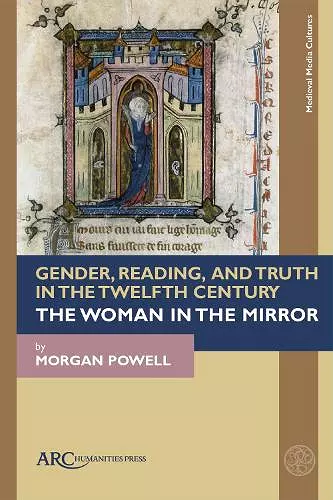
The twelfth century witnessed the birth of modern Western European literary tradition: major narrative works appeared in both French and in German, founding a literary culture independent of the Latin tradition of the Church and Roman Antiquity. But what gave rise to the sudden interest in and legitimization of literature in these “vulgar tongues"? Until now, the answer has centred on the somewhat nebulous role of new female vernacular readers. Powell argues that a different appraisal of the same evidence offers a window onto something more momentous: not “women readers” but instead a reading act conceived of as female lies behind the polysemic identification of women as the audience of new media in the twelfth century. This woman is at the centre of a re-conception of Christian knowing, a veritable revolution in the mediation of knowledge and truth. By following this figure through detailed readings of key early works, Powell unveils a surprise, a new poetics of the body meant to embrace the capacities of new audiences and viewers of medieval literature and visual art.
Morgan Powell’s Gender, Reading, and Truth in the Twelfth Century: The Woman in the Mirror is a meticulously written and highly sophisticated book that argues for a re-evaluation and new understanding of the act of reading and of the meaning of a female reader (including in the form of an iconographic representation in manuscripts and as a textual motif) in the long twelfth century. Eschewing binaries such as literate/illiterate, vernacular/Latin, oral/written, male/female, and even text/picture, Powell’s approach offers a much more complex and ultimately convincing approach to understanding the rise of vernacular literature and the role women--or rather “the woman”--played in the twelfth century.
-- Alison L. Beringer * The Medieval Review TMR 23.05.02 *Morgan Powell begins this impressive, well-written volume by taking issue with the connection made in German scholarship (and in that of other European languages) between the emer- gence of vernacular literatures and the evidence of women’s involvement in bookish culture in the twelfth and thirteenth centuries. The corresponding argument that an increase in women’s literacy arises from this emergence is, Powell finds, fatally flawed. With broad strokes he sweeps this “literacy hypothesis” aside, at least as far as the long twelfth century is concerned.[...]
Some readers might stumble at the language of originality and genius that filters in and out of Powell’s narrative, particularly in the chapters focusing on Chrétien and Wolfram. Yet, when we consider that all writers at this time learn to read or write in a religious context regardless of gender, the notion that a mode of knowing emerging out of this context would also manifest in what we call secular literature is one of those insights that is as profound as it is obvious, once it is pointed out.
-- Sara S. Poor * Speculum 99, no. 1 (January 2024): 269-70 *[Morgan Powell] montre la façon dont l’expérience de la femme dans la narration renouvelle et rend présente l’expérience mariale en tant que corps du Verbe. Amenés à s’identifier avec la femme et avec sa faiblesse face à Dieu, les laïcs ont désormais accès à la gnosis féminine. Le xiie siècle propose alors une lecture alternative visant à rendre accessible le savoir à un public nouveau. Celle-ci se développe dans un processus de translation où latin devient vernaculaire, lecture devient performance, et liturgie se transforme en instruction poétique. Ainsi, suivant le parcours analytique de l’A., depuis le Cantique des Cantiques jusqu’aux textes vernaculaires, la lecture s’étend du milieu monastique au milieu laïque grâce à la femme, médiatrice d’une nouvelle poétique sensorielle du savoir.
-- Isabel Barros Felix * Le Moyen Âge 129 (2023): 922-24 *This elegantly written, deeply considered, and fluidly argued monograph examines representations of the reading woman in select twelfth- and very early thirteenth-century texts and manuscripts, both secular and sacred, through the lens of medieval concepts of gender difference as these shaped medieval understandings of learning and reading. Linguistically, the material studied is drawn from Latin, Anglo-Norman French, Old French, and Middle High German sources. [...] At times, the framing scholarship upon which Gender, Reading, and Truth draws can feel dated, but the monograph’s lucid analyses and strong, clear arguments more than compensate. It is refreshing to read a study that so successfully sets aside the academic and disciplinary divides that can distort our perception of the medieval past and explores instead the intercultural, intertextual, and inter-linguistic conversations that sustained intellectual inquiry in the twelfth century.
-- Ann Marie Rasmussen * Digital Philology: A Journal of Medieval Cultures 12, no. 2 (2023): 289-91 *In this book Morgan Powell advances an interesting and wide-ranging hypothesis about the figure of the woman in twelfth-century Latin and vernacular literature, both sacred and secular. He focuses on her frequent appearance as distraught or bereaved lover or bride – sometimes also mother – who witnesses and fully shares in the pain and suffering of her beloved; and, linked to that, on her equally frequent appearance as audience, patron, reader, or recipient of both oral and written texts. The figure in whom these threads ultimately converge is Mary. [...] Powell’s readings are detailed, intricate, and often ingenious; while they may sometimes seem slightly forced, they more often open up fascinating insights into a dimension of vernacular literature, and especially courtly romance, that has not been much explored. It is impossible in the short space of a review to do justice to his extensive analyses and the networks he identifies. One must hope that future studies will probe these very suggestive ideas about the workings of vernacular literature, with its focus on love and adventure, in order to develop and test their further validity, implications. and consequences for the larger picture of vernacular literary culture.
-- Sylvia Huot * Medium Ævum 91, No. 1 (2022): 144-ISBN: 9781641893770
Dimensions: unknown
Weight: unknown
440 pages
New edition