From Surviving to Metaviving
A New Rhetorical Formation in Metastatic Breast Cancer Patient Discourse
Format:Hardback
Publisher:Bloomsbury Publishing PLC
Published:13th Nov '25
£67.50
Supplier delay - available to order, but may take longer than usual.
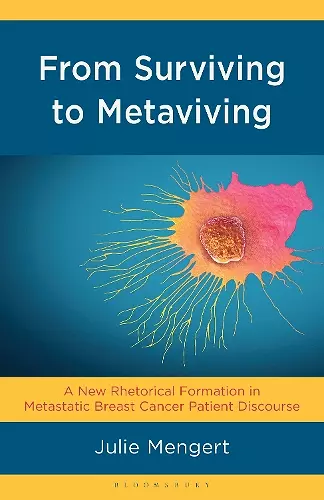
As metastatic breast cancer has become a chronic disease for some women, how women discuss living with this disease has also evolved. The author examines and analyzes these changes and the rhetorical impacts of this evolution in overall breast cancer discourse.
As treatments have advanced, metastatic breast cancer has become a disease that some women can live with for years, which has changed the language that women use to discuss living with this form of breast cancer as discussed in this book.
Using the framework of Celeste Condit’s rhetorical formations, which includes uses of metaphors, topics, and values, among other rhetorical features, the author examines how language has shifted from one of war and survivor rhetoric to that of metavivor rhetoric, which includes metaphors of water and prison, among others. Another hallmark of this emerging rhetorical formation is existing in a state of liminality where the cancer neither progresses nor retreats, leading to women experiencing time differently. By examining how women discuss living with cancer in an online breast cancer support group, the author analyzes the language shifts taking place and argues that women have moved from the dominant war/survivor rhetorical formation to one grounded in metavivor rhetoric.
Within this evolution comes an understanding of what it means to live with a chronic, yet ultimately, terminal, illness and an acknowledgment of the impact that their lives’ perceived time has on these language choices.
Metavivors are people living with—and dying from—metastatic breast cancer. Metaphors of war and survival, still dominant in breast-cancer discourse, are, if they are useful to anyone, not, in general, useful to them. Indeed, they may be harmful. Mengert engages with these metaphors, and, with nuance and care, goes beyond them to explore questions of breast-cancer rhetoric more broadly—what it is and what it can be: When, as happens increasingly, cancer becomes a chronic illness, how do we speak of it and why does that matter? * Judy Z. Segal, Professor Emerita, University of British Columbia, Canada *
ISBN: 9781666973105
Dimensions: 230mm x 158mm x 16mm
Weight: 340g
136 pages