Alimentary Orientalism
Britain's Literary Imagination and the Edible East
Format:Paperback
Publisher:Bucknell University Press,U.S.
Published:16th Jun '23
Currently unavailable, and unfortunately no date known when it will be back
This paperback is available in another edition too:
- Hardback£120.00(9781684484676)
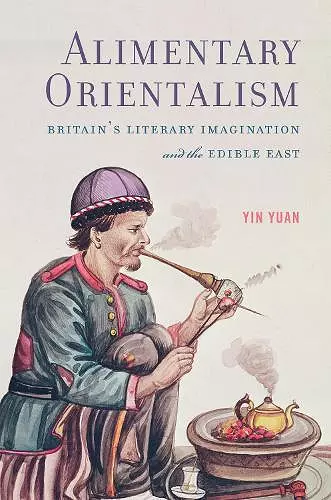
What, exactly, did tea, sugar, and opium mean in eighteenth- and nineteenth-century Britain? Alimentary Orientalism reassesses the politics of Orientalist representation by examining the contentious debates surrounding these exotic, recently popularized, and literally consumable things. It suggests that the interwoven discourses sparked by these commodities transformed the period's literary Orientalism and created surprisingly self-reflexive ways through which British writers encountered and imagined cultural otherness. Tracing exotic ingestion as a motif across a range of authors and genres, this book considers how, why, and whither writers used scenes of eating, drinking, and smoking to diagnose and interrogate their own solipsistic constructions of the Orient. As national and cultural boundaries became increasingly porous, such self-reflexive inquiries into the nature and role of otherness provided an unexpected avenue for British imperial subjectivity to emerge and coalesce.
"Bracingly original, Alimentary Orientalism moves beyond predictable 'self/other' binaries to delineate new complexities in British 'Orientalist' literary discourse. Focusing on such 'psychoactive groceries' as tea and opium, Yuan details how various texts represent the literal incorporation of otherness, even as they self-critically investigate the nature of Orientalist representation itself."— Alan Richardson, author of The Neural Sublime: Cognitive Theories and Romantic Texts
"A bold and powerfully generative take on the literary shockwaves produced by the massive influx—at once unsettling and inspiring—of Eastern products in eighteenth- and nineteenth-century Britain. By centering eating and drinking as the paradigmatic forms of exotic consumption, Yin Yuan surfaces previously unrecognized currents of ironic self-reflexivity with respect to bodily and cultural boundaries set in motion by the period's insatiable appetites for the Orient. Rarely has such a theoretically astute treatment of the cultural politics of eating made for such devilishly delicious fare."— David Porter, author of The Chinese Taste in Eighteenth-Century England
"The analysis is convincing, grounded in close reading and always in dialogue with other scholars . . . a book of definite interest to those who care about Asia and Asian people and who recognize Orientalism, in its pernicious form, as a concern of the present."— Asian Review of Books
"Eating, drinking, smoking—the bodies in nineteenth-century British writing took in Chinese influence both cavalierly and copiously. Yin Yuan's book helps us understand this consumption by explaining, with erudition and grace, how such exotic ingestants navigated Britain's symbolic and material Oriental encounters on their way to the heart of the empire."— Elizabeth Hope Chang, author of Britain's Chinese Eye: Literature, Empire, and Aesthetics in Nineteenth-Century Britain
"Focusing on early British Orientalism as a distinctly literary effort to negotiate the new material realities of imperial commerce, Alimentary Orientalism locates in eighteenth- and nineteenth-century writing about exotic comestibles an emergent form of semiotic theory. Imperial self-making, it shows, not only rehearsed mythologies of encounter, but did so as a way of orienting British selfhood in the liminal space where sign meets substance—the space where empire unfolds."— Eugenia Zuroski Jenkins, author of A Taste for China: English Subjectivity and the Prehistory of Orientalism
ISBN: 9781684484669
Dimensions: 235mm x 156mm x 18mm
Weight: 399g
282 pages