Otherwhere
New & Selected Poems 1976–2026
Format:Paperback
Publisher:Bloodaxe Books Ltd
Publishing:22nd Oct '26
£14.99
This title is due to be published on 22nd October, and will be despatched as soon as possible.
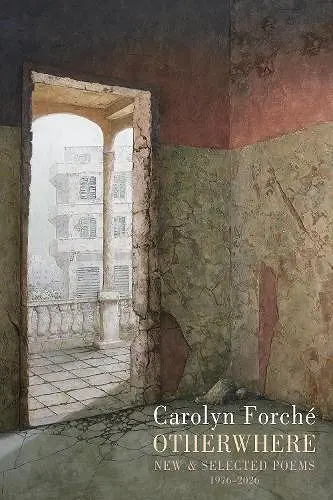
Carolyn Forché is one of America’s most important contemporary poets – renowned as a ‘poet of witness’ – as well as an indefatigable human rights activist. Over five decades, she has crafted visionary work that has reinvigorated poetry's power to awaken the reader. Her groundbreaking poems have been testimonies, enquiries and wonderments. They daringly map a territory where poetry asserts our inexhaustible responsibility to each other.
Her meditative poetry has a majestic sweep, with themes ranging from life on earth and human existence to history, war, genocide and the Holocaust. Her retrospective, Otherwhere, is published fifty years after her debut, Gathering the Tribes, winner of the Yale Series of Younger Poets Award in 1975. It includes selections from that book and from four subsequent collections published by Bloodaxe in the UK: The Country Between Us (1981/2019), The Angel of History (1994), Blue Hour (2003) and In the Lateness of the World (2021), and opens with If there is ink, a group of 16 new poems. According to Joyce Carol Oates (New York Times Book Review), Forché’s ability to wed the “political” with the “personal” places her in the company of such poets as Pablo Neruda, Philip Levine and Denise Levertov. Jane Miller called Blue Hour ‘a masterwork for the 21st century’.
Carolyn Forché's own selection from her books is prefaced with an introductory essay, Older Than Glass, Younger Than Music: a poetics, in which she relates her life and times to her development as a poet and thinker, tracing the shifts in her poetry across her five collections. This concludes: 'What draws me to poetry is mystery, sensibility, and the hidden architecture of the poem, excavated in its making, and revealed in the tremor of its wakefulness. When I’m truly writing, the poem takes me as close as possible to the precipice, and allows me to see, however obliquely, what the other has seen. Only the poem knows the route, tacking between temporal latitudes until the armada of impeding thoughts have been blown off course. We live in a sea of ambient language: speech that surrounds and is also within us: why not set it in motion to a music of its own? – at least to honor what we experienced, from ancient times to...
The poignant cri de coeur of this singular work must affect all who have an integrity still possible in this painfully despairing time. Carolyn Forché makes a complex voice for all the mute victims of our destructive world as the killing goes on and the patterns of our lives continue our committed self-destruction. Hers is the heroism which still cares.
-- Robert Creeley * on Blue Hour *In the Lateness of the World, her fifth book of poems after a hiatus of seventeen years, meditates on questions of witness, displacement and war. Through poems touching on the refugee crisis, genocide, nationalist strongmen and climate emergency, Forché paints a bleak but accurate picture of the West's supposed postwar prosperity. Throughout this new collection, she turns her inimical, at times prophetic, eye onto a still new and unstable century.
-- Sandeep Parmar * Poetry Book Society Bulletin *Carolyn Forché has never undertaken less than the responsibilities of conscience, and now in The Angel of History she has written a poem that is suddenly important, like the Morning News, as habitual and callous in its events, but with this luminous and permanent difference: with a natural light that purifies and even exalts them by the iron fragilities of its compassion, a compassion that makes beauty political by its endurance. The book, with its refreshing leaves, mutters like a hill grove untouched by the devastations beneath it, restoring the craft of verse to its ancient sacral task of comfort. She reminds us, through piercing admonitions that more than just record the obscenities of civilisation, with an old faith in her craft that everything should be sung, and that the miracle in metre assembles limbs, ruins and fragments. The tone is that of a distant echo of a far train; the language, first searching, then gaspingly exact, has the distance of translation. This distance gives her poem the spiritual authenticity of a charred journal extracted from rubble, one written in secret by a poet whose name we do not know (that is, not only Carolyn Forché), but whose anonymity is certainly some woman’s. Tsvetaeva? Pauline Celan? Her mutterings are a voice that spoke, speaks, and will continues to haunt the future, after the camps, after the holocaust of Hiroshima, during Sarajevo and Somalia and Haiti, and during whatever fresh horror our century will repeat each morning, condemning them not with dialectic, but by the ironic serenity of beauty.
-- Derek Walcott on The Angel of HisISBN: 9781780378183
Dimensions: 234mm x 156mm x 19mm
Weight: unknown
240 pages
Paperback original