Mapping Information Landscapes
New Methods for Exploring the Development and Teaching of Information Literacy
Format:Hardback
Publisher:Facet Publishing
Published:26th Jun '20
Currently unavailable, and unfortunately no date known when it will be back
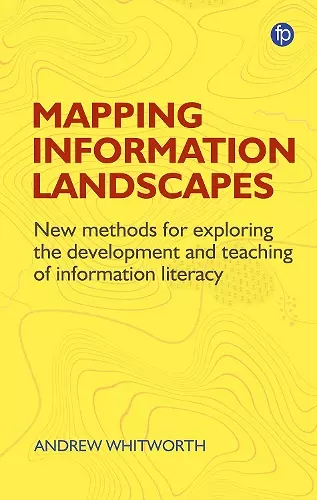
Mapping Information Landscapes presents the first in-depth study of the educational implications of the idea of information literacy as ‘the capacity to map and navigate an information landscape’. Written by a leading researcher in the field, it investigates how teachers and learners can use mapping in developing their ability to make informed judgements about information, in specific places and times.
Central to the argument is the notion that the geographical and information landscapes are indivisible, and the techniques we use to navigate each are essentially the same. The book presents a history of mapping as a means of representing the world, ranging from the work of medieval mapmakers to the 21st century. Concept and mind mapping are explored, and finally, the notion of discursive mapping: the dialogic process, regardless of whether a graphical map is an outcome.
The theoretical framework of the book weaves together the work of authors including Annemaree Lloyd, Christine Bruce, practice theorists such as Theodore Schatzki and the critical geography of David Harvey, an author whose work has not previously been applied to the study of information literacy.
The book concludes that keeping information landscapes sustainable and navigable requires attention to how equipment is used to map and organise those landscapes. How we collectively think about and solve problems in the present time inscribes maps and positions them as resources in whatever landscapes we will draw on in the future.
Information literacy educators, whether in libraries, other HE courses, high schools or the workplace, will benefit by learning about how mapping – implicitly and explicitly – can be used as a method of teaching IL. The book will also be useful reading for academics and researchers of information literacy and students of library and information science.
I would recommend this book to information professionals who would like a fresh take and inspiration on how to present information and engage learners. Others in the education sector would also benefit from the insight into the information world and how learners can be engaged in its navigation.
-- Helen Bond, Journal of Information LiteISBN: 9781783304172
Dimensions: unknown
Weight: unknown
272 pages