Quennets
Format:Paperback
Publisher:Carcanet Press Ltd
Published:28th Jul '16
Should be back in stock very soon
* Philip Terry is Director of the Centre for Creative Writing, University of Essex* Quennet is a form invented by Raymond Queneau in 1975, the fifteen-line sonnet...* Themes: the pschyogeographies championed by Will Self, including Essex estuary walks and the Berlin Wall Trail* Translated Queneau's Elementary Morality, a Telegraph Best Poetry Books of the Year
Three psychogeographical sequences exploring Queneau’s Oulipian ‘quennets’
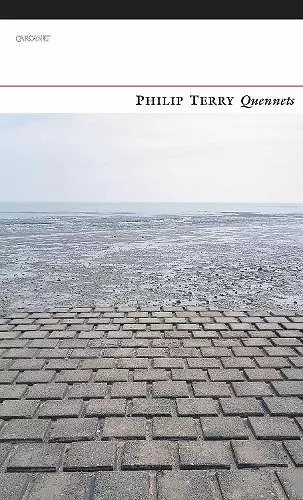
In Quennets Philip Terry develops a sonnet-like form invented by the Oulipian poet Raymond Queneau. Across three sequences, the ‘quennet’ is reworked and refigured in response to three perimiter landscapes. The first sequence, ‘Elementary Estuaries’, is inspired by a series of walks along the Essex estuary, the poems’ appearance on the page suggesting the landscape’s expansive esturine vistas, its pink sail lofts and windswept gorse, beach huts and distant steeples. In the second sequence, written after a series of walks around the Berlin Wall Trail, or Mauerweg, the form changes to reflect the physical, almost bodily tension of the wall as an architectural and social obstruction. The final sequence, ‘Waterlog’, retraces the steps of W. G. Sebald through Suffolk, and here the quennet’s newely elongated shape and ragged margin evoke the region’s eroding coastline, its deserted piers and power stations, electric fences and waterlogged fields. Terry’s project is bold in scope, his poems subtle in effect, a mix of sign and song, concerete and lyric, Oulipo and psychogeography. It is a work about boundaries, political, social, and natural, and about the walk as a critical apparatus through which these fields are shown to connect.
'Though Terry's 'I' is all but absent, his eye is keen throughout, seizing on significant details of his wanderings around estuaries, around the old Berlin Wall, and finally along the digressive paths followed by W. G. Sebald through Suffolk in The Rings of Saturn. En route, Terry's precise [...] selection of language -- sampled from the vocabularies of biology, geography and history, among other disciplines -- offer hints and glimpses and conjectures about the ways in which these three modern landscapes have been shaped by their past and present inhabitants and vice versa. There is no overt editorialising, but rather a pervasive air of pensiveness that invites many re readings. These are poems of high ambition and integrity, and there is nothing else in the English language quite like them.'
Kevin Jackson
'These surprising and intriguing poems offer new ways of seeing overlooked places; of reading landscapes too often dismissed as illegible. Tonally adventurous, formally radical, sometimes witty, sometimes melancholically beautiful, they stand at a convergence of nature writing and experimental poetics.'
Robert Macfarlane
'Sparse by design, this poetry is a strong reminder of the power of words when allied to our imagination, experience and emotions.'
Prize Judges, New Angle Prize for East Anglian Literature
ISBN: 9781784102685
Dimensions: 216mm x 138mm x 1mm
Weight: unknown
144 pages