Against Decolonisation
Taking African Agency Seriously
Format:Paperback
Publisher:C Hurst & Co Publishers Ltd
Published:30th Jun '22
Should be back in stock very soon
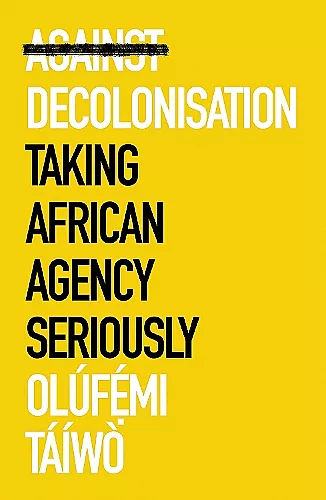
This book critiques the modern decolonisation movement, arguing it hinders African scholarship and undermines the agency of contemporary thinkers in Africa.
In Against Decolonisation, Olúfẹ́mi Táíwò presents a compelling critique of the contemporary decolonisation movement, which he argues has strayed from its original purpose. Initially intended as a means to liberate African nations from Western political and economic control, the concept has evolved into a vague notion that often prioritizes performative morality over genuine intellectual engagement. This shift, according to Táíwò, stifles African thought and undermines the agency of African scholars and thinkers.
The author challenges the indiscriminate application of ‘decolonisation’ across various disciplines, including literature, sociology, and philosophy. He contends that this trend not only dilutes the significance of the term but also inflicts harm on scholarship related to Africa. By fixating on cataloguing past injustices, the decolonisation movement risks overlooking the innovative contributions of contemporary African intellectuals, who are capable of adapting and synthesizing ideas in ways that are relevant to their contexts.
Against Decolonisation serves as a vital intervention in the discourse surrounding African empowerment. Táíwò calls for a reevaluation of how decolonisation is understood and applied, advocating for a recognition of African scholars as dynamic thinkers who engage with global ideas on their own terms. This book is essential for anyone interested in the complexities of decolonisation and its implications for African thought and scholarship.
'We need a more sophisticated analysis of the continuity of ideas between Africa and the western world, and Táíwò’s book provides this. [Against Decolonisation] makes a powerful case for how Africans can get out of their malaise: not by being trapped in a psychological state of victimhood, but by reclaiming their agency.'
* Tomiwa Owolade, Financial Times *'An electrifying book.'
* The Wall Street Journal *'[A] bristling new takedown.'
* Prospect *‘A provocative and epic call-out.’ * Brittle Paper, '100 Notable African Books of the Year' *
‘Both in Africa and far beyond, academics, disciplines, universities and nations are being urged to face up to their dark histories and to decolonise many aspects of the ways they operate. Táíwò is an urgent and eloquent voice in suggesting that they need to think harder about whether and how that should be done.’
* Times Higher Education *‘A rigorously combative intervention in the application of decolonisation to thought and ideas.’
* African Arguments *A valuable, thought-provoking, fiery book.'
* Peace News *'Provocative.'
* The Point *'An erudite and necessary antidote.'
* Current History *‘The first sustained critique of the contemporary decolonial movement, characterising it as a fad in western academe that does not take the agency of Africans seriously.’
* Matatu: Journal of African Culture and Society *‘[A] courageous book… an original and timely contribution.’
* Survival *'Táíwò's Against Decolonisation delivers a clearly-articulated and well-supported defense of its eponymous thesis... he offers a thoroughgoing, meticulously-argued text making diverse intellectual engagements with a variety of African thinkers.'
* American Philosophical Association *'An impressive and courageous book.'
* Das Milieu *'It doesn’t happen very often, but now and again one comes across a book that is really transformative. An author who simply changes the narrative and argues so persuasively there is really little more to be said on the subject. Olufemi Taiwo’s Against Decolonisation is one such author and this is one such book.'
* Martin Plaut, journalist and former Africa editor for BBC World Service News *'Against Decolonisation launches a trench war. Its flaming arrows hit all, sparing no axiom of reflex decolonisation. This is a bọ́lẹ̀kájà (come-down-let-us-slug-it-out) critique in its most consequential form. If you are not provoked by its argument, you sabe nothing.'
* Adélékè Adéẹ̀kọ́, Humanities Distinguished Professor, Ohio State University *'With characteristic cogency, lucidity and audacity, Táíwò shows that "decolonisation" has become an idea promoting indiscriminate hostility to forms of thought and practice wrongly tarred with malign colonial auspices. The ironic result is a rhetoric that gives short shrift to African agency. It's time to drop the erroneous conflations and recognise our right to inventive appropriation of the human commons.'
* Ato Sekyi-Otu, Emeritus Professor of Social and Political Thought, York University, Toronto, and author of Left Universalism, Africacentric Essays *‘[An] incisive volume [that] takes aim at the ever expanding and encompassing discourse on decolonization in contemporary African settings.’
* CHOICE *‘Offers a bold and critical perspective on the current state of decolonization.’
* Politics Today *‘[An] extraordinarily courageous study…. Against Decolonisation is required reading’ /p>
* Journal of Informational Ethics< *'Exemplary scholarship.'
* South African Journal of Science *'Táíwò has written an indispensable book. To sloganise for cultural and ideological decolonisation is to deny history and agency to Africa. He makes his point through a thorough analysis of politics, economics and debates around language and philosophy.'
* Gayatri Chakravorty Spivak, Columbia University, author of A Critique of Postcolonial Reason *'A bracing and much-needed riposte to contemporary efforts to "decolonise" culture, language and politics in the Global South. Elegantly demonstrating the ignorance and violence of such aims, Táíwò inaugurates a new way of thinking about the persistence of empire as one of the great intellectual and political themes of our times.'
* Faisal Devji, Director of the Asian Studies Centre, University of Oxford *'This is a book whose time has come. Basing his arguments principally on philosophy and language, Táíwò demonstrates how "decolonisers" reject as inauthentically African the works of even the most gifted and influential African scholars, thinkers and writers. Consistently cogent, commonsensical, powerful and wise, this book will not be the last word on decolonisation--but it is close to it.'
* Biodun Jeyifo, Professor of African and African American Studies and of Comparative Literature, Harvard University *'A highly important and deeply argued book. Táíwò asks us not to succumb to the simplistic siren song of the word "decolonisation". A vague word, an easy trope does not help to create the modern African with complicated agency amidst complex historical and twenty-first-century demands.'
* Stephen Chan OBE, SOAS University of London, author of African Political Thought *'With immense brio and a generous dose of common sense, Táíwò exposes the weaknesses of an over-extended notion of decolonisation and offers a convincing alternative. This highly readable, engaging and challenging book is a must for everyone interested in modern Africa.'
* Dame Karin Barber, Emeritus Professor of African Cultural Anthropology, University of BirminghamISBN: 9781787386921
Dimensions: unknown
Weight: unknown
368 pages