Insurgent Planning Practice
Roberto Rocco editor Gabriel Silvestre editor
Format:Hardback
Publisher:Edinburgh University Press
Published:23rd Apr '24
Should be back in stock very soon
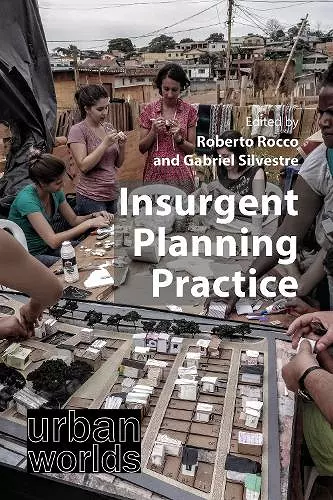
This book investigates insurgent planning practices and their potential for alternative forms of civic engagement and democracy-building. It explores how planners can challenge technocratic planning by incorporating notions of participation, inclusion, trans-sectionality and the right to the city into their daily practices. Each chapter delves into those daily practices to answer: What does insurgent planning practice look like in practice? How are radical planners coping with traditional, technocratic planning as practised in most places around the world? And what do they do to advance an agenda of democratisation and the right to the city, counteracting neoliberal forms of governance? Chapters draw on conversations with planners in several cities around the world, cataloguing insurgent experiences that challenge the status quo of contemporary market-based, exclusionary city-making. Throughout, cross-cutting issues such as gender, race and class are explored to consider ways in which insurgent planners bring diversity into planning.
A timely and important contribution to the scholarly conversations on radical, insurgent, and pluriversal planning practices... reinvigorates geography and urban planning by foregrounding the everyday, messy, situated practices of diverse configurations of dissidence against technocratic and neoliberal city-making... the volume’s strength lies in its empirical richness and its attempt to make visible the unruly muddiness of insurgent praxis... for scholars and practitioners invested in urban politics, Insurgent Planning Practice offers valuable insights and provides critical instances to think with and learn from about the future of insurgent planning in an era of escalating polycrises. -- Efadul Huq, AAG Review of Books
This account of the work of community activists and their insurgent planning allies is a must-read for all who seek to disrupt the assumed normalcy of the neoliberal order and the unquestioned rationality of dominant planning regimes. -- Bjørn Sletto, Town Planning Review
Since the 1960s, there were pressing pleas and cries to incorporate citizen participation in urban planning. Nowadays, most of the participatory planning attempts, when allowed by the powerholders, have been critically assessed as limited, flawed or even manipulative. This volume opens our eyes and invites to examine these contradictions. The 'insurgent' standpoint helps the authors explore various rich forms of collaboration between planners, scholars, activists and citizens worldwide, especially when challenging the rule of capital and technocrats. Rather than a focus on 'heroic planners', readers will find valuable lessons from practices and processes that contributed to the emancipation of the oppressed once they took the tools of urban planning in their own hands. -- Miguel A. Martínez, Professor of Housing and Urban Sociology, University of Uppsala
If there were ever any doubts that there are 'alternatives' to the neoliberal order, this book helps to revoke them. Inspired by the work of Faranak Miraftab, the contributors provide a rich and diverse set of examples of insurgent planning in both Global North and South. Instead of dwelling on the theoretical coherence of the concept, they offer inspiring cases of how insurgent planning works in particular social contexts. For the planning scholars, practitioners and educators who aspire to prefigure alternative modes of practice, this book is essential reading. It shows that the so-called 'realities' of our time are not how things are, but how they are made to be, and how they can be unmade through disruptive politics of insurgent planning. -- Simin Davoudi, Chair of Town Planning, School of Architecture, Planning and Landscape, and Co-Director of Centre for Researching Cities, Newcastle University, UK
This book is essential reading for anyone interested in creating a world that is other than the one the neoliberal urban order seduces us to thinking is normal. Offering real case studies of how insurgent planning works in practice across many different geographical and practice contexts, the book provides an overview of the field and insights from diverse geographical and practice applications that illuminate distinct dimensions of insurgent planning and contribute to deepening the conceptual and practical terrain. Drawing together writers from community-based planning cases, researchers and scholars, and planning practitioners the book provides not only a call to action for our times, but the practices to make such action real. -- Libby Porter, Professor of Urban Studies and Director of the Centre for Urban Research, RMIT University, Australia
No matter from which position insurgent planning is practised, we need to ask whether they contributed to destabilizing the status quo, provoking a just alternative future. I hope this timely and important volume helps readers to see the range of actions and practices of insurgent planning undertaken by various actors in distinct social professional positions. This volume’s contributors help us see that, from wherever we are as residents, as citizens or as professionals, we all have the ability to engage in insurgent planning. -- Faranak Miraftab, Professor of Urban and Regional Planning, University of Illinois Urbana-Champaign
The studies in this book provide us with many examples of head-on collisions within the Liberal State, and no doubt given the urgency of so many urban injustices such confrontations will remain the prime focus of insurgent planning practices. But this brilliant volume also indicates that insurgent planning can produce a prefiguration of an alternative democratic imagination that emerges under the radar of state control and repression. Such practices of insurgent citizenship can also show us how to disrupt the entrenchments of inequality, how to institutionalize, in other words, a regular, predictable, persistent, and reliable democratization of democracy. -- James Holston, Professor of Anthropology at the University of California, Berkeley
The collection provides a timely and updated account of scholarly conversations around the notion of insurgent planning. It therefore holds promise due to its comparative approach, providing a window on diverse empirical cases of insurgent planning evidencing different strategies. -- Abigail Friendly * Planning Theory *
ISBN: 9781788216760
Dimensions: unknown
Weight: unknown
224 pages