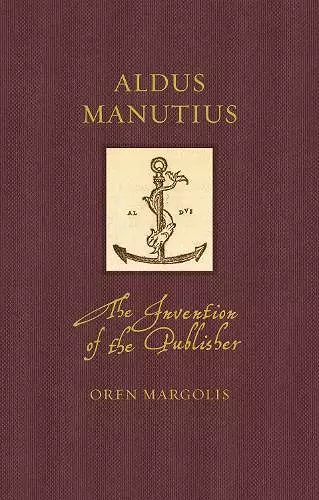
Aldus Manutius

The Invention of the Publisher

Oren Margolis author

Format:Hardback

Publisher:Reaktion Books

Published:1st Oct '23

Currently unavailable, our supplier has not provided us a restock date

Aldus Manutius cover

Aldus Manutius is perhaps the greatest figure in the history of the printed book: in Venice, Europe’s capital of printing, he invented the italic type and issued more first editions of the classics than anyone before or since, as well as Hypnerotomachia Poliphili, the most beautiful and mysterious printed book of the Italian Renaissance. This is the first monograph in English on Aldus Manutius in over forty years. It shows how Aldus redefined the role of a book printer, from mere manual labourer to learned publisher. As a consequence Aldus participated in the same debates as contemporaries such as Leonardo da Vinci and Erasmus of Rotterdam, making this book an insight into their world too.

"Winner of the 2025 Gladys Krieble Delmas Prize for the Best Book in Renaissance Venetian Studies." - Awarded by the Renaissance Society of America
"This fascinating biography, by an author extremely well-versed in Parisian cultural life . . . traces the turbulent life of a difficult man, who survived the horrors of the Holocaust to become “a theoretician of utopia”, with all its follies and splendours. Isou and the Lettrists are still little known and barely translated in this country – an omission which Speaking East, successfully, seeks to redress." - Jon Savage, New Statesman
"In Unearthing the Underworld, palaeontologist Ken McNamara finds incredible worlds preserved in stones we tend to ignore as he explores life's rocky roads." - New Scientist
"Piero di Cosimo’s bizarre paintings inspired the Surrealists – and are celebrated in Sarah Blake McHam’s myth-busting new study . . . In her informative study Piero di Cosimo, the artist, less celebrated than his direct peers Botticelli, Leonardo and Michelangelo, appears as an underappreciated figure in the history of Renaissance art . . . In Blake McHam’s hands, the full scope of Piero’s talent is explored . . . This book does a wonderful job of exploring Piero’s context . . . Without the facts required to write a biography, this is a delightful, diligent study of the most playful, surprising artist of the Renaissance." - Francesca Peacock, Daily Telegraph
"The book contributes to our understanding of the interconnectedness of the medieval world, where ideas, goods, people and images regularly passed across geographical and cultural borders. The fashionable idea of a “global Middle Ages” is sometimes overstated, yet in the case of falconry itis clear that depictions of the practice, alongside equipment, techniques, birds and even falconers, travelled widely across medieval Eurasia and North Africa." - Sebastian Dows-Miller, Times Literary Supplement
"Venus is well-written and illustrations of Venus from ancient times to the modern day make this visually appealing. The authors cover a huge amount of science . . . it's a worthy addition to Reaktion's science Kosmos series." - BBC Sky at Night Magazine
"I love a book that tells me something I don't know. Mikkel Borch-Jacobsen's Freud's Patients: A Book of Lives – which digs up all that can be dug on the people who were personally treated by Freud – did that. I knew Freud's reputation was on the slide, but this pushes it right into the drink. Borch-Jacobsen shows how Freud sometimes outright falsified his results to fit his theories; and kept even hopeless cases on the couch as long as the fees rolled in. Scoundrel!" - Sam Leith, TLS 'Books of the Year'
". . . a beautifully bound and presented little volume that is a pleasure to handle, and even the prints inside the covers are worthy of a pause to admire the swirls of flowers and butterflies. The pages are luxuriously thick and glossy, showing off the glorious photographs and illustrations within . . . the well-researched prose and outstanding pictures will be a delight to all readers of a more cultural inclination . . . In addition to the excellent list of references and index, there are sections on suggested further reading and a list of websites which may lead on to further explorations of all things rowan." - Stephen Tong, Scottish Forestry
"Extraordinarily erudite, richly detailed, beautifully illustrated and deeply felt, Trees Ancient and Modern captures a lifetime of thinking with and through trees. On every page Charles Watkins challenges us to think of trees and woodland as central to our engagement with the world and our acts of world-making – and shows how our attitudes to, and management of, trees reveal a great deal about the human condition. If much of this wonderful book provides a salutary warning for our acts of exploitation and mismanagement, ultimately it proves genuinely hopeful. Our trees and woodlands are not only remarkably resilient, Watkins shows, but they are our homes, our places to learn, to play, to think, to heal." - Carl Griffin, Professor of Historical Geography, University of Sussex
"The point of this brisk book, the latest addition to Reaktion’s Medieval Lives series, is not to give a comprehensive account of medieval people’s experiences of time or to propose any radical new theory. Rather, it offers a lively, insightful overview for the general reader, filled with wonderful nuggets." - Pablo Scheffer, Times Literary Supplement
"2023 Outstanding Academic Title" - Choice
"[a] wonderfully eloquent and informative new book . . . Robinson examines by chapter every aspect of this deliciously intriguing civilisation, from religion, society, art, trade, and agriculture, to their origins, disappearance and rediscovery . . . a comprehensive account of the Indus people, condensed into a highly accessible volume and a very good read indeed." - Current World Archaeology
"Chris Caseldine has invested a career of scholarly expertise and enthusiasm for Iceland in the creation of a unique 324-page book on the many diverse landscapes of this small island nation. This passion project goes much further than providing a simple geological explanation, as it combines the humanities with historical and cultural geography to tell the story of Iceland’s environmental history. Consequently, the book reads more like a story, comprehensively communicating the essence of what Iceland is, and how it is perceived. Professor Caseldine exceptionally weaves together the physical, cultural, and historical geography of the island, providing a detailed interpretation of the regional geography of the country. He communicates the how, what, when, where, and why of the Icelandic landscape, adding to its fascination and ongoing awe, curiosity, novelty, and chaos . . . Stories of the Icelandic sagas compliment the landscapes where they took place, many of which are beautifully illustrated with more than 100 images, the majority of which are in color. The book invites the reader to travel across both time and space in an immersive manner, where body, mind, and spirit are simultaneously engaged." - Progress in Physical Geography
"The originality of this study of Rus lies in its focus on specific families which dominated political life and deeply affected social, cultural, and religious life there . . . the book has many strengths. The authors show deep knowledge of primary sources and look critically at original narratives in them that have been too readily accepted by numerous later historians. They display a command of the secondary literature on their subject. They carefully examine such complex matters as interfamilial and interclan relationships and rivalries, the rise and decline of different regions within the lands of Rus, and shifts in the complex understandings and practices governing inheritance and succession. It should also be said that the book is attractively produced and generously illustrated." - Derek Offord, European History Quarterly
"John Withington’s meticulous history of fireworks." - Malcolm Gaskill, London Review of Books
"This book, at once readable and scholarly, shows how the fascinating historical figure of Richard the Lionheart metamorphosed into the character of myth and romance that we know today. An ideal introduction to England’s most legendary medieval king." - Jay Rubenstein, Professor of History and Religion, USC Dornsife
"One of the strengths of art historian McClanan’s newest book is its intention: to provide a historical overview of the many modes in which the legendary creature known as "the griffin" appears in art and literary history. Griffinology: The Griffin’s Place in Myth, History and Art purposefully offers a range of distinct perspectives on various regions and eras to illustrate this mythical creature’s prevalence in the cultural history of ethnoreligious groups around the world." - Hyperallergic
"This is a much-needed monographic work treating early Korean history in a comprehensive yet very readable manner. Covering mythic foundations as well as current understandings of the origins of the earliest states in Korean history, this narrative describes the rise and decline of polities, their societies and cultures and their relations with neighbouring polities, ending with the fall of the Silla kingdom in 935 and the rise of the state of Koryŏ. This book covers over a millennium of Korean history concisely and clearly and should be required reading for anyone interested in Korea’s early history and cultures." - Mark E. Byington, founder and director of the Early Korea Project at the Korea Institute, Harvard University
"Duggan does not aim merely to supplement the narrative of males writers with a few women at the margins. Rather, she seeks to shift the mainstream . . . [she] shows that we should regard the conteuses not as incidental curiosities, exhumed then quickly forgotten, but as princesses of literary history who were never really lost at all." - TLS
"Scientific botanical illustration flowered in the Renaissance, thrived in the eighteenth century and declined in the nineteenth century with the rise of photography. Today it is generally associated mostly with art. But it remains ‘art with a scientific purpose: to record, display and convey scientific data about plants’, argues Stephen Harris, curator of Oxford University Herbaria, UK. His history, colourfully illustrated with exquisite illustrations unfamiliar outside specialist literature, brilliantly unifies art and science." - Nature
"Breakfast Cereal will reward readers with relatable stories and familiar images. It is worthy of a place at the Edible Series table and is the ideal starting point for your collection of the same: one down, 89 to go." - Culinary Historians of Canada, 'Digestible Bits and Bites"
"Williams gives us an account of the life and ideas of its protagonist that is sharply focused and wise." - Wall Street Journal
"An excellent general introduction to Marco Polo . . . Kinoshita provides much-needed elegant and imaginative discussions of historical contexts, in terms of people, places and activities in different parts of the world in Marco Polo's time, as a way of bringing Polo and his work to life." - Margaret Kim, Professor, National Tsing Hua University
"Mina Kim showcases the artistic themes and concepts inherent in Korean art, skilfully crafting a narrative that intertwines multiple threads. Her work serves as a comprehensive guide, leading readers through the avant-garde movements that emerged after the Korean War and illuminating Korean art's present standing in the global art scene. This resource is a must-read for those interested in Korean contemporary art, art history and Korean studies." - J.P. Park, June and Simon Li Professor in the History of Art, University of Oxford
"Sporting a rich array of early modern images in paint and print, especially from Baroque artists working in Italy, Street Style delivers a lively cultural history of European clothing with a welcome, fresh focus on types of men and women from marginal social groups. The author smartly shows how genre art is no simple mirror of a past world but a broader cultural representation of ways of wearing and living." - Elizabeth S. Cohen, York University (Toronto)
"The book is written in a straightforward manner, free of technical jargon, so I would happily recommend it to anyone interested in race, art or science . . . It would do a world of good if those who make art, as well as those who consume it, are more aware of the connections drawn in Bindman’s important book." - Metascience
"Christopher Breward’s intelligent consideration of the suit is an antidote to all the bombastic how to guides written by fashion journalists and bloggers whose idea of cultural context is to speed read a Wikipedia page . . . a rich, deep and satisfying study." - World of Interiors
"Andrew Spira’s Foreshadowed sets out to trace the various dark paths, cultural, philosophical and iconographic, that led to Malevich’s square. Some of these seem far-fetched, but turn out not to be." - TLS
"The authors document campaigns of letter bombs by anarchists, fascists and national liberation movements . . . Roth and Cengiz have gone to great lengths to collect so many examples across several hundred years . . . Murder by Mail provides absorbing and grizzly insight into this centuries-old deadly tactic that has so rarely been examined." - Kieran McConaghy, Irish Times
"Fasting is deeply embedded in most of the world's major faiths. This book makes a modern argument offering a new form of transformation and redemption." - Ken Albala, Tully Knoles Endowed Professor of History, University of the Pacific
"Early human relationships with water were expressed through beliefs in serpentine aquatic deities. This looks into the vast human history of water worship and of our broken relationship with all things aquatic." - Outdoor Swimmer
"David Ellis's intelligent and fair-minded new short Life for Reaktion." - Seamus Perry, The Times Literary Supplement
"At last, we have a history of British Paganism written from the inside, by somebody who not only has a good knowledge of the sources, but explicitly understands how Pagans and magicians think." - Ronald Hutton
"Through the life stories of 10 wandering women, Andrews explores “the previously unacknowledged breadth, depth and distinctiveness” of their writing, and reveals a rich “female tradition of walking” . . . For Linda Cracknell, who lives in the Tayside town of Aberfeldy, both writing and walking are empathetic activities. The paths she walks “ring with the voices of earlier women-walkers who passed there”. After writing this book, Andrews too finds her paths “companioned” (to use Nan Shepherd’s word) by other women-wanderers, part of a rich cultural heritage that her fascinating research has revealed." - The Guardian
"It’s not only fearful fiction that is having a moment. With the world full of real-life terrors, nonfiction writers are also respondi...

ISBN: 9781789147797

Dimensions: unknown

Weight: unknown

208 pages