Amazing Worlds of Science Fiction and Science Fact
Format:Hardback
Publisher:Reaktion Books
Published:17th Mar '25
Should be back in stock very soon
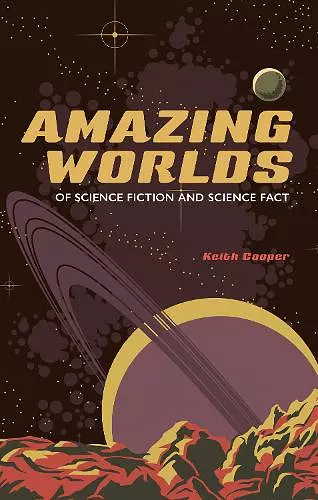
Have you ever wondered what it would be like to watch a double sunset on Tatooine, stand among the sand dunes of Arrakis or gaze at the gas-giant planet Polyphemus from the moon Pandora? In Amazing Worlds of Science Fiction and Science Fact, Keith Cooper explores the fictional planets of films such as Star Wars, Dune and Avatar, and discusses how realistic they are based on our current scientific understanding and astronomical observations. The real exoplanets astronomers are now discovering are truly stranger than fiction, as the author shows. Featuring insights from over a dozen scientists and award-winning science-fiction authors, including Charlie Jane Anders, Stephen Baxter and Alastair Reynolds, Amazing Worlds of Science Fiction and Science Fact is perfect for readers of popular science and fans of science fiction.
"The title of Cooper’s Amazing Worlds of Science Fiction and Science Fact echoes that of Amazing Stories, a magazine founded in the 1920s that was the first to be devoted to “science fiction” – a term coined by its editor, Hugo Gernsback . . . In 1928 the writer Jack Williamson recounted Gernsback’s view: Science fiction “takes the basis of science . . . and then adds a thing that is alien to science – imagination. It lights the way.” . . . Cooper’s informed, engaging account of the ways that science-fiction planets correspond to their real counterparts provides a lucid primer on exoplanets, while also demonstrating that Gernsback’s hopes for science fiction have been fulfilled." - Wall Street Journal
"Keith Cooper’s book summarizes recent advances in our understanding of exoplanets and compares them to fictional planets in books and films, in an attempt to determine to what extent science fiction has been influenced by actual science, and whether these fictional worlds are based on real observations and scientifically plausible . . . This book shows how science and science fiction play leapfrog with each other." - Times Literary Supplement
"While testing the plausibility of the most remarkable fictional worlds, the author manages to provide an in-depth introduction to key topics in exoplanet science and habitability – some of which would be quite challenging to explain to the general public without the narrative pull of fictional worlds . . . It is always a challenge for an expert scientist to approach a book aimed at the general public, as it is far too tempting to focus on every little detail rather than appreciating the general picture . . . I found myself eagerly reading through each chapter, smiling at the many familiar sci-fi references, admiring the depth of scientific explanations, and all in all amazed by how close imagination and reality are." - Nature Physics
"It becomes obvious early on that Cooper, who is a science journalist in his day job, knows his stuff on the fiction side as well as the current science . . . it’s a good exploration of the field, with neat SF references." - Popular Science
"[A] fascinating book . . . Despite dealing with some cutting-edge science, this isn’t a technical book, focusing instead on the wonder and excitement of the subject. Keith Cooper draws heavily on his own conversations with exoplanet scientists, discussing the techniques they use, the discoveries they’ve made and their plans for the future. Comparisons with fictional planets run like a thread through the book – and it’s fair to say they bear out the old saying that the truth is stranger than fiction." - Andrew May, How It Works magazine
"Astronomers observed the first confirmed exoplanet in 1992. Some 5,900 are now known, in about 4,500 planetary systems, with around 1,000 containing several planets, according to NASA. No life has been detected yet, showing just “how rare our planet Earth still is” and how “the imagination imbued within science fiction can only carry us so far,” notes science journalist Cooper. His engaging book, based on interviews with writers and researchers, examines what science fiction has got right and wrong, and what science can learn from it." - Nature
"Shaped by interviews with an eclectic mixture of science fiction authors, exoplanet astronomers, planetary and atmospheric scientists, Cooper’s engaging and informative text traces how our perceptions of alien worlds are reshaped by both scientific discoveries and cultural influences . . . As popular science communication, it aims for the middle ground, and hits that target solidly, building towards a clear and correct description of both the range of genuine alien worlds now under investigation and the uncertainties intrinsic to research in a fast-moving field . . . Amazing Worlds is a peon of praise to both contemporary exoplanet research and science fiction. Above all, it encourages readers to recognize the ways in which changing science changes our worldview, and to ponder both the potential and limitations of our explorations of exoplanets – real or imagined." - Nature Astronomy
"Planetary science and Science Fiction (SF) were always closely related . . . This tome appears to be targeted at SF readers and those (non-professional astronomers) who enjoy popular science. However, many in the astronomy field will also enjoy this. I certainly did. Recommended." - The Observatory
"The book cleverly uses reader’s familiarity with invented worlds from science fiction television programs, films, and books as a way to get them to think about astronomy in general and actual extrasolar planets in particular. . . . As a lifetime reader of science fiction and a student of astronomy, I enjoyed the rapid-fire, round-robin tenor of the book as references to many books and films I had enjoyed came up for discussion. There is significant attention paid to real-world exoplanets and the missions that discovered them, giving readers a sense of how fast this area of study is progressing." - National Space Society’s Ad Astra
"Films such as Star Wars, Dune and Avatar, and the work of science-fiction visionaries like Arthur C. Clarke and Ursula Le Guin, have fired the imagination of science-fiction fans for decades, but how realistic are their predictions of what alien planets might look like? That, and much more besides, is discussed in this fascinating, accessible book, with the author concluding that the real exoplanets (any planet beyond our solar system) being discovered by scientists and astronomers today far surpass the strangeness of any film or work of fiction." - Choice Magazine, UK
"Despite dealing with some cutting-edge science, Cooper’s book isn’t too technical, focusing instead on the wonder and excitement of the subject. He draws heavily on his interviews with exoplanet scientists, discussing their techniques, discoveries and plans for the future. Comparisons with the fictional planets of movies, TV shows and novels run like a thread throughout the book, and support the old saying that the “truth is stranger than fiction.” While most fictional planets are at least vaguely Earth-like, real-life exoplanets are amazingly diverse." - LiveScience ‘48 Best Science Books for Young Adults’
"‘In Amazing Worlds of Science Fiction and Science Fact, science journalist Cooper explores the exoplanets found in popular media. Over a dozen scientists and authors weigh in as Cooper analyzes how realistic the fictional planets are in Star Wars, Avatar, Dune, and more." - Astronomy Magazine
"Unpacking science fiction alongside real exoplanet discoveries, Keith Cooper’s Amazing Worlds of Science Fiction and Science Fact is a captivating, cutting-edge view of worlds beyond our Solar System that explores the intersection of fiction and fact. An essential read for anyone fascinated by the cosmos." - Sara Seager, Professor of Planetary Science, Physics and Aeronautical and Astronautical Engineering, Massachusetts Institute of Technology, and author of The Smallest Lights in the Universe
ISBN: 9781789149944
Dimensions: unknown
Weight: unknown
248 pages