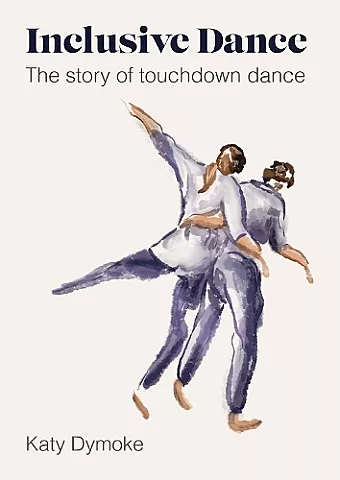
Inclusive Dance is an ethnography of disability arts, and historiographic overview of the 1980s when many new disability arts groups came to fruition. Touchdown Dance was the research 'ambition' of dancer Steve Paxton and theatre maker and psychotherapist Anne Kilcoyne, involving visually impaired and sighted adults in Contact Improvisation - a dyadic movement form requiring physical contact. Katy Dymoke took over Touchdown Dance in 1994 and refers here to archives, accounts and personal experience to share the learning that has been shared over the years to today.
Touch and movement are vital for accessibility and inclusion and modality specific approaches were devised to ensure a democratic process towards the inclusion of visually impaired people in a pro-touch activity. The continuum of movement based methods fills the gaps in polarities of visual and nonvisual and a two-way membrane interlinks all the participants in a body focused learning experience. The mutable membrane becomes a heuristic device for the relational realm, a locus for debate, for change. Touch deprivation, exclusion and inequality are the consequence of an inaccessible visually dominant society.
Three point of view chapters - from two visually impaired and one sighted company dancer - further describe the performance work, revealing how lives are changed and why sociocultural inclusion is imperative.
'Inclusive Dance reinforces a critical argument made by many CI (Contact Improvisation) practitioners and performers: that touch is imperative. Dymoke further bolsters this point by stating that touch is a necessary access technology for blind and visually impaired people and is a device that enlivens our social capacity for intentional inclusion and relational encounters. Dymoke offers a generous input to the field of disability dance, where disabled voices remain under-represented and pedagogies and instructional methods require varying and updated contributions.'
-- Elisabeth Motley, Dance ResearchWithin the broad sweep of dance histories, we can overlook the complexity of how truly innovative practices emerge. This is a wonderfully in-depth account of Dymoke’s journey and the network of people (Paxton, Kilcoyne et al.) and events that led to the formation of Touchdown Dance and its concomitant breakthrough in inclusive pedagogy and praxis (which reached far beyond work with blind dancers). In a post pandemic era, it is also a timely reminder of the importance of touch and of the responsibility and role of dancer as researcher to question, explore and extend the boundaries of what we are told is possible. -- Adam Benj
ISBN: 9781789388367
Dimensions: 244mm x 170mm x 20mm
Weight: 612g
380 pages