The Economy of the Later Roman Province of Third Palestine
Format:Paperback
Publisher:Archaeopress
Published:18th Jul '24
Should be back in stock very soon
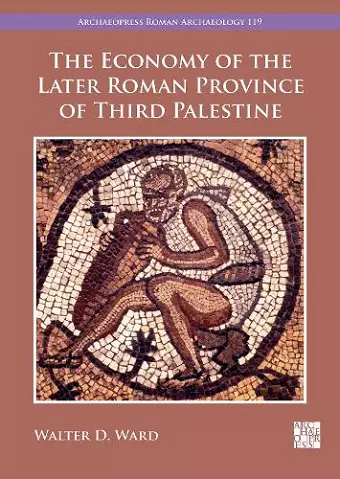
This book provides a comprehensive examination of the evidence for the economy of the later Roman province of Third Palestine, which roughly corresponds to southern Jordan, the Negev desert in Israel, and the Sinai Peninsula. It begins with a discussion of the historiography and attempts to create modern models (cliometrics) to explain the ancient economy. After covering this foundational material, the author uses archaeological data, papyri, and literary sources to understand agriculture and pastoralism in the largely arid province, and he examines the limited evidence for the urban economy and industry, focusing on ceramics and copper production. The next chapter looks at regional trade in the province by plotting the finds of four amphorae types and also examines the trade in fish from the Red Sea through faunal remains and papyri. The chapter ends with a discussion of the date trade and the records of a particular caravan described in the Nessana papyri. The focus then shifts to the role of international trade, including Red Sea trade through the port of Aila and trade with Mecca. Next, the economic impact of monasticism and pilgrimage on the province is appraised. The final chapter critically evaluates the role of economic modeling and quantification for understanding the economy of Third Palestine. It argues that the ancient economy was neither primitive, nor modern, but something unique that should be approached without introducing contemporary assumptions.
‘Overall, this is a good book that provides a valuable account of the region’s economy as well as the place of Third Palestine in late antiquity in general. Ward makes full use of the diverse evidence … and brings to life many of the daily rhythms of its inhabitants. Ward’s Third Palestine is full of vitality, with significant trade and manufacturing. … If there is a quibble, it is that although he touches on the province’s relationship to the imperial centre, I think there was scope for a fuller discussion of taxation and the law.
Still, the breadth of coverage is significant, and Ward has managed to squeeze as much insight as possible from what evidence we have. To that end, Ward has managed to collect all the material we have for the province’s economy. Regarding Ward’s second goal, although he has revealed the limited role the province has played in wider discussions of the economy, I hazard that this book would be valuable to others interested in the economy of other Roman provinces, whether of the high or late empire. Indeed … Ward has done the province a valuable service. He has shown the way forward on how to integrate the varied evidence (amphorae, environmental, papyrological) to uncover details of wider import for the Mediterranean economy.’ – Conor Whatley (2025): Bryn Mawr Classical Review
ISBN: 9781803278070
Dimensions: 245mm x 174mm x 6mm
Weight: 860g
134 pages