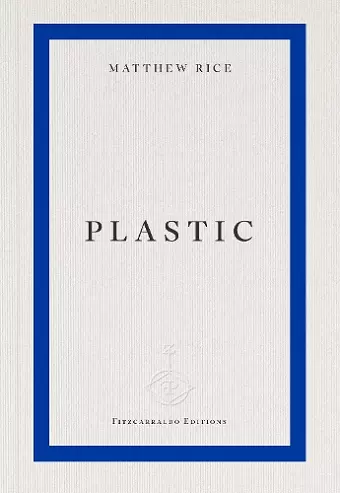
plastic
Format:Paperback
Publisher:Fitzcarraldo Editions
Published:29th Jan '26
£12.99
Available for immediate dispatch.
Shortlisted for the 2026 PEN Heaney Prize for Poetry.
Set during a single twelve-hour night shift in a factory, plastic is a book-length poem exploring the life of the industrial worker turned poet.
Bringing together memoir, ekphrasis and satire, Bplastic is based on Matthew Rice’s experience working in a plastic moulding factory for ten years. Illustrating alienated twenty-first-century Irish labour in poetic form, plastic engages with the inflictions and implications of a ‘post-industrial’, ‘post-Troubles’ society, all while weaving in depictions of factory work from literature, film and the visual arts.
Time-stamped to highlight the claustrophobia of the worker’s experience, this is a poem about feeling a calling while being submerged in the world of menial labour – making plastic airplane parts by night, making poetry by day, uniting what Jacques Rancière calls the ‘labourers in love with the intellectual nights’ and those ‘intellectuals in love with the toilsome and glorious days of the labouring people.’ plastic’s evocation and lucidity moves with grace through working class realities and hopeful imaginings.
'Matthew Rice’s plastic, set during a single twelve-hour shift in a plastic moulding factory, finds space in the routines of physical graft for poems that slyly challenge the very notion of “poetic” subject matter. Random thoughts and snatches of song lyrics or poems sit alongside vignettes of fellow workers and wider considerations of social reality and historical dissonance. Altogether, plastic offers a time-stamped, vigilant, orchestral portrayal of a mind at work.'
— PEN Heaney Prize for Poetry
’Each of the poems has a timestamp title – we’re watching the clock. But the poetry is far from dreary. There’s beauty… There are good jokes too… plastic is a genuine original.’
— Graeme Richardson, The Times
‘This sardonic, bleakly moving book interrogates ideas of working-class masculinity and intergenerational trauma, with “hell as an idea of what work could be”; there are glimpses of hope in poetry itself, “the treasure buried in my father’s field”.’
— Jennifer Lee Tsai, Guardian
‘Whether Rice is observing the enforced machine-order of the production line, evaluating his own thoughts about cinema, music and literature, or empathising with the other workers, each individual short poem is a cherished fragment of perception seeking a moment of freedom from the tyranny of its time-stamp... [T]he poems in plastic both honour and transcend their traditional factory setting, and remind us of how much there could be to gain in the dawning digital era.’
— Carol Rumens, Guardian
‘In Matthew Rice’s furiously everyday and erudite book, all senses of plastic are in play, but this is first of all a (seemingly autobiographical) study of the rigours of work in a plastics factory in the poet’s native Northern Ireland…. In the end, [plastic] is also a poem about knowledge and art: the words and music and imagery that live alongside the night’s labour, that make it bearable and at the same time highlight its violence.’
— Brian Dillon, 4Columns
‘With cutting, spare elegance, passages of the long poem tangle with the complex and violent implications of petrochemical supply chains. I kept returning to this line, so apt for plastics: ‘I wonder for a moment if preservation means perishing in increments.’
—Frieze
‘Singular and Moving; Rice is a true inheritor of Hattersley, or Voss; here is the extraordinary ordinary, the real work of real people, sat alongside, and sung, and celebrated’
— Andrew McMillan, author of Pity
' ...at the heart of plastic is a commentary on the relationship between the working-class and their work, and the politics of artistic production outside of work.... In a time when our working lives appear on the verge of being fractured by new technologies like AI, works like plastic show how the worker can attempt to take hold of their own creative agency.... While Rice may have found his own creative fulfilment in creating the work itself, whether compensated well or not, it’s at 08:00, at the end of the shift, when we are met with the most sobering of plastic’s timestamps: ‘who knows who I wanted to be in that past whose future never came’. This is the line that will resonate the most with those who feel trapped by their work.’
— Jake Trelease, Tribune
‘Matthew Rice's plastic goes where poetry seldom does: the factory floor, the canteen, the night shift, and it does so astutely and with insight and grace. This is real and vital work.’
— Nick Laird, author of Up Late
‘In plastic, the hours are “bent out of time” and slowed to their minutes on a factory night shift, where workers are churned in liminal borderlands and clocked by the ever-present spectre of death. Here, the relentless and precarious cycle of avoiding getting fucked over or worse in “far too narrow” circumstances. Rice is attuned to sound, and in these moving, visceral and formally precise poems, we are given dazzling glimpses of whole worlds lying just beyond the relentless tightrope of these dented, “bastarding jobs”. At the outset, the speaker confides: “Really it’s my heart that wakes me”. In this way, genuinely beautiful moments of hope and revelation spring from cracks in the strange and ominous like sparks from a grinder: crisp packets “doin’ the tango”; a smiley on the window; twin hares in an industrial park; machinists as concert pianists in another life, another universe. Rice’s book is one of deep compassion and vulnerability. plastic is 4am light in dark times.’
— Dawn Watson, author of We Play Here
‘This is life, but not in the affirmative sense. plastic occupies the negative space between tasks, or the minutes stolen from one’s boss. It is the literary equivalent of the air within the concave plastic moulds that populate the factory in which our speaker yearns, mutters and dreams. We come to know him from the pop music, the holiday snapshots and the Arthurian romances that all march through him like a drunken parade. If Baudelaire believed that the modern man was a "kaleidoscope equipped with consciousness", then Rice has written his contemporary equivalent, iPhone in hand. A miracle of a text, proving that the centre of influence has always resided within the working person's heart.’
— Nathalie Olah, author of Bad Taste
‘Remarkable...perhaps the most realistic poetic depiction of industrial work since Philip Levine’s seminal What Work Is.’
— James Patterson, RTÉ
‘plastic confronts the daily realities of work and labour, revealing how the body endures the relentless grind. Yet within these poems are flashes of light, moments of grace and a quiet, fond sensibility. This continuous narrative offers a hopeful, heartfelt reorientation, reminding us of the vitality found in the overlooked lives of many. Surprising, tender and true.’
— Hatty Nestor, co-author of The Aching Poem
ISBN: 9781804271421
Dimensions: unknown
Weight: unknown
112 pages