Imperfect Equilibrium
Civil–Military Relations in Russian Defense Policymaking
Format:Paperback
Publisher:C Hurst & Co Publishers Ltd
Published:19th Feb '26
Should be back in stock very soon
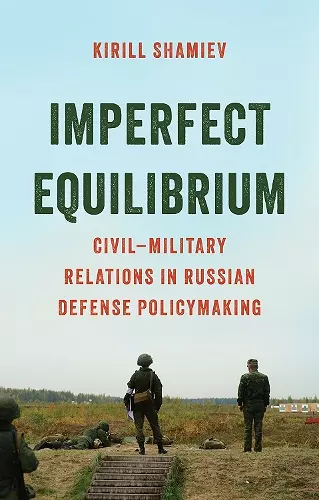
Why has Russia’s military struggled to adapt to the challenges of contemporary warfare?
Despite years of attempts to improve its military capabilities, Russia’s full-scale invasion of Ukraine in 2022 revealed a crippling lack of skill, discipline and equipment. Non-material factors, in particular the power struggle between military and civilian leaderships, have hindered reform of its armed forces: with officers dominating defense policy, the Kremlin has struggled to implement the necessary changes.
Kirill Shamiev explores the political reasons behind Russia’s poor military preparedness for the war in Ukraine. He demonstrates how a seemingly obedient military has frequently blocked civilian reforms, taking advantage of weak oversight mechanisms. The Kremlin’s efforts to centralise control and make the armed forces personally accountable to President Vladimir Putin harmed institutional learning, cementing a conservative civil–military status quo. While this protected the military from civil society interference and ensured Putin’s autocratic rule, it ultimately limited the pace and scope of change.
Analysing three cases of reform between 2000 and 2021, Imperfect Equilibrium offers critical insights into the relationship between civilian control and military effectiveness in Russia. Drawing on extensive qualitative and quantitative evidence—including interviews, parliamentary speeches, media reports and surveys—it shows how unchecked autonomy can undermine military development, even in authoritarian contexts.
‘Comprehensive.’
* Foreign Affairs *'A thoughtful and deeply researched account of civil–military relations in the post-Soviet period.'
-- Mikhail Kasyanov, former prime minister of Russia'Every army reflects the society from which it is drawn; Russia is no exception. Imperfect Equilibrium explains how conservatism, competing strategic visions, and bureaucratic infighting left Putin’s army ill-prepared for his war in Ukraine and will continue to hinder military reform.'
-- John Foreman, UK Defence Attaché in Moscow (2019–22) and Kyiv (2008–11)'A deeply insightful and illuminating account, shedding light on the important role civilian–military relations played in shaping defense reform and policymaking in Russia, from the end of the Cold War to the Russian invasion of Ukraine.'
-- Michael Kofman, Senior Fellow, Russia and Eurasia Program, Carnegie Endowment for International Peace'Timely, nuanced and compelling. Essential reading for anyone seeking to understand the Russian military and defense establishment over the last several decades.'
-- Risa Brooks, Allis Chalmers Professor of Political Science, Marquette University'Shamiev insightfully connects complex Kremlin politics to its influence on military development. This fascinating, well-researched book is a welcome addition to the field of military analysis.'
-- Dara Massicot, Senior Fellow, Russia and Eurasia Program, Carnegie Endowment for International Peace'A comprehensive account of civil–military relations in post-Soviet Russia. Shamiev's analysis focuses on the ideas, interests and identities of key actors and their impact on the performance of the Russian armed forces. A must-read for scholars of Russia.'
-- Vladimir Gel’man, Professor of Russian and Eurasian Politics, University of HelsinkiISBN: 9781805264279
Dimensions: unknown
Weight: unknown
280 pages