The Powerful Primate
How Homo Sapiens Came to Dominate the Planet
Format:Hardback
Publisher:Oneworld Publications
Published:5th Mar '26
Should be back in stock very soon
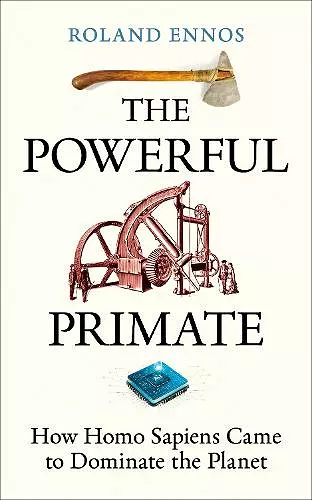
How did an ungainly hairless ape conquer the planet?
Why are humans the most feared predator in the world?
Over five million years ago, a group of primates discovered tools. Perhaps it was a large rock, ideal for cracking nuts, or a stick to extract honey from a beehive. Regardless, the future of our planet was changed forever.
Slowly, the primate evolved, abandoning the trees for solid ground and four legs for two – and the tools changed with it. Stones were sharpened, then attached to sticks, before stone gave way to bronze, iron, steel. With axes came agriculture and the first permanent human settlements, which soon became villages, towns and cities. Sticks and stones transformed into gunpowder, the printing press, combustion engine, electric light, antibiotics and finally the computer. Through sheer invention, Homo sapiens had conquered the planet.
Tracing the evolution of humans into the planet’s apex predator – the foremost ‘bullies of the natural world’ – Roland Ennos explores the miraculous and devastating power of human technology from the earliest tools to the present day.
'Ennos writes clearly and concisely and delights in suggesting that some of the ideas taught at school were wrong... an invigorating chronicle of human ingenuity... food for thought.' —Mail on Sunday
'A nimble, wide-ranging history of homo faber, skillful man.' —Kirkus Reviews
'Roland Ennoss argues that it is impossible to understand our world without recognising "the miraculous and devastating power of human technology". Building skillfully on his previous, successful books... He is excellent on biomechanics and the science of tools and machines.' —Times Literary Supplement
'A striking call to reconsider whether humanity controls energy or it controls humanity.' —Publishers Weekly
'[A] fascinating mix of anthropology, biomechanics, and history . . . Highly recommended for readers curious about human evolution.' —Library Journal
ISBN: 9781836431305
Dimensions: unknown
Weight: unknown
304 pages