Notions
The Lives of Irish Working Class Academics
Stephen Baker editor Michael Pierse editor Iona Burnell Reilly editor
Format:Paperback
Publisher:Emerald Publishing Limited
Published:19th May '26
Should be back in stock very soon
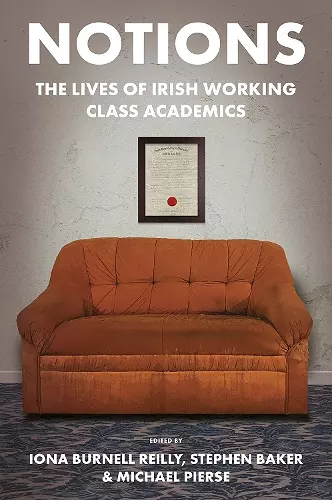
In Ireland, it is said that people with notions are acting above their station and with a misplaced sense of their own importance. Certainly, working-class academics often feel out of place at work, caught somewhere between where they come from and where they are now. To be at once working class and an academic is seemingly paradoxical, since the career assumes a moving away from one’s origins. That transition, if it is made at all, is seldom straightforward.
A series of autoethnographies from Irish academics, both at home and abroad, all of whom have a working-class heritage, these are stories of people negotiating not only class in the context of higher education, but on occasion the experience of colonialism and diaspora. Notions is a fascinating insight into the journey of working-class people through an elite and professional environment that is ill-prepared to received them, despite institutional and sectoral claims to equality, diversity and inclusion. These stories of working lives that have required struggle, resilience and ingenuity, offer important lessons for the future of a higher education sector at a watershed moment.
This is a timely and wholly welcome book which comprises a series of unique personal reflections on shared but individually distinctive career journeys made by Irish academics. These often frank and probingly self-reflexive testimonies traverse, challenge and disrupt the class boundaries and prejudices that are still a stubbornly persistent feature of higher education in Britain and Ireland in the 21st century. The book’s greatest strength is in how its contributors’ political, religious and cultural positions inflect and interrogate established assumptions about how class and ethnicity interact within third level institutions and affect the lives of their employees. At a time when universities on both sides of the Irish Sea are arguably no longer paying much more than lip service to the progressive principles of widening participation established half a century ago, the issues raised here have important implications for educational policy and practice more generally.
-- Dr Tony Murray, London Metropolitan University, UKWhat does it mean to be a working-class academic? Does such an identity even exist? What’s the trajectory from council estate to higher education? What is gained, what is lost? And how does this all play out in relation to other aspects of identity? These are all questions asked and explored in this fine collection of autoethnographic essays by Irish working-class academics.
Despite most of these stories starting in Ireland (both urban and rural areas and encompassing the Republic and the North), there is much in this collection that is relatable to my experience as a council estate kid who eventually became an academic. Many of the essays recount the lack of educational opportunities for young working-class people, the journey into higher education ‘beset by detours and dead ends’ (O’Neill), the feelings of inadequacy and imposter syndrome, the everyday classism due to broad working-class accents, the pressure to assimilate into middle-class culture and the constant pull back to working-class origins. These similarities show how class experience can translate across geographical regions, across different eras and circumstances. This is not to discount the specificity of the Irish experience though – some of the authors grew up in the shadow of sectarian violence in Northern Ireland, and others were impacted by the legacy of British colonialism both in Ireland and as members of the Irish diaspora in England, but the essays do reveal the commonalities between working-class academics around the world.
The choice of autoethnography as essay style allows for the lived experience of class to be conveyed, and it is within these lived experiences that the nuances of class emerge. As many of the authors note, while the idea of class as a concept, learnt through exposure to education can be transforming, it is through the lived experience that class is truly understood. It is the everyday that shapes us and the personal accounts in this collection build a vivid picture. Some of the essays, such as Vicky Brady’s, point to the alienating effect of higher education on working-class people because the institutions are ‘not built with working-class lives in mind’. This alienating effect also manifests in pressures on working-class academics to distance themselves from their class backgrounds, creating, what Stephen Baker describes as ‘dislocation’. But amid these negative impacts are the acknowledgements of the important of working-class voices and what they bring to the institutions. As Sorca McDonnell outlines, working-class people bring ‘cultural wealth’ to the places that they work and ‘care, empathy and solidarity’. Sheila Gaffney also points to the richness of storytelling and Michelle Kinsella champions the inclusion of anecdotes to illustrate the transformative effects of education.
Many of the authors find themselves drawn to the work of Bourdieu, which is understandable because ideas of cultural capital, of habitus, and of cleft habitus are very common to the experiences of working-class academics. This comes through strongly in the essays. Marcus Free writes about his ‘secret guilt’ as a ‘class defector’, and Kieran McCartney describes the disconnect he experienced as child, growing up on a council estate, but holding middle-class values, inherited from his mother. Keith Murphy recounts the accentism he experienced as a student with a broad Dublin accent, and his attempts at mirroring the middle-class students in order to fit in. Deirdre O’Neill relates these feelings of not fitting in to those of the Irish diaspora in England – who were not always welcomed. Being a working-class academic can feel like being a member of a group that isn’t accepted for who they are and the culture they bring.
Some of the authors, such as Declan McKenna, don’t work in academia – and still feel uncomfortable with the ways in which higher education leads to changes, but others such as Aaron Edwards, state that eventually, their working-class experience became an asset in the work that they do.
These essays are heartfelt and genuine, they provide the reader with an accessible way in to understand the experiences of being working class in a higher education setting, both as a student (with many of the authors experiencing that rocky road to education mentioned earlier), and later as an academic. It isn’t easy – but as the essays show, amid the imposter syndrome, the lack of belonging and the impact of the cleft habitus, being a working-class academic also means possessing a wealth of experience, of strong working-class values such as community, collectively and solidarity and using this to inform teaching, research and the other work we take into the world. And sometimes something small makes it all worthwhile. Recently a student came to speak to me after a lecture. She was in tears. I had included some images of my old council estate on the slides, and spoken about the place that had made me. The student is from a similar high-rise estate in Sydney, and she had never heard anyone speak positively about council estate life. It was a transforming moment for her – suddenly she saw someone with a background like her, doing a job that she thought she’d never be able to do. My working-class background - my working-class identity was the connection, and maybe one day, that student will be doing the same thing for her students. This book shows the importance of talking about working-class experience and of demanding working-class presence in the academy. The authors show why they deserve to be there and the difference they have already made.
-- Dr. Sarah Attfield, Senior Lecturer, Creative Writing, University of Technology Sydney, AustraliaNotions: The Lives of Irish Working-Class Academics’ is a significant, timely, and very important book. Edited by leaders in this domain, Iona Burnell Reilly, Michael Pierse, and Stephen Baker, the volume features the critical autoethnographies of 11 authors who identify as having an Irish working-class background. This collection is courageous, compelling, and wonderfully challenging.
Social class remains a highly contested subject. In the context of what we know about the frequent invisibility of (and silence about) class and related discrimination in, though, and resulting from education, this provoking collection demands our attention to social class as a central structuring and consequential device. The focus is the contributing authors’ journeys to becoming an academic as people of Irish and working-class heritage. This book is not an analysis of social class-based inequalities but instead invites the reader to critically engage with these individuals’ lived, classed experiences through an autoethnographic approach in which relevant concepts and theories are interwoven to interrogate and understand life experience.
Whilst drawing on other aspects of their identities, such as religion and gender, each author reflects on what social class means to them relative to the circumstances of their own lives. It is interesting – but unsurprising given previous research on the matter – that most of the authors continue to identify as working class ‘despite’ becoming an academic, thus existing in highly liminal spaces. Given suggestions that engaging in higher education even as an undergraduate student ‘makes one’ middle class, maintaining a working-class identity as an academic demonstrates the strong and long-lasting influence of one’s social background. Despite evidence of the ‘suffering’ that Bourdieu predicted would result from the habitus clash involved in working in a profoundly (upper?) middle class culture as someone with working class heritage, the contributors’ rich narratives clearly demonstrate that becoming an academic does not necessitate relinquishing one’s class of origin.
Compelled to engage via the brave, often highly personal, and revealing accounts of life that reveal the long-lasting marks of structural inequalities in society, the reader gains unique insight into navigating an elitist and classist system. We see what class means and examples of how it is being lived in Irish and Northern Irish contexts, illustrating the impact of the complex particularities of Irish social, cultural, and political history, including in a post-colonial context. We see identifications, disidentifications, and confused identifications, and how class happens for people on symbolic, relational, and interactional levels helping us to better interrogate the personal-theoretical nexus. We see the complexities of lived classed identities, as we read of people still trying to work out their ‘place’, as they weigh up the relative role of materiality and wider influences on one’s original and emergent positionality. We see life examples of the highly classed mirroring, chameleoning, and distancing behaviours reported in the empirical research literature, with which so many of those from working class backgrounds are familiar, that are often necessary to navigate structural exclusion. We see, hear, and bear witness to the refusals, resistances, and victories upon which the contributors reflect in recounting their trajectories. We see the significant resources, assets, and ‘funds of knowledge’ that those of working-class heritage bring to academia and beyond, enabling us to continue to challenge and resist dominant deficit discourses about working class ‘inferiority’. Knowing that the personal is political, the volume demonstrates the myriad ways in which these domains are inherently intertwined, as well as the material and emotional effects of class structures and processes.
Burnell Reilly, Pierse, and Baker’s volume hits your core; irrespective of your ‘place’ in classed society, it is simultaneously refreshing and provoking, underscoring the travesty (and irony) of the exclusion of social class as a prohibited discriminatory ground, in legal terms, in both Ireland and United Kingdom. This collection will undoubtedly appeal to many, including the academic community across diverse disciplinary areas and to all those interested in and oriented towards equality and social justice outcomes in and through education.
-- Professor Elaine Keane, School of Education, University of Galway, IreISBN: 9781837080373
Dimensions: 229mm x 152mm x 12mm
Weight: 338g
232 pages