Policing Northern Ireland
Format:Hardback
Publisher:Taylor & Francis Ltd
Published:1st Nov '05
Currently unavailable, and unfortunately no date known when it will be back
This hardback is available in another edition too:
- Paperback£43.99(9781843920724)
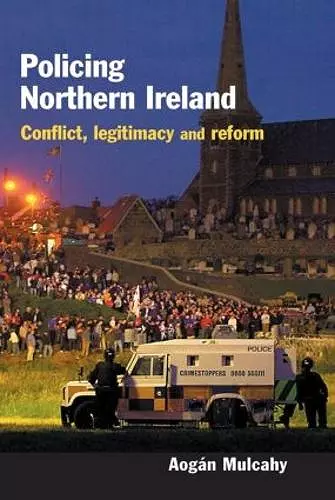
This book provides an account and analysis of policing in Northern Ireland, providing an account and analysis of the RUC (Royal Ulster Constabulary) from the start of 'the troubles' in the 1960s to the early 1990s, through the uneasy peace that followed the 1994 paramilitary ceasefires (1994-1998), and then its transformation into the Police Service of Northern Ireland following the 1999 Patten Report. A major concern is with the reform process, and the way that the RUC has faced and sought to remedy a situation where it faced a chronic legitimacy deficit.
Policing Northern Ireland focuses on three key aspects of the police legitimation process: reform measures which are implemented to redress a legitimacy crisis; representational strategies which are invoked to offer positive images of policing; and public responses to these various strategies. Several key questions are asked about the ways in which the RUC has sought to improve its standing amongst nationalists: first, what strategies of reform has the RUC implemented? second, what forms of representation has the RUC employed to promote and portray itself in the positive terms that might secure public support? third, how have nationalists responded to these initiatives?
The theoretical framework and analysis developed in the book also highlights general issues relating to the implications of police legitimacy and illegitimacy for social conflict and divisions, and their management and/or resolution, in relation to transitional societies in particular. In doing so it makes a powerful contribution to wider current debates about police legitimacy, police-community relations, community resistance, and conflict resolution.
Policing Northern Ireland is an outstanding contribution to the scholarly literature on policing, leadership, and peacebuilding. Providing security is one of the essential functions of police and essential in a post-conflict society. While many have maligned the Northern Ireland peace process for not overcoming historic sectarian divisions, Murphy and White explain the difficulties and complexities of reforming or reformulating security services that are much more effective in providing public safety to Catholic and Protestant communities. While Catholics historically despised the RUC and Protestants were reluctant to reform it, the PSNI has been an imperfect means of transitioning toward a more effective cross-communal police service for Northern Ireland. The difficulties of achieving this goal are still present 25 years after police reform and reflect continuing difficulties in transcending the sectarian divide in post-Agreement Northern Ireland.
Professor Timothy J. White, Xavier University, USA
Drawing on their deep scholarship on policing in conflict and post-conflict societies, Murphy and Bonnan-White offer a compelling account of the transformation of policing in Northern Ireland. Their expertise in leadership and organisational change shines through, illuminating how institutions and individuals navigate political turbulence, contested legacies and the demands of reform. Rich in evidence and insight, this is a book whose lessons extend well beyond Northern Ireland, speaking to some of the most difficult challenges facing policing and its leadership.
Professor Siddhartha Bandyopadhyay, Director, P-ACE LAB- The Policing Academic Centre of Excellence, Leicester, Aston and Birmingham, University of Birmingham
This fascinating book explores the shifting nature of policing in Northern Ireland over the past 25 years. Drawing on extensive documentary evidence and first-hand accounts, Murphy and Bonnan-White reveal the complexities and ambiguities of leading change in action. Although grounded in a specific context, this book should be of far wider interest and relevance to anyone seeking to understand how organisational and cultural change can be advanced in contexts of conflict and contestation.
Professor Richard Bolden, Bristol Business School, University of the West of England
ISBN: 9781843920731
Dimensions: unknown
Weight: 600g
240 pages