Vermeer
A Life Lost and Found
Format:Hardback
Publisher:Penguin Books Ltd
Published:23rd Oct '25
Should be back in stock very soon
The Times Art Book of the Year
A Guardian Book of the Year
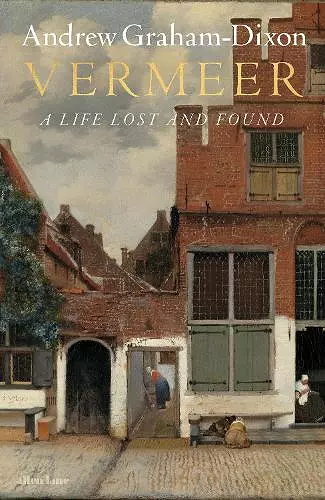
The paintings of Johannes Vermeer of Delft are some of the most beautiful, even sublime, in the history of art. Yet like the life of Vermeer himself, they are mysterious and have for centuries defied explanation. Following new leads, and drawing on a mass of historical evidence, some of it freshly uncovered in the archives of Delft and Rotterdam, Andrew Graham-Dixon paints a dramatically new picture of Vermeer, revealing many of the painter’s hitherto unknown friendships as well as his previously undetected allegiance to a radical movement driven underground by persecution.
He also vividly evokes the world of the Dutch Republic as it was in its so-called Golden Age. This was a watery world of fortresses and flood plains, taverns rocked by argument and cities stunned by devastating attacks and explosions: all linked by a network of canals where a uniquely efficient public transport system, operated by horse-drawn passenger barge, enabled people, goods and ideas to glide effortlessly from one place to another. The author sets Vermeer firmly in the context of his time, revealing the patterns of patronage that make sense of his work, and also exposing the difficulties posed by his home life, which was dominated by his Jesuit mother-in law and disturbed by the psychotic behaviour of her only son.
In the past Vermeer has been imagined as a remote and enigmatic figure, but he emerges from this new account as a man deeply engaged with his own society: well-travelled, a reader of books, a man personally connected to many of the most interesting people of his time, including merchants, philosophers, preachers, bankers and regents, as well as his childhood friend, a philanthropic baker named Hendrick van Buyten. Vermeer was also deeply affected by the struggles that shook his world, the Eighty Years War for Dutch independence and the yet more terrible Thirty Years War, which ravaged the neighbouring German lands and resulted in the deaths of millions. The author shows how he was moved to become a pacifist by such atrocities, and thereafter made many of his closest friends in the ranks of Europe’s first peace movement. A further revelation is that Vermeer’s closest collaborator...
Vermeer: A Life Lost and Found is a powerfully persuasive investigation into the intellectual and devotional world of Vermeer and his circle. Painting by painting, the riddle of the Sphinx is masterfully unravelled ... [Andrew Graham-Dixon] trawls the archives, lays out new evidence, links pictures never linked before, and teases new meaning from signs, symbols and sitters ... His reading of the paintings is revelatory -- Laura Freeman * The Times *
Densely researched and highly original .... this book is an extraordinary portrait, flooded with light and colour, and a splendid unfolding of the pressure of meaning in everyday life; in other words, it emulates the special charge of Vermeer’s paintings -- Kathryn Murphy * Literary Review *
Graham-Dixon puts forward a revolutionary theory... Right, or wrong, it is a theory that will change the way people look at that famous pearl earring, as well as at the painter’s other luminous portraits of lone women -- Vanessa Thorpe * Observer *
With the skill of a good showman and the meticulousness of a scholar, [Graham-Dixon] .... sets out to illuminate the elusive life of Johannes Vermeer [and] to solve the riddle of the ''Girl'' herself .... In his quest to decode Vermeer's work, he draws together a piercingly analytical gaze and some well-informed speculation ... There are few better writers to take on the task -- Evgenia Siokos * Telegraph *
Andrew Graham-DIxon is that rare thing - a tireless scholar and critic who looks beyond the analysis and appreciation of art into its very soul ... [his] book seems to be driven by what other works on the artist lack: passion. Anyone who loves art with warm to the beguiling, personal nature of this beautifully written narrative ... this is art history as an imaginative leap into a world in which the enlightenment was the only bulwark against chaos, and toleration was - and still is - necessary for civilisation. -- Bel Mooney * Scottish Mail *
Eloquently argued, engagingly written and ultimately rather moving -- Michael Hall * Country Life *
Challenging existing scholarship, Graham-Dixon has a radical new sense of
Vermeer [that] focuses afresh on the artist’s social networks and the history and religion of the Dutch Republic
Graham-Dixon is an experienced and diligent writer on art, and the book contains much absorbing factual information about Vermeer's mysterious life and his circle ... [it] attempts to return Vermeer to his own period -- Philip Hensher * Financial Times *
This book is going to revolutionize the way we understand Vermeer. I read it slowly, feeling 'like some watcher of the skies when a new planet swims into his ken'. How extraordinary to realise that things are not the way you have imagined all your life -- Peter Carey, twice winner of the Booker Prize
This is a phenomenal book. The research and originality are staggering, suddenly creating a coherent character simply out of understanding the religious, social and political setting properly. I was utterly absorbed by it -- Diarmaid MacCulloch, author of Lower than the Angels
ISBN: 9781846147104
Dimensions: 241mm x 164mm x 40mm
Weight: 734g
416 pages