The Hundred Thousand Places
Format:Paperback
Publisher:Carcanet Press Ltd
Published:28th Nov '09
Should be back in stock very soon
To walk through a landscape is to be part of a slow unfolding of time and distance, to commit yourself to an adventure. The Hundred Thousand Places is a single poem that travels across seasons, through a variety of Scottish highland and island landscapes, from dawn to dusk. Make an early start, 'feel your way out / into what might…take form'. It is a long walk, along the coast, over mountain and moorland, through pine and birch forest, ending on a shore where the sea offers 'another knowledge / wild and cold'.
Attentive and responsive, the unhurried pace of Thomas A. Clark's writing draws the reader into a shared journey, pausing on the possibilities of a phrase, the music of the names of trees and flowers, or turning the page to open new horizons.
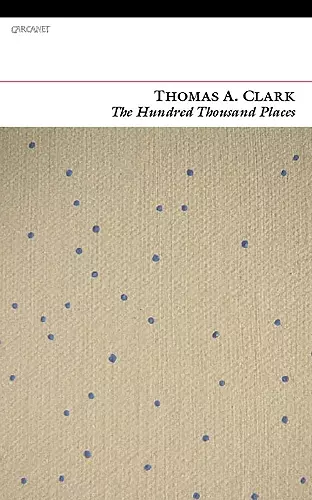
Cover painting: One Thousand Blue Places (detail) by Laurie Clark, reproduced by kind permission of the artist. Cover design by StephenRaw.com.
Poetry offers a haven of calm amidst all the bustle - Rosemary Goring
Reading Thomas Clark's new poem, the book-length 'A Hundred Thousand Places', on a Christmas commuter train was perhaps not the ideal environment. And yet, in many ways it was perfect. As parcels swayed on the overhead racks and the trilling of phones cast a festive air over the carriage, the sense of windswept tranquility that rises from Clark's pages was a haven. In the midst of frenzy, he proffered calm. In a week of hectic activity and consumer panic, he opened a door to the sort of solace weary travellers would be seeking from a bottle before the night was done.
Clark's crucible is the natural world, the more remote the better. As this poem charts his progress through various landscapes, across the span of day into night, Clark's spare, almost spartan stanzas cut to the bone of the heath, woods and seascapes he roams. These spaces go far deeper than human history and may even, he hints, hold their own spirits:
'by the roadside
a wood
carpeted with wintergreen
wind in the high branches
stillness over moss
before you came here
was there dancing
and are the lugubrious
elders of the wood
pausing'
There's a hauntingly lambent quality to Clark's words, and a rhythm that stops just short of hypnotic.
Richard Price's collection, Rays, is a more playful affair, coloured by a strong vein of wit, romance and tenderness. The opening poem about insomnia, titled 'the thoughts keep coming' combines melancholy and frustration with an irrepressible urge to make puns and recast cliches:
'The night's A-Z is stuck at Why.
Anyone know Zed street?
''In your dreams.''
A stylish stylist, Price roams lightly over the realms of love, passion and work. In some moods he's reminiscent of Norman MacCaig, as in the miniscule poem 'Wren':
'A tidy wren, tiny apron on,
spot-checks the garden.
Not a speck-
she's gone.'
Elsewhere he plays with form, moulding his own voice from traditional shapes, be they haikus or sonnets. While some of these poems work like a bullet to the heart, others need patience for their meaning to emerge. This is an intriguing, if occasionally opaque collection, and as with Thomas Clark, Price's work cries out to be read again and again.
The Hundred Thousand Places, inspired by walks across the isles and highlands, is a single poem in three parts. Time unfolds gradually in Clark’s verse. His short stanzas, some only a few lines long, illustrate a slow gathering of thought. The collection begins in the isles, at dawn: 'once again/for the first time/morning'. Descriptions of sea mists, salt winds and sand bars transport the reader. The second section begins inland and guides the reader along the ground. Bracken, mica and thorns suggest the rough moorlands. The final section shares the first’s air of discovery and the second’s earthiness. The narrator climbs a summit, confirming his sense of self and his relationship to the land. What’s good about this collection is how the form is based on the narrator’s sense of direction. Clark is very aware of where his narrator is going: 'you are not where/you are not there/ahead of the given/in continual revelation'. His use of second person also creates a sense of freedom and distance. Space, pace and wild beauty are on the reader’s mind throughout this tantalising collection. TM
Clark is an installation artist whose book-length sequence The Hundred Thousand Places explores the landscape round Pittenweem on the Fife coast. There is little of Wordsworth's egotistical sublime on show here. The only thing between my goal and me is me, Woody Allen joked, and Clark is at pains not to allow the observing 'I' to impose itself on the scene: 'do not speak /your name here', 'a breath is enough', 'brightness / takes your place'. Instead, self and landscape appear to fold into each other seamlessly: 'what you see / you will become'.
Here are redshanks, plovers and lapwings, but not one instance of the first-person pronoun in all the book's 96 pages. The use of 'you' instead might be simple displacement, but abets the underlying project of self-dispersal. Joyce's explorations of the unconscious in Ulysses have been compared to turning the light on fast enough to try to see the dark, and something of the same paradox informs Clark's quicksilver quest:
you are not where
you are but there
ahead of the given
in continual revelation
Perhaps the Wordsworthian note is not so easily banished after all ('it has taken half a lifetime / to learn to sit in the sun'), but The Hundred Thousand Places stands at a tentative and oblique angle to the more established modes of pastoral writing. There is a beautiful moment in George Oppen's 'Psalm' when he exclaims of some deer, 'That they are there!', and the fact of the natural world's being there at all supersedes the need for description. There is plenty of description in these poems, but they too converge on a place of revelation whose name is simply 'there'.
Spring 2010
Thomas A Clark has produced a book-length poem of genuine visionary intent. Elegantly typeset, The Hundred Thousand Places invites reading in a single sitting. It also invites incantation; Clark has spoken of his poems generating 'small harmonies which attune our ears to harmony' (Oxford Poetry, VII.3). The natural world is glimpsed in fragments of language aspiring to the quality of music:
between sea and sky
drifts of bugloss
a blue butterfly
lifting from the lyme grass (p.20)
Clark's subject matter is the dramatic, windswept landscape of the Scottish highlands, his methodology that of walking, looking and listening. I use the term 'methodology' deliberately; in its studied minimalism, there is something of the chemical formula or mathematical equation about his poetry. The material world is observed not as a site for personal revolution but as the theatre of cause-and-effect.
the rock by the water
broken by bracken
tormentil and heather
releases colour(p.40)
[...]
from rock
heather
from astringency
colour (p.41)
Thomas A Clark's poetry often appears as installations in galleries and public spaces. He shares the visual artist's concern with the act of seeing. Sometimes landscape is presented as a kind of devotional act. Perception is invariariably guided by light.
in the gloom the eye
flies to light
to light on a branch
and pause(p.58)
The conceit of this reputation of 'light' renders vision an active force, which not only captures but alters subjective reality. Throughout this poem, we negotiate a path between perception as a passive and active process. Landscape is constantly in flux, moving in and out of focus:
a plane
of appearance
where nothing is deferred
lacking depth(p.22)
At times, the reader is led through what appears to be an illusory topography, revealing computer-generated vistas, a world created by and for the viewer's presence.
if you stretch out
in the long grasses
your weight is distributed
over the headland
to rest as lightly
on the crushed grasses
as sky on sea(p.26)
If there is any sense of progression in this poem of walking, then it is towards a recognition of the individual's immersion in the elements, in 'constantly/ spilling water' which 'pours around you'.
you are the first
thing the wind meets
as it whistles up
the side of the mountain
rocks, trees
mountains
solitary persons
swept up
in the wind(p.47)
Occasionally Clark tends towards a naïve (perhaps deliberately naïve) representation of the interaction of human and landscape. Scree is 'innocent/ of incident'; a hill-walker is 'free of concern'. Whilst these lines seem to sanction a nostalgic, idealized position (landscape as therapy), the poem is no thesis. Later, the poet is more pragmatic:
it was not your
intention to bring
all your resources
here but you do (p.69)
The Middle English dream vision Pearl is brought to mind as a poetic forebear, both for its unashamed delight in language and landscape, and for its tendency towards philosophical inquiry. The language of delight is, in fact, one of several registers in The Hundred Thousand Places; each moderating the others. Clark is particularly skilled at a kind of deadpan abstraction. For instance:
whatever is lifted
by the wind is dropped
again into a calm
slightly ahead of itself(p.35)
That 'slightly' is right on the mark, illustrating the precision of Clark's writing [...] The Hundred Thousand Places realigns our understanding of the lyric voice and of its investment in the natural world.
ISBN: 9781847770059
Dimensions: 216mm x 135mm x 10mm
Weight: 136g
80 pages