Hitting the Streets
Raymond Queneau author Rachel Galvin translator
Format:Paperback
Publisher:Carcanet Press Ltd
Published:25th Jul '13
Should be back in stock very soon
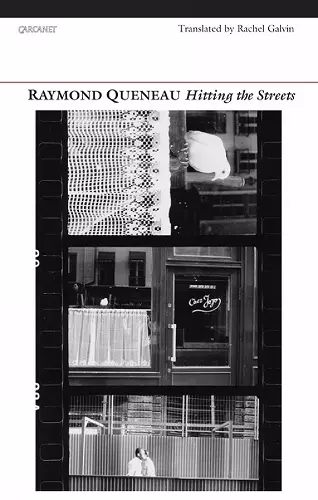
Unreeling like a series of film clips recorded during a stroll through Paris, Raymond Queneau’s Hitting the Streets is wickedly funny. It is also a bittersweet meditation on the effects of time and memory. Hitting the Streets is Queneau’s love letters to Paris – a Paris that is always in the process of becoming obsolete. This lively, idiomatic version is the first complete translation available in English.
'Galvin's electrifying translation forms an exemplary point of departure for the rediscovery of Queneau's poetry.'
David Wheatley, Poetry Review
'I promise you'll love this, especially if you love Paris.'
Nicholas Lezard, the Guardian
'Rachel Galvin has met the challenge of Queneau's difficult language with extraordinary aplomb and agility, finding equivalents for the poet's elaborate puns, rhymes, double entendres, and neologisms, even as she keeps intact the colloquial suppleness and playful street slang of Queneau's poetry. Hitting the Streets is an enchanting book, guaranteed to make you smile in recognition.'
Marjorie Perloff
'Galvin has caught the verve of the language while also retaining its sound-play – a remarkable achievement – resulting in a stunning book that brings both Paris and the cultural power of language into vivid focus.'
Cole Swensen
'I promise you'll love this, especially if you love Paris.'
Nicholas Lezard, the Guardian
'This book changed Parisians' view of their city and fertilised French poetry as few others have. A book of daydreaming and flnnerie, it's absolutely worth hitting the poems' pavement, getting the lay of its loopy land, and sailing away.'
Paul Fournel
'I promise you'll love this, especially if you love Paris.'
You have to love an Oulipian. These were, or are, the writers who, as Queneau himself put it, are rats who build the labyrinths they try to escape from. You know, writing entire novels without the letter E, or telling the same very banal story (about a young man in a silly hat getting jostled on the bus and then being seen in a park a couple of hours later; really, it is banal) in 99 different ways, many of them absurd (and very funny). That latter wheeze, Exercises in Style, was Queneau's; and he co-founded the movement – whose name is short for ‘Ouvroir de littérature potentielle’, or ‘potential literature workshop’ – when he asked a mathematician for help in composing his work Cent mille millard de poèmes. This involved each line of 10 different sonnets being printed on its own strip of paper, so that one hundred million million poems, give or take a million or so, can be constructed by the reader.
No such japes in this volume of poems, though – just an enormous number of headaches for the translator. But it is fun for the reader. In one of his poems, just four lines long, Queneau sets a number of traps, punning on, to take one example, different meanings of ‘fils’ (son, or wires, take your pick), and ends with the challenge: ‘allez me traduire ça en anglais!’ Which Rachel Galvin, naturally enough, renders as ‘go translate that into French for me!’
It's the spirit you have to get into above all here, and Galvin knows it. As she points out in her excellent introduction, Queneau's most famous work (and the one that released him from half a century of financial anxieties), Zazie dans le métro, begins with the word ‘Doukipoudonktain’. Fancy a stab at that? She also coins, in an attempt to translate the portmanteau word ‘fientaisie’, the fantastic word ‘whimsicrap’, which I have a feeling is going to come in very handy for us all.
So it is as well that this book comes with the French, too. Queneau was one of those writers who knew pretty much everything there was to know about literature, but he also loved word games, and the language of the streets. These combined to produce this book, which contains about 150 poems, almost every one of which is a love letter to Paris. Though maybe ‘love letter’ isn't the right phrase to describe ‘Un beau siècle’ (‘One Fine century’), which goes ‘Conneries des années 1900 / Connerie de la belle époque’ (‘stupidity of the 1900s...’ etc) all the way through to the year 2000, even though the book itself dates from 1967. (‘Conneries’ is rather stronger than ‘stupidity’, but we don't have a word for it.)
But the thing I most want to impress upon you is that just about every single one of these poems is a delight – the kind you want to show to people. There is a very impish, almost mischievous sense of humour at work here; you get the impression that Queneau would have been a delight to meet and get to know. I'm thinking of ‘There was a Waterloo Passage / it's been demolished / it's just that we're patriots in Paris’, or ‘Advice for Tourists’, which lists, as attractions near the Boulevard Sébastopol, the Acropolis, Whitechapel, the Kremlin, the Pentagon … I could go on and on.)
Galvin quotes another Oulipian as saying ‘since Baudelaire, poetry has explicitly loved the big city’, and Hitting the Streets is an extension of that project – especially as incarnated by the work of Apollinaire, who also made extremely witty and readable poetry out of avant-garde forms. Paris seems particularly suited to this kind of project; and Queneau is particularly good at it. The city becomes anthropomorphised, or at least given a vibrant and inimitable character; even its flies are, if that is the word, celebrated (‘The flies of today / are no longer the flies of yore / they are less cheerful’). You might balk at the idea of paying nearly thirteen quid for 197 pages of poems, and French poems at that, but I promise you you'll love this. Especially if you love Paris.
Raymond Queneau (1903–1976), French novelist, poet, and co-founder of Oulipo, was seriously comic, a friend of Surrealists, a flâneur of the unexpected, playful with language, is of the past while being (I reckon) newly very welcome again with this new translation. Cheran (b.1960), whose poems here come from three decades of writing, is Tamil, away now from the unsettled and unsettling Sri Lanka, an Associate Professor in the Department of Sociology at the University of Windsor, Ontario. His mood and mode could hardly be further from Queneau's: I hope yet again that the translation, as the Arc books in particular might be, is a transposition for healing.
Both books are bilingual on facing pages. It will not be difficult for many people to double-check Queneau's French; Cheran's Tamil is something else to Western eyes.
[...]Two Queneau poems on the same page convey his wandering around Paris:
Vaugelas Bouquiniste
EVERY BUYEROF FIVE BOOKSGET1 BOOK FREE
Rue Linné
The poor animals behind the bars of their enclosurehear all manner of jabberwhether it's in the Jardin des Plantes or the Vincennes zoowhat balderdash they give ear tothe poor animals behind the bars of their enclosuredeserve our pityfor having to tolerate so much hooeybut they go on grazing with composurethe poor animals in their enclosure
from Raymond Queneau, Hitting the Streets, translated by Rachel Gavin, Carcanet Press, 2013
The translator has over-egged the end rhymes; his third line ends with the named 'Zoo' and the fourth with 'pas comme propos idiots', neither rhyming there or elsewhere. The translator's introduction, though, embraces this possibility, of engaging with the spirit of his poems, not always strict form for form (but always neatly more or less), impossible anyway in carrying over from one language to another, and it seems reasonable to say she has caught his engaged eye and his lightheartedness. We are 'hearing' a life lived. And the notion that poetry is news that stays news is applicable here, is of the essence. And it isn't that he refers repeatedly to what a journalist would call News, though there is that for us not least in how Paris has changed - as in parallel with the poems one sees in old photographs - but that he combines the observation as he passes by, on his way it seems to nowhere else in particular, and indirectly here is History:
Jean-Girard Lacuée Count of Cessachad the right to a bit of street under Louis-Philippeto a nice avenue under Napoleon the Thirdand finds himself again under the Republicwith a modest roadotherwise known as Terres Fortes[...]
The originals throughout have no punctuation. I am not clear whether or not this is a book of the highest poetic genius - I do know it is a book I am glad to have, is unlike any other, and is one I shall treasure and return to.
Cheran's In a Time of Burning looks back from exile. Again this is poetry as News, if we can hear it, if we want to hear it; and News of a very different kind. A poem called 'Four Years':
Four Years
Once, on a dewy morningwalking along the jasmine-strewn streetI stopped short, hearing you cough:that memory will last to eternitylike the parallel lines of our lives.
If I lived at all, it was in those moments:when the thin clouds spread graduallyinto the evening's rednessand I lay on the sand, my head in your lap,the hair curling about your earlobes,a trace of sadness in your eyes,your body yielding, your voice calling,your eyelids closing,your trembling hands tighteningabout my shoulders.In those perfect moments.
But now I stand in the coldin the middle of a long landscape:a lone palmyra tree.
from Cheran, In a Time of Burning, translated by Lakshmi Holmström, Arc Visible Poets, 2013
The translator, Lakshmi Holmström, says in her brief preface, that 'Cheran steadfastly refused to align himself with any of the political groups within the Tamil community. This has enabled him to speak out against all atrocities committed, both by the Shri Lankan army and the Tamil militants. He sees his role as chronicler and witness: the poet is often present within the frame of the poem, watching, commentating, indicting.' They are powerful poems in precisely that way, the being there or imagining being there. I can in truth say these poems are for me compelling in translation, and he is our contemporary, I should say that the book will stay with me, his poems are News that is News now, Shri Lanka is in our News. But reading his and Raymond Queneau's poems I see how culturally bound I am, where my sensibilities, spontaneously, are positioned.
[...]My impression of these two very different books, as their authors look out at their world, is of Queneau observing, engaged but from an emotional distance as well - or that his emotion is in the walking itself, in the gaze - while Cheran is having a battle of words with himself to get it clear, Shri Lanka's troubles and his own in relation to them, whether there 'at home' or in exile.
Galvin’s electrifying translation forms an exemplary point of departure for the rediscovery of Queneau’s poetry.
For Lard’s Sake
What is the shortest street in Paris? Who was Père Lachaise? There is one bronze cobblestone in Paris. Where is it located? With such questions Raymond Queneau quizzed the readers of his ‘Do You Know Paris?’ column in L’intransigeant between 1936 and 1938. Queneau’s research for his column took the form of a latter-day beating the bounds, that medieval rite of circumambulating the parish to call down blessings on it, and 30 years later he was still feeling the benefits. Introducing Hitting the Streets, her translation of his 1967 collection Courir les rues, Rachel Galvin recounts the story of Amphion, who constructed the ramparts of Thebes by playing the lyre so well the stones moved and went where he told them. Guillaume Apollinaire designated Amphion the bard of flâneurs, and christened his poems antiopées. Queneau has more than a touch of Amphion about him in Hitting the Streets, with the small difference that where the Greek bard hymned a city into being Queneau celebrates a Paris on the point of disappearance, the picaresque city captured so winningly in his novels Le chiendent and Zazie dans le Métro. There is a grimmer reaper at work here than the scissors sharpener of ‘Future Pasts’, in the form of post-war redevelopment. We are, I presume, licensed to find an irony in Queneau lamenting the ‘abolished residence’ of a line of chimney pots in a poem called ‘Boulevard Haussmann’, Haussmann having spent the mid-nineteenth century flattening what survived of medieval Paris and goading Baudelaire into the ghetto nimbyism of ‘Le Cygne’ (‘Paris change! mais rien dans ma mélancolie / N’a bougé!’).
Before the dust quite settles, much work remains to be done. These are poems of mythpoeic gusto, answering to animist impulses as deep as the Paris sewers (‘Einai gar kai entautha theous’, runs the epigraph from Heraclitus: ‘the gods are here also.’) Speaking of Apollinaire, that poet features obliquely in ‘Rue Pierre-Larousse’, which explains the identity of the Comte de Mirabeau thus: ‘Below his bridge flows the Seine.’ ‘Sous le pont Mirabeau coule la Seine / et nos amours’. Hitting the Streets is a love song to urban transience, to the woman undressing spotted from the platform of Passy Métro station and the inscriptions on a pissoir wall. In his recent jeremiad against modern life in general, Jonathan Franzen drew a distinction between the urban experience in Latin countries and that of Germany and more Nordic climes. Going to buy a loaf of bread in Lisbon or Florence is an aesthetic pleasure, conventional wisdom tells us, but doing so in Dortmund is not. Queneau’s Paris comes with plenty of imported Breton grit (he was born in Le Havre), and the jejune rhapsodies of Breton’s Nadja are notably absent (Queneau’s parting of the ways with the surrealists came early). With his love of mathematics and of that ‘dégonfleur d’enflure’ (‘detumescer’), Nicolas Boileau, Queneau may cut a forbiddingly rationalist figure. But this is only half the story, the other half being the comedic, Oulipian sower of mayhem that stalks Hitting the Streets.
Queneau tends to prefer his humour dry, but herein lurks another of this volume’s surprises. If, like me, you have previously suspected Queneau’s poems of a certain over-calculated quality (the rather contrived fun of the Hundred Thousand Billion Poems), what will most pleasantly surprise about Hitting the
ISBN: 9781847771575
Dimensions: 216mm x 135mm x 20mm
Weight: 272g
224 pages