Jacqueline Groag
Textile & Pattern Design: Wiener Werkstätte to American Modern
Richard Chamberlain author Geoff Rayner author Annamarie Stapleton author
Format:Paperback
Publisher:ACC Art Books
Published:2nd Jun '15
Currently unavailable, our supplier has not provided us a restock date
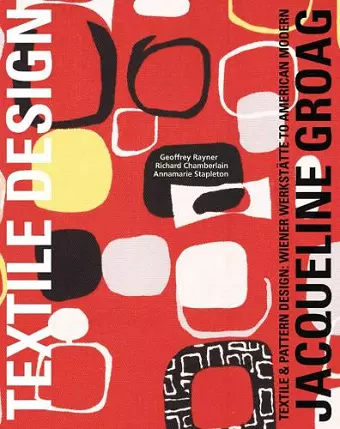
Jacqueline Groag was probably the most influential textile designer in Britain in the post Second World War era. Although originally Czech, she studied textile and pattern design in Austria in the 1920s. During the late twenties and early thirties she designed textiles for the Wiener Werkstatte in Vienna and subsequently designed and produced unique hand printed lengths of fabrics for many of the leading Parisian fashion houses, including Chanel, Lanvin, Worth, Schiaparelli and Paul Poiret. She was awarded a gold medal for textile design at the Milan Triennale in 1933 and another gold medal for printed textiles at the Paris World Fair in 1937. Jacqueline was not only a serious and highly respected contender in the field of textile and pattern design but, with her husband, the Modernist architect Jacques Groag, was also deeply immersed in the intellectual life of Vienna.
In 1938 the sophisticated world of Jacques and Jacqueline was brutally shattered when the Anschluss, the political unification of Austria and Germany, occurred and the German army entered Vienna. Faced with the actuality of the Nazi terror the Groags, who were Jewish, fled to Czechoslovakia and their home city of Prague. After a brief respite they were once more forced to flee in 1939, this time to London. On their arrival in England they were welcomed and championed by leading members of the British design fraternity, amongst whom were Sir Gordon Russell, the doyen of British architects Sir Charles Reilly and Jack Pritchard, founder of the modernist design company, Isokon. Much of the Contemporary style of the textiles and wallpapers shown at the 1951 Festival of Britain were heavily indebted to Jacqueline's influential designs of the 1940s. Many examples of her work were featured prominently at the Festival and from then on she became a major influence on pattern design internationally. She developed a large client group in the United States during the fifties and sixties, amongst whom were Associated American Artists, Hallmark Cards and American Greetings Ohio.
In the later 1950s and throughout the 1960s she became increasingly involved with Sir Misha Black and the Design Research Unit (D.R.U.), working on the interiors for boats and planes and trains, particularly the design of textiles and...
This absorbing tribute to Jacqueline Groag begs the question of how someone so significant in mid-twentieth century pattern design in Britain, can be so little heard of today." House and Garden, April 2010
ISBN: 9781851495900
Dimensions: unknown
Weight: 1100g
184 pages