Northborough Sonnets
John Clare author Eric Robinson editor
Format:Paperback
Publisher:Carcanet Press Ltd
Published:22nd Jun '95
Should be back in stock very soon
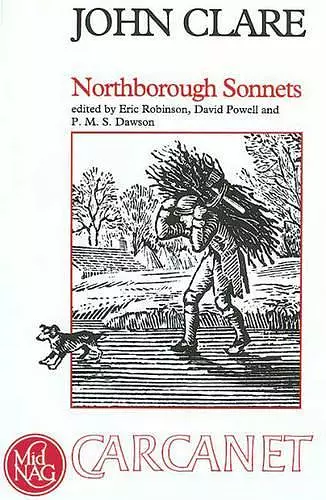
John Clare was an assiduous practitioner of the sonnet form at all periods of his poetic career. The sonnets he produced in the last few years before his institutionalisation in 1837, fist at High Beech and then in Northampton General Asylum, are of particular interest, since he exploited the inherent brevity of the form to express a simultaneous precision of observation and starkness of vision that he rarely achieved either before or after.
The present volume prints all the sonnets that Clare wrote at Northborough between 1832 and 1837 with the exception of those included in The Midsummer Cushion and The Rural Muse, both also available from Carcanet. Northborough Sonnets allows the reader to trace the development of Clare's handling of the form in this period. They constitute fascinating vignettes of rural life in the early nineteenth century and the record of a unique poetic sensibility. They are accompanied by an introduction, informative notes, and a glossary of dialect and unfamiliar words.
CONTEMPORARY REVIEW
01 JUL 96
REVIVING JOHN CLARE'S POETRY
Northborough Sonnets. John Clare. (Edited by Eric Robinson, David Powell and P.M.S. Dawson.) Carcanet Press. 9.95. ISBN 1-85754-198-7.
The Northborough Sonnets are so named because they were written in the troubled
years John Clare spent at Northborough between 1832 and 1837, by which time he
had fallen into pitiful mental disrepair and agreed to have enlightened treatment by a
Doctor Matthew Allen in his private mental home in Essex.Enlightened because
otherwise it was normal practice to whip the mentally ill, and give them straw to sleep
on.
In the Spring of 1832 the Clare family (eight children and ageing parents) moved
from Clare's childhood home at Helpstone into a bigger cottage, better able to
accommodate them in the Fen village of Northborough, which was three miles
distant.From the new cottage, Clare could see the Glinton Church spire which
brought back to him memory of his great childhood love, Mary Joyce, who lived at
Glinton.They moved just at the time Clare was in the middle of preparing his poems
for his cherished The Midsummer Cushion, which he finished in November. It was also four years since he had last visited London and met his publishers' authors; his
description of one of them, De Quincey, is a picture, not imagined.
In 1820, he had written. If my hopes don't succeed, the hazard is not of much
consequence: if I fall. I am advanced at no great distance from my low condition: if
I sink from want of friends, my old friend Necessity is ready to help me, as before.'
Later that year he married Martha (Patty) Turner.
Clare had several well-wishers and benefactors, and this support enabled his family
to move into a bigger home.Clare had also had to put up with a constant barrage of
interference, in the form of religious admonishment. from what were. after all, self-benefacting benefactors.
His mental distress had begun at Helpstone with the enclosure of common land.In,
fact, 'More than half the total acreage of Northamptonshire was enclosed by Act of
Parliament', as G. M. Trevelvan says in his English Social History (1944).The sonnet
on page 83 illumines the position of the almost outlawed country-folk from their own
countryside: the first line says.'I dreaded walking where there was no path'.In a
sonnet on page 87, he says of such enclosed land.'The smiling summer would keep
it green / But ploughs went over it as naught had been.'
At Northborough, he chose to re-work earlier, long poems into the sonnet form,
which enabled him to direct his mind within the accepted form.His other sonnets, too,
all restrict attention to the permanent and recurring aspects of natural life, which is,
one of the reasons why Clare will always be so eminently readable.
In letters he wrote between 1833 and including 1837, Clare explained that he had
been suffering severely from indisposition', unable to think to write. or to calm his
mind to read.His reaction to the uprooting had been kept at bay while he concentrated
on bringing to the end his poems for The Midsummer Cushion, in which he had his
greatest faith.The collection was unwanted.It led him to prepare a prospectus
inviting subscriptions to enable its publication, but that fell down too.In despair he
accepted £40 for the outright copyright of 130 poems which he selected from The
Midsummer Cushion: 126 were published in 1835 as The Rural Muse.It sold
dismally. The Midsummer Cushion was not published until 1979, one hundred and
fifteen years after Clare's death.It received great critical appreciation.
Northborough Sonnets are those sonnets not selected for The Midsummer Cushion
or the Rural Muse.They give the impression, due to Clare's quality of preparation,
that he intended them for another collection.They are remarkable, and possibly the
most moving of all that he wrote.Of the 213 sonnets, 80 have never been published
before in an anthology or otherwise.Now to have them all collected together is almost
certainly what the poor, sad, worsted John Clare had in mind.
Three bookmarks are recommended for the full enjoyment of this book: one to
keep one's place; another for the fascinating notes; and the third. for the equally
interesting glossary. Finally, the index to first lines assuredly marks Clare as one of
our greatest poets: each one gives a picture in itself.
RODNEY AITCHTEY
ISBN: 9781857541984
Dimensions: 200mm x 130mm x 13mm
Weight: 203g
192 pages