Second Best Moments In Chinese History
Format:Paperback
Publisher:Carcanet Press Ltd
Published:26th Jun '97
Should be back in stock very soon
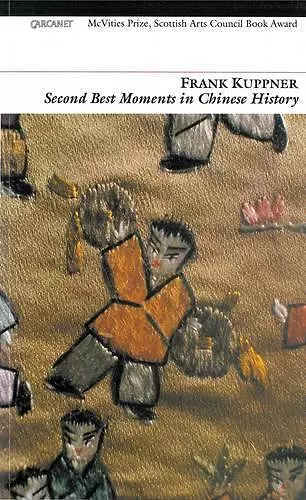
"A Bad Day for the Sung Dynasty" won the Scottish Book Council Award, 1984. Kuppner was also awarded the Saltire Prize for his fiction in 1995.
A repackaged version of Frank Kuppner's celebrated first collection "A Bad Day for the Sung Dynasty (1984)" with a different tone - something to do with maturity and cadencing, which make the laughter and heartbreak more intense, more political.The 501 quatrains of Second Best Moments in Chinese History make it seem at first like a repackaged version of Frank Kuppner's celebrated first collection A Bad Day for the Sung Dynasty (1984). But it isn't: 'Please note that this is a completely different work, although it is formally identical and very similar in its preoccupations.' Its tone is different -- something to do with maturity and cadencing, which make the laughter and heartbreak more intense, more political. 'Basically,' he confides, 'it is an attempt to get it completely right this time.'
'Kuppner's poetry invites us to reflect on human knowledge and the ineffable, trivial nature of existence; it is true philosophy.'
Book of a Lifetime.
Some years ago, when artists and writers frequented the Groucho Club, there was much excited late-night chatter about founding The Frank Kuppner Appreciation Society. Stationery would be printed, and the Glaswegian electronics engineer transported first-class to one of London's top hotels, where a reading would be arranged. Sadly, perhaps, the scheme was never realised. It was feared that the author of The Intelligent Observation of Naked Women, A Bad Day for the Sung Dynasty and Second Best Moments in Chinese History might feel like a performing monkey, obliged to showcase his skills to an audience he cared little for.
His books continued to circulate, passed from hand to hand feverishly, and lines from his verse extracted and adored. How much lighter life seemed when one could at last acknowledge that 'Life is a dinner party without a host. / And, frequently, without a dinner party either.' And how much richer both religion and language felt when the poet observed that 'God is real, but not as we use the word 'real'. / Or, for that matter, as we use the word 'God'.'
With a masterful palette ranging from Stoic philosophy to theology, physics and Oriental aesthetics, the reader not only delights in the unlikely concatenations Kuppner orchestrates but also learns something. The constructions and fancies of human knowledge are continually offset against the worldly and the trivial, or a perverse baseline of sexual desire. '"From which we may deduce", said Avalokiteshavara, / As he was carried feet-first out of the young girl's bedroom, / "That the 54,545 steps towards self-control / Are not susceptible to short-cuts, really".'
We read of priests, wise men, poets and sages, system building or engaged in spiritual pursuits, who nonetheless keep returning to the brute object of their desire: a naked temple goddess, a neighbour's wife, tattooed buttocks. Animadversions on astrophysics end up with the image of footwear discarded by a bed, a pitcher of wine or some meaningless artefact. 'The day after the last day will be of quite staggering beauty / Rather like the whole Universe waking up in your bed; / To find itself looking at an imitation antique clock.'
This dialectic of the vast and the tiny, and of abstraction and crude desire, is as lively as it is funny. Kuppner uses China as a kind of laboratory, as it includes both the idea of an infinitely precise and focused wisdom and an uncountable mass of people getting on with the drudgery of daily lives. 'But if you too lived on a huge stone hurtling through the sky - / Much of it an explosion - what would you believe? / What would it be right to believe, in such a predicament?'
Kuppner's poetry invites us to reflect on human knowledge and the ineffable, trivial nature of existence; it is true philosophy. He makes us think about what it means to be alive, and to recognise that 'Perhaps life is background music playing in the foreground.'
Some years ago, when artists and writer frequented the Groucho Club, there was much exited late-night chatter about founding The Frank Kuppner Appreciation Society.
Stationery would be printed, and the Glaswegian electronics engineer transported first class to one of London's top hotels, where a reading would be arranged. Sadly, perhaps, the scheme was never realised. It was feared that the author of The Intelligent Observation of Naked Women, A Bad Day for the sung Dynasty and Second-Best Moments in Chinese History might feel like a performing monkey, obliged to showcase his skills to an audience he cared little for.
His books continued to circulate, passed from hand to hand feverishly, and lines from his verse extracted and adored. How much lighter life seemed when one could at last acknowledge that 'Life is a dinner party without a host,/ And, frequetly, without a dinner party either'. And how much richer both religion and language felt when the poet observed that 'God is real, but not as we use the word 'real',/'Or, for that matter, as we use the word 'God'.
With a master palette ranging from Stoic philoshophy to theology, physics and Oriental aesthetics, the reader not only delights in the unlikely concatenations Kuppner orchestrates but also learns something. The constructions and fancies of human knowledge are continually offset against th wordly and the trivial, or a perverse baseline of sexual desire. '"From which we may deduce', said Avalokiteshavara, /As he was carried first out of the young girl's bedroom,/ 'That the 54,545 steps towards self-control/ Are not susceptible to short cutrs, really'".
We read of priests, wise menm poets and sages, system building or engaged in spiritual pursuits, who nonetheless keep returning to the brute object of their desire: a naked temple goddess, a neighbour's wife, tattooed buttocks. Animadversions on astrophysics end up with the image of footwear discarded by a bed, a pitcher of wine or some meaningless artefacts. 'The day after the last day will be of quite staggering beauty/ Rather like the whole Universe waking up in your bed,/ To find itself looking at an imitation antique clock'.
This dialectic of the vast and the tiny, and of abstraction and crude desire, is as lively as it is funny. Kuppner uses China as a kind of laboratory, as it includes both the idea of an infinetly precise and focused wisdom and an uncomfortable mass of pople getting on with the drudgery of daily lives. 'But if you too lived on a huge stone hurtling through the sky-/ Much of it an explosion- what would you believe?/ What would it be right to believe, in such a predicament?'
Kuppner's poetry invites us to reflect on human knowledge and the ineffable, trivial nature of existence; it is true philosophy. He makes us think about what it means to be alive, and to recognise that 'Perhaps life is background music playing in the foreground'.
ISBN: 9781857543100
Dimensions: 215mm x 135mm x 8mm
Weight: 137g
96 pages