Collected Poems
Format:Paperback
Publisher:Carcanet Press Ltd
Published:27th Mar '97
Should be back in stock very soon
The Observer described Anne Ridler as 'one of the best poets of her generation'. Anne Ridler's first book, Poems, was published in 1939. She worked on the Faber editorial staff (1935-1940), for a time as assistant to T. S. Eliot. Her poetry developed in the light and shadow of the poets of the day - MacNeice and Auden, but also Durrell and Watkins. Asimportant is a deep affinity with the secular and devotional writers of the sixteenth and seventeenth centuries. Ambitious for her poems, she was never ambitious for reputation. Like that of her friend E.J.Scovell, her work has not received proper recognition until now.
The Listener called her 'a purposeful and undistracted poet, with a maturely consistent technique at her command.' This collection contains all that she wished to preserve from her volumes of lyric poetry, together with the choruses from the play The Trial of Thomas Cranmer, and a masque for music by Elizabeth Maconchy, The Jesse Tree.
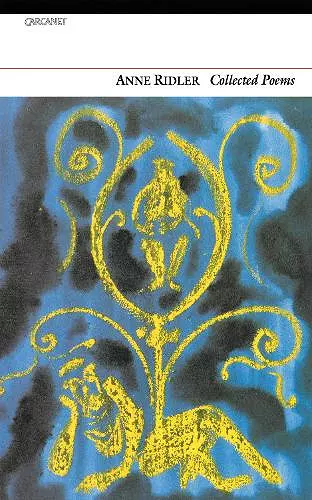
She published ten collections of poetry, original and translated opera libretti, including Monteverdi's Orfeo. She was also the author of verse plays which have been performed in Oxford and London. The handsome John Piper cover image was originally drawn for The Jesse Tree.
A review of Ridler's collection The Nine Bright Shiners in 1944 commended the fact that 'even when her theme is in a sense private and domestic... she brings to it... to a sense, immediate and penetrating, of the glory of being,' a sense that 'our footsteps echo in another world.' Equally unsurprising, perhaps, is the fact that once such mortal dangers were over the appetite for religiously-minded poetry began to fade. Certainly after Eliot's death in 1965, her poetry fell from favour - although she continued to work successfully as a librettist and translator of Monteverdi and Mozart operas until well into the 1980s - so that a reviewer could complain of her 1972 collection Some Time After about the 'notably unproductive genre in which she continues to work... a post-Eliotic, rhetorical, moralizing and metaphysical vein,' a list of adjectives that neatly captures the widening gap between Ridler's strengths and the poetical alignments of the period. It was not until the publication of her Collected Poems by Carcanet in 1994 that it became possible to look afresh at the work of this complex, witty, moving poet, 'as profoundly religious a person as I have ever met,' as Ronald Gordon said in his obituary in the Independent, vividly and genuinely aware - like her beloved Traherne - of 'Eternity in all appearances / The holiness of everything that is.' Although Ridler agreed with Kathleen Raine that poets should think of themselves as invisible, both her admirers and those new to her work will be delighted by Carcanet's decision to make the Collected Poems - out of print for a number of years - available again as a print-on-demand title.
'In Cornwall' is a fine example of the kind of dynamic equilibrium Ridler characteristically achieves between the revealed universe and an unrevealed God. Language shuttles between this world and another in this effortlessly visionary poem lit by dazzling luminescence only just beyond the intensity of the everyday. The sea 'seems the bright and easy floor of heaven': 'There saints like ships can navigate, and fair / The crops of golden plants like sparkle shine. / And O that we were there.'
It is as if - to misquote Pierre Reverdy - 'there is no such thing as God' in Ridler's poetry, 'only proofs of God.'
The sea serves Ridler well. In 'Kirkwall 1942', the first of a series of poems dedicated to a husband away on active service, it becomes an image of separation - an image, that is, in the sense that any part of natural reality loved by the poet is coloured by her fundamentally Christian outlook. The same is true of her debt to other poets: if there is a nod to Donne in the idea that although loneliness makes islands of us love connects us to the human continent, it is not a mere literary borrowing but part of a personal theology that finds sacramental expression in a symbolic grammar that shares the same deep structures as her seventeenth century predecessors but is merely differently construed. The sea is, as it were, the ground of many of Ridler's most productive metaphors, recalling evolutionary and Biblical accounts of the origins of life and coloured by both Classical and Romantic myth and periods spent living on its margins. In 'Views of the North Coast', for example, the centuries of attrition and deposition that account for patterns of human settlement dissolve into the darkness on the face of the waters - part primeval, part Biblical - that frequently lies just beneath her treatment of it. In a characteristically subtle elision, geography slides into theology as 'the unseen monstrous waters pour / In centuries against the crumbling shore.' In 'Romney's Marsh' life's 'strange beginnings' are not only suggested by land 'our fathers stole' from the sea but also survive as a race memory in the collective consciousness.
It is not only the sea that summons the epiphanic moment. In 'A Mile From Eden', strong directional winter sunlight turns a snowy wood into a visionary landscape where the poet and her husband walk 'tipsy with too much light.' But again, Ridler ensures that the radiance comes from without - 'On snow even the shadows are white' - before she sees it reflected 'in his eyes / Eyes of the humble hoping for heaven.' It is walking 'in a waste of snows' that reveals 'that power before our eyes': 'Which is we learn its usage can / Break up the amber, reverse the sun, / The bird's eye glory to full sight / The bird's eye glory to full sight / Bring, and outcasts into delight'.
The unforced drifting of immanent meaning to the surface of Ridler's poetry is nowhere more apparent or more touching than in 'For a Child Expected' and 'For a Christening' in which the poet's child becomes not so much a metaphor as a sacrament expressing at a secular level the mystery of God's incarnation in Christ. The success of 'For a Child Expected' resides largely in the fact that the natural imagery for which Ridler reaches has a Biblical rightness about it perfectly in keeping with the tone of hushed reverence in which, naturally, she contemplated the miracle of birth so that 'Lovers whose lifted hands are candles in winter / Whose gentle ways like streams in the easy summer / Lying together / For secret setting of a child... / ...do better than they know.' A similar combination of self-involvement and self-removal ensures the success of 'For a Christening' which also presents the agency of human love as a conduit for the spread of the Holy Spirit. Having invoked as many blessings as she can on her child, Ridler asks 'may we learn to leave you alone,' a touching recognition of every individual's divine selfhood and one that fills out the Jacobean cadences of the closing couplet with real emotional conviction: 'Life is your lot: you live in God's hand / In His terrible mercy, world without end.'
Ridler was a lifelong member of the Oxford Bach Choir, an interest that sits well both with her work as a librettist and her abiding fascination with the overlap between art and the divine, what the eye sees and the mind discerns. The epigraph to 'Bach's B Minor Mass', for example, taken from Austin Farrer's The Glass of Vision, identifies the difference between seeing with and through the eye: 'faith discerns not the images but what the images signify: and yet we cannot discern it except through the images. We cannot by-pass the images to seize the imageless truth.' Here, it is music that gestures towards the ineffable as it cries 'to the unattainable height / Only through the lung's pressure and the bow's bite.' Elsewhere, the truth is even more 'imageless'. In 'Backgrounds to Italian Paintings: Fifteenth Century' Ridler considers a landscape that seems to be haunted by figures painted out of it, so that: 'The wonder awaits you, cornerwise, but never / Full in the face; only the background promises / Seen through the purple cones at the edge of the eye / And never to be understood'.
These absent figures, however, come to stand more tellingly for the presence of the divine than what she calls, in 'Deus Absconditus', 'the junk and treasure of an ancient creed' that we persist in carrying 'To a love who keeps his faith by seeming mute / And deaf, and dead indeed.'
Some of Ridler's most successful poems are those where, indeed, 'wonder awaits you, cornerwise.' In 'Picking Pears' the delicate autumnal vignette is compelling enough on its own terms to hold at bay gathering hints of another kind of fall: 'Nor heaven, nor earth, a state between, Whose walls of leaves / Weave in a chequer of dark and bright / The falling sky; whose roofs of green / Are held by ropes and chains and beams of light'.
The last line puts Vaughan's theology of blinding light to practical descriptive use so that when, at the end of the poem, the pears are harvested and 'summer's nimbus shrivels on the rind.' It is an aureole of natural light, not a halo, that we imagine around the fruit and with which the poem can continue to glo if we choose to let it.
Ridler is acutely aware, nevertheless, that the balance between the visible world and the divinity with which it appears to bristle can only be achieved by the shaping power of art which consequently, when it fails, threatens the ability to perceive God in Nature. Matters are further complicated by the fact that it was the desire for knowledge that led to the exile from nature it is part of the function of poetry to redress. 'The Images That Hurt' presents the poet as Adam, urged towards an understanding that brings only pain: 'Far too much joy for comfort: / The images hurt because they won't connect. No poem, no possession, therefore pain'.
What lie scattered about in the poet's garden are 'all the materials of a poem' but unless or until she can connect them all they do is reproach her both with her failure and with her inability to live simply amongst them. And when poetry fails so, too, does the struggle to imagine the divine that it attempts to articulate: 'As those who gaze from the cliff at the depth of the sea / And know they cannot possess it, being of the shore.'
Most of the time, of course, not only do the images connect, they do so with an almost Metaphysical combination of delicate feeling and robust dialectic.
'Nothing is Lost', for example, uses 'proofs' from heredity, memory, even cellular regeneration to suggest the immortality of the soul, the final verse moving easily from the opening quasi-empirical 'thus' to a teeming sea of souls on which we float and which will not let us drown: 'Thus what we see, or know, / Is only a tiny portion, at the best, / Of the life in which we share; an iceberg's crest / Our sunlit present, our partial sense, / With deep supporting multitudes below'.
The sense of being 'sustained by powers not my own' becomes a physical feeling in 'Bathing Off Roseland' where the sea, 'a firmament that curves below,' is a reflected heaven on whose floor the poet feels 'lulled and directionless' like a bird - Ridler resists saying 'angel' - 'with all four wings outspread.' Although she drifts on a 'tide of prayer', however, the closing image reminds us that the other-worldly can only be comprehended through this one: 'Another's love can sway me toward / Some good that of myself I would not: / Powerful,hidden to me, / As the purpose which drives these great ships forward / Parting the sea'.
But belief is most convincing where it struggles most honestly with doubt - as Ridler said 'you've got to face the fact of death, that it is an ending; one hopes that it is also a beginning, but you mustn't cheat yourself by believing too easily in that' - and a late poem, 'Free Fall', dramatises this struggle through a description, finely balances 'between dismay and laughter', of a French tailor who, in 1900, was filmed attempting to fly from the top of the Eiffel Tower in a bat-winged costume he had made himself. 'The wins will surely beat / And bear me up,' he thinks, and yet is understandably reluctant to jump. When he does, 'the lens below / Can barely follow the plummeting shape/ So quick his fall.' A 'ridiculous death' perhaps and yet the absurdity of expecting a miracle goes to the heart of all belief which, in the end, requires of 'each in that crowd, and you, reader, and I' a last, lonely leap of faith.
ISBN: 9781857543179
Dimensions: 217mm x 130mm x 17mm
Weight: 337g
240 pages
New edition