Colour for Solitude
Format:Paperback
Publisher:Carcanet Press Ltd
Published:26th Apr '02
Currently unavailable, our supplier has not provided us a restock date
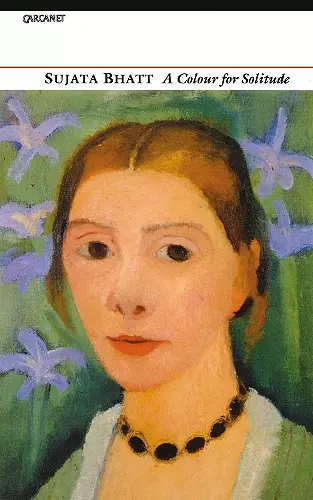
This sequence of poems takes the reader into the early 20th century, to Northern Germany where a group of artists founded a colony in Worpswede, a rural community near Bremen. Fascinated by the number of self-portraits, Sujata Bhatt imagines the painters' inner and outer worlds.
'Bhatt's style is refreshingly plain and direct, depending for its lyricism on moments of gentle repetition.'
Alan Marshall, The Daily Telegraph
Poetry London, Autumn 2002
Poetry that's vibrant, quiet, cool
Poems about paintings, poems about, for and after Rilke; one of those nebulous poetry-ish titles-Sujata Bhatt's A Colour for Solitude gets off to an inauspicious start - but don't let that put you off.
Her fifth collection (not counting 1997's Point No Point selection) is a sequence of poems extrapolating three lives from the paintings of Paula Modersohn-Becker, "the first true modernist in German art."The tensely triangular relationship between Modersohn-Becker, her friend Clara Westhoff and Clara's husband, Rainer Maria Rilke-all members of an artists' colony in Worpswede, Northern Germany, in the first few years of the twentieth century-is explored through all three voices, but principally through Paula's.
Having first discovered the existence of Paula through Rilke's poem "Requiem for a Friend" and that of Clara through his letters and journals, Bhatt can't, or won't escape the influence of Rilke himself.In 'You are the Rose' - a poem in Clara's voice to Rainer - and in the subsequent spray of red rose poems, Bhatt recalls Rilke's own French poems, Les Roses, joining Paula and Clara (and Jo Shapcott, of course) in a nectar-sipping holding pattern around him:
And then I knew
It is you -
You are the rose
And all your life
you will seek
the perfect gardener.
This inversion of the quest for the perfect rose-and, in the title poem, Bhatt imagines Paula sighing to Rainer, "I could never be / the rose in your poems"-casts the women as tender carers, the imperfect gardeners of Rilke's art.Yet the poems in A Colour for Solitude:the insoluble conflict between the absolute necessity for interaction and companionship (as illustrated by the artists' colony at Worpswede) and the "solitude" essential to the creative artistic process.
And when we kissed
this morning
watched by all the eyes
in my paintings-
did you think we were still
two artists, two misunderstood
solitudes trying to protect each other?
[...]
Give me
a better colour
for solitude.
['A Colour for Solitude']
While some of these poems may seem rather insubstantial when read as discrete pieces, their cumulative muscle is exhilarating.The companionable-the impulse toward the erotic-is constantly edged towards a fevered state by repetitions of images.For example, citrus fruits become a totem of sexuality:
Look at the lemon in my left hand
right between my breasts
Look at the orange in my right hand
held further down
a bit below my waist
('Self Portrait as a Standing Nude with Hat')
and
the innocence of lemons
the innocence of little girls
who wait for butterflies-[...]
they play naked in the garden-[...]
One standing, the other kneeling
they examine a lemon-probe
an orange-undecided
about what to do-
('Two Girls:Nude, One Standing, the Other Kneeling in Front of Red Poppies')
And there's plenty more fruity stuff here.
In the end, though, this book is the portrait of an artist, guessed at from the artist's self-portraits.The layering effect of the poems, as indeed must be the case with the paintings themselves, is three-dimensional - at least in the way a palimpsest is three- dimensional.'Self Portrait with Scratches' (a poem whose title's implication of self-harm surely suggests deep emotional and psychological turbulence) epitomizes the achievement of A Colour for Solitude:
The scratches are intentional,
deliberate.This is your new method:
layer upon layer of paint-
a muddy river-
and then you enter
with a sharp knife
to carve out the light.
To find light beneath salt, brine-
to find your first pale colours
swallowed by muddy paint.
Here is your clawed out light-pulled out
from somewhere deep inside the canvas.
The character of Paula Modersohn-Becker is, ultimately, brilliantly drawn, layer by layer.The more Bhatt slashes away at the paintings, the more fully her subject is revealed-the more Paula's light is carved out, clawed out, pulled out.Bhatt insists in her introduction that A colour for Solitude is a collection written to fill the silences of Paula and Clara in the writings of Rainer Maria Rilke, and it does.It's vibrant, colourful and tense - an exquisite portrait.Read it in one sitting.
Ruth Padel, Poetry Watch, Saturday 29th June 2002
Inner eye of the painter
Sujata Bhatt was born in Ahmedabad, India, in 1956, studied in the famous Writer's Workshop at Iowa in the United States, currently lives in Germany, and was awarded the Italian Tratti Prize for Poetry in 2000.
Her new book-length sequence A Colour for Solitude focuses on the painter, Paula Modersohn-Becker, born in 1876.Paula, a friend of Rilke and the sculptor Clara Westhoff, died at 31 after giving birth to a daughter but left behind a panoply of watchfully calm self-portraits, painted at an artists' colony in Worpswede, a rural community near Bremen in north Germany where Bhatt herself lives.
In a series of poems with a litany of titles like 'Self-Portrait as My Sister', 'Self-Portrait with Coppery Hair', 'Self-Portrait with a Lemon', 'Self-Portrait with Two Flowers in the Left Hand', Bhatt's poems reconstruct Paula's inner and outer worlds, and alchemise her into the archetypal woman creator.
Exploring whatever mystery it is that lets a woman bring to birth a whole new way of outward seeing by gazing inward at herself, the poems focus on flowers, surfaces, and light. They bring out the strangeness of painting: how the sensory experience of people a hundred yaers ago is here in front of you, in paint:
In the shade, when she stood
like that against the light:
in the shade, her face
looked darker,
darker than it really was
The noise of insects
prickled across the air...
the heat opening and opening
skin, cell by cel
ISBN: 9781857545890
Dimensions: unknown
Weight: unknown
112 pages
2nd edition, replaces previous.